World & Politics
France Counts the Cost After Weekend Protests Turn Into Widespread Riots and Looting
France spent Sunday cleaning glass off pavements and counting what Saturday’s protests cost in arrests, injuries, and burned buildings.
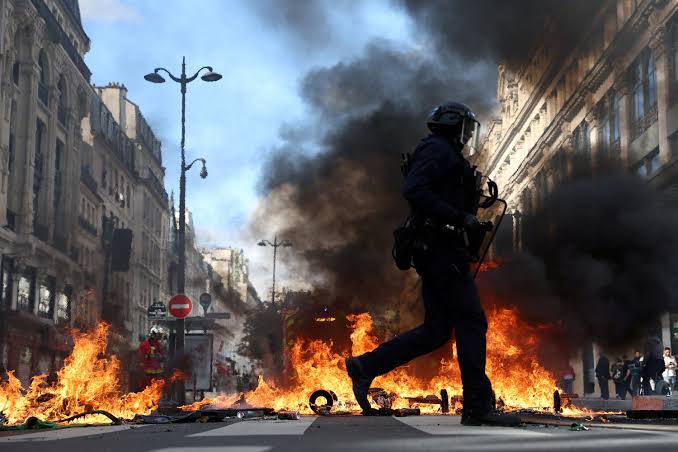
Nationwide demonstrations against high prices, fuel costs, and the state of public services, including schools, drew about 550,000 people, according to the interior ministry. Most of the marches were peaceful. On the margins, in Paris, Marseille, Lille, Lyon, Bordeaux, Strasbourg, Nice, and other cities, groups in masks and dark clothing set fires, smashed shopfronts, looted stores, and clashed with police. Interior Minister Laurent Nuñez said about 1,800 people were arrested and more than 500 police officers, gendarmes, and firefighters were injured. The Retail and Trade Federation put the number of damaged shops and retailers at about 1,500, with losses estimated in the hundreds of millions of euros. One person died during the main march in Paris; officials said the death was health-related and not linked to the violence.
The images from Sunday morning were consistent across cities: burnt-out cars and bicycles, shattered windows, graffiti, and municipal workers sweeping debris. Paris deputy mayor Lamia El Aaraje called the capital’s violence a level she did not believe had been seen before. A resident in central Paris told AFP it was “like we had a war.”
What Was Destroyed
In Limoges, the 143-year-old town hall was set alight and largely destroyed. Mayor Guillaume Guérin compared the loss to the 2019 Notre-Dame fire and said there had been a period with no police in sight. A regional administrator called the attackers a “wild horde.” In Marseille, demonstrators used a metal fence as a battering ram to enter city hall. In Lille, a McDonald’s was set on fire and an Apple store was broken into and looted. In Lyon, riot police used tear gas and water cannons to clear people who were blocking firefighters from a blaze at the tourist office. In Bordeaux, a masked group entered the prefect’s residence. Town halls and administrative buildings in Angers and elsewhere were ransacked, with statues and furniture broken.
Retail damage was widespread. Carrefour CEO Alexandre Bompard told BFMTV that 50 of the company’s shops were damaged, including 20 that were looted, with losses in the tens of millions of euros. Luxury boutiques and supermarkets were among the targets in multiple cities. The Retail and Trade Federation’s figure of roughly 1,500 damaged businesses and hundreds of millions in losses is the broadest early estimate. Insurers and city halls will revise it as claims are filed. Alexandre Bompard, also speaking for the retail federation, said professionals cannot be the ones who foot the bill after every demonstration.
The Official Response
President Emmanuel Macron wrote that those who smashed property, attacked prefectures and businesses, and looted town halls would be prosecuted and punished, and that the country would stand united against those whose aim was to bring down institutions. Nuñez said investigations were underway to identify perpetrators. In Paris, police reported a record 855 arrests, with hundreds still in custody on Sunday, about a third of them minors. Lyon reported 160 in custody. The clean-up ran from Lille in the north to Marseille in the south, and from Strasbourg to Bordeaux.
The protests were called over the cost of living and the condition of schools and other public services. That grievance is not new in France, and large peaceful marches have been a regular feature of Macron’s presidency. The scale of the peripheral violence — a destroyed historic town hall, 1,500 damaged shops, more than 500 injured security personnel — is what officials described as extraordinary. Macron is in the final months before elections to replace him. The weekend raises the temperature of that campaign without, on its own, deciding it.
What the Numbers Do and Do Not Capture
Five hundred and fifty thousand marchers and 1,800 arrests are both large figures. They describe different populations. The interior ministry’s attendance number is for the demonstrations. The arrest number is for the day, concentrated where the rioting and looting occurred. Treating the entire march as a riot misstates the ministry’s own split. Treating the violence as marginal misstates the damage: a city hall gone, a retail bill in the hundreds of millions, and a provisional injury count above 500.
The one death is the fact that requires the most care. Officials said it was health-related and not caused by the clashes. It is part of the day’s toll. It is not evidence that police or rioters killed a demonstrator, which has not been reported.
Insurance, emergency repairs, lost trading days, and the cost of extra policing are the economic line that will lengthen through the week. Carrefour’s tens of millions is one chain. The federation’s hundreds of millions is the early aggregate. Neither includes the Limoges town hall, which is a public rebuilding project measured in years.
What to Watch
Updated arrest and injury figures as custody processing finishes.
The insured-loss total once retailers and insurers compile claims.
Any charges specifically tied to the Limoges arson.
Whether further demonstrations are called this week, and under what policing plan.
Macron’s next statement, and how opposition parties use the weekend before the election calendar tightens.
France is counting the cost of a Saturday that began as cost-of-living protests and ended with riots and looting in multiple cities. About 550,000 marched. About 1,800 were arrested. More than 500 police and firefighters were hurt. Roughly 1,500 shops were damaged, with losses estimated in the hundreds of millions of euros. A 143-year-old town hall in Limoges was burned. The clean-up started Sunday. The prosecutions and the insurance bills will take longer.
Comments (0)
Please log in to comment
No comments yet. Be the first!