Health & Fitness
Microplastics in Water Generate Reactive Chemicals on Their Own, Nature Study Finds
Plastics were supposed to be chemically inert. A paper in Nature says that, once they are small and wet, they are not.
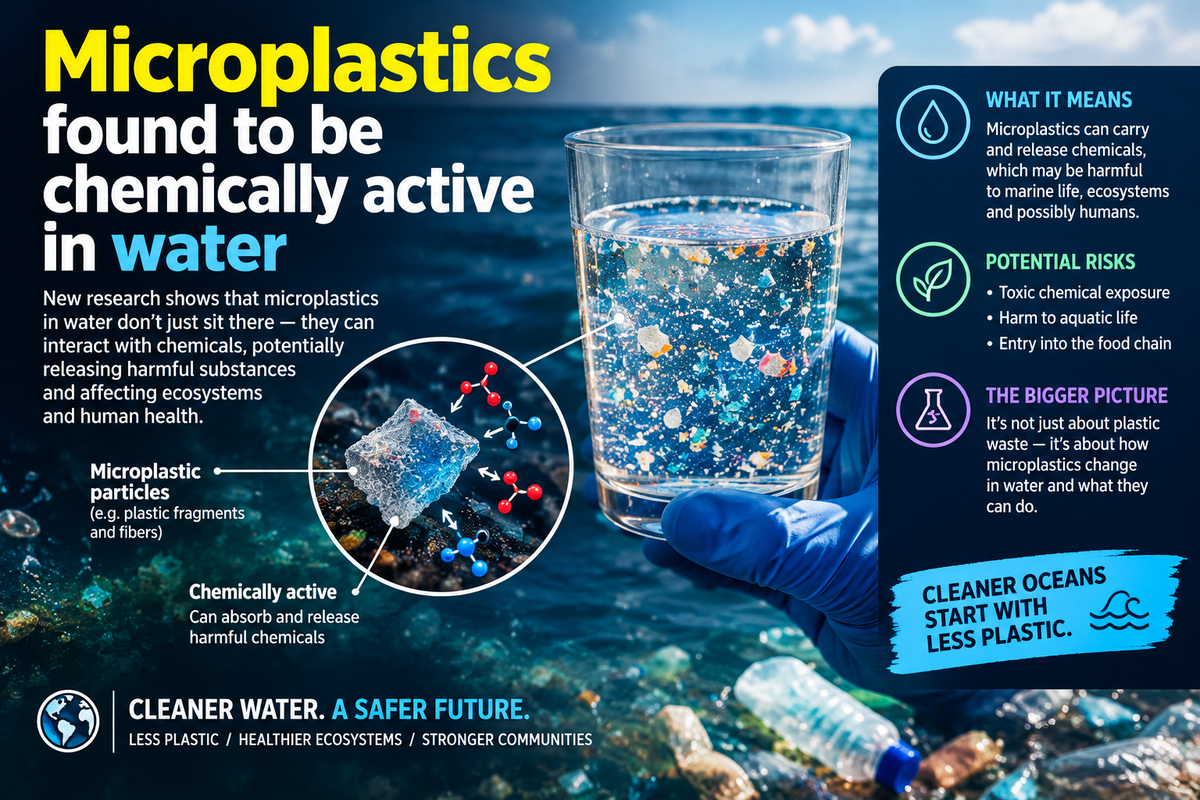
Wei Min’s group at Columbia, with theoretical work from Teresa Head-Gordon’s lab at Berkeley, reports that commodity microplastics suspended in water spontaneously generate reactive oxygen species, including hydroxyl radicals, at the plastic–water boundary. The activity needs no light, no added catalyst, and no external oxidant. It rises with how strongly the plastic repels water. Polyethylene and polypropylene, the most hydrophobic of the six plastics tested, were the most active. PET and acrylic, which carry groups that attract water, were the least. Polystyrene, PVC, and the others all produced radicals. The paper’s title frames it as intrinsic physicochemical activity at the microplastic–water interface.
The health implication is a hypothesis, not a result. Min said the radicals “very likely contribute to biological damage that we see in animals and potentially in humans,” and that the lab wants to measure how much of that damage this effect explains. The experiments show the chemistry. They do not show a disease rate.
What the Experiments Did
One demonstration used a dye. Polystyrene microparticles in water with methyl orange, stirred for ten days, faded the solution nearly to colorless and destroyed almost 90 percent of the dye. The same particles in ethanol, methanol, acetonitrile, or other solvents left the dye intact. Water was required. The group concluded the reaction happens at the boundary, where water meets a surface that does not want it.
Ab initio calculations support the picture. At a hydrophobic surface, hydroxide ions that are only partly solvated need less energy to lose an electron and become a radical. The plastic also accumulates a negative charge in water, which lowers that energy further. Head-Gordon’s simulations tied the strongest electron-transfer reactivity to the most water-repellent plastics. The more surface area a fragment has relative to its volume — which is what happens as plastic breaks into smaller pieces — the more of this boundary exists.
The team also looked at biomolecules. DNA oligomers and proteins with positive or negative charge accumulated on the particle surfaces. The paper suggests the interfacial reactions can contribute to protein aggregation and cellular injury. New Scientist noted a related observation that microplastics generated potentially harmful molecules when they contacted serum from blood in a lab setting. Blood is mostly water. A particle that is chemically active in water is a particle that does not become inert when it enters a bloodstream. That is the logical step. It is still a lab step.
What “Chemically Active” Changes
The standard account of microplastic harm has been physical and chemical in a different sense: particles that lodge in tissue, or additives and adsorbed pollutants that leach off. The Nature paper adds a third route. The plastic itself, by the way it organizes water at its surface, generates oxidants. Those oxidants — hydroxyl radicals are among the most aggressive — can damage proteins, lipids, and DNA. If the finding holds outside the beaker, the dose is not only how many particles a person ingests or inhales. It is how much reactive surface those particles present, and how hydrophobic that surface is.
Bottled water, ocean water, and blood are all aqueous. The paper’s authors flag all three. They do not claim the effect has been measured in a living person, or that it explains any specific diagnosis. Min’s own next question is the contribution to disease. Until that measurement exists, the result is a mechanism that was missing, not a risk number.
Why Smaller Is Worse on This Account
Fragmentation increases surface area. A gram of microplastic has more boundary with water than a gram of bottle. A gram of nanoplastic would have more still. The paper’s activity scales with that boundary and with hydrophobicity. Policies aimed at reducing plastic leakage still matter for the old reasons — wildlife, additives, persistence. They also matter, on this chemistry, because every fragment that stays in water is a small radical source for as long as the surface remains.
The finding does not say all plastics are equal. PET, common in bottles, was among the less active. Polyethylene and polypropylene, common in packaging and textiles, were among the more active. A regulatory response that treated “microplastic” as one substance would miss that gradient. A materials response, which Head-Gordon gestured at, would be to redesign commodity plastics so the interface is less reactive. That is an engineering suggestion, not a product.
What to Watch
Replication by another lab, especially the dye-degradation and the radical assay.
Any in-vivo measurement that ties this surface chemistry to tissue damage.
Whether the activity persists in real water — with salts, organic matter, and biofilms — or is quenched.
How the result is read by agencies already reviewing microplastic exposure.
Materials work that tries to blunt the hydrophobic interface.
Microplastics in water are not chemically inert, according to a Nature study from Columbia and Berkeley. They generate reactive oxygen species at the surface, more so when the plastic repels water, and they do it without light or a catalyst. The authors propose this as a route to biological harm. They have not yet shown how much harm, or in whom. The water is part of the reaction. That is the finding.
Comments (0)
Please log in to comment
No comments yet. Be the first!