Health & Fitness
Kenya Confirms Its First Imported Ebola Case After a Traveler Dies in Nairobi
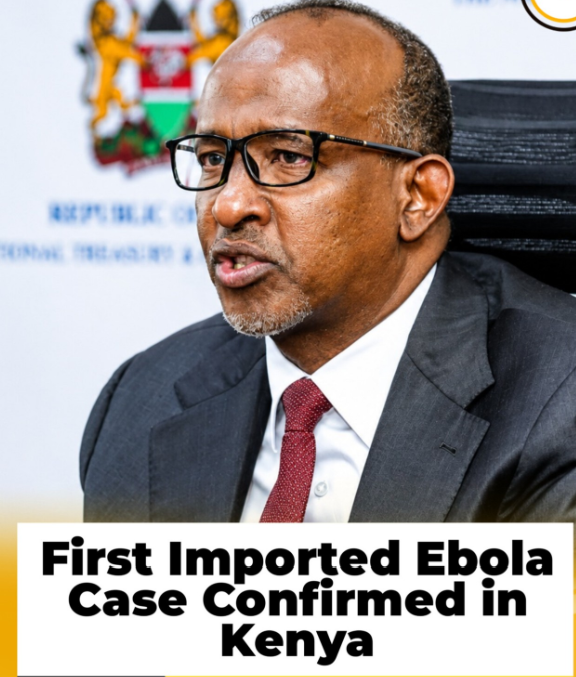
Kenya has confirmed an imported Ebola case. The patient has died.
Health Cabinet Secretary Aden Duale said on Tuesday, October 6, that the Ministry of Health had confirmed the country’s first imported case of Ebola Bundibugyo virus disease. The patient was a Kenyan citizen who had been living and working in the Democratic Republic of Congo for seven years. He fell ill about a month ago, was treated at several hospitals in Congo, traveled by road to Kampala, and boarded Jambojet flight 8523 to Nairobi. The flight carried 23 passengers and four crew. He arrived at Jomo Kenyatta International Airport on Saturday, October 3, at about 1:10 p.m., passed routine public-health screening and immigration, and was taken by a relative and a friend to Nairobi Hospital.
Doctors isolated him in a separate room in the accident and emergency area, then moved him to the East Wing isolation facility. He had fever, chills, intense fatigue, muscle pain, painful swallowing, a sore throat, and bleeding under the skin at injection sites. On that history and the travel, clinicians treated it as a viral hemorrhagic fever and sent samples. Both the National Virology Reference Laboratory and the Kenya Medical Research Institute confirmed Ebola Bundibugyo. He was put on supportive treatment and died on Monday, October 5, at 11:30 p.m. A safe and dignified burial under Ebola protocols was planned for later on Tuesday.
Reuters reported that 28 contacts had been identified so far, including family members and health workers. Duale put the country on alert. This is an imported case, not a finding of community spread in Kenya. The difference matters, and it holds only as long as the contact list holds.
The Virus and the Outbreak He Left
Bundibugyo is one of the Ebola species that infects people. It is rarer than the Zaire strain that has caused the largest recorded epidemics. It spreads by direct contact with the bodily fluids of a person who is sick or who has died of the disease. Fever, vomiting, diarrhea, and, in severe illness, bleeding are the picture clinicians watch for. There is no public indication in Tuesday’s briefing of a wider chain inside Nairobi beyond the contacts now being followed.
The outbreak he traveled out of is not small. Congo declared an Ebola outbreak in mid-May. Authorities have said it may have started months earlier. Reuters described it as the country’s largest, caused by Bundibugyo, with more than 8,000 cases and more than 4,000 deaths, and said it had resisted containment. The BBC described the Congo toll this year as more than 4,000 deaths and the second-deadliest known Ebola outbreak. Uganda reported 20 cases and two deaths earlier in the spread. The World Health Organization declared Uganda free of the disease in August. Kenya’s case is a person who left the Congolese epidemic, crossed Uganda by road, and flew the last leg.
That route is the surveillance problem. Airport screening caught a history. It did not stop a symptomatic traveler who had already been in hospitals in Congo from boarding a regional flight. Twenty-three passengers and four crew are now part of the follow-up, along with the relative and friend who drove him from the airport and the clinicians who saw him before isolation was complete.
What the Ministry Is Doing
Isolation at Nairobi Hospital, dual-lab confirmation, a contact list, and a protocol burial are the steps Duale put on the record. Counties have been told to watch for further cases. Naming the species matters for the response: Bundibugyo is not Zaire, and tools and past outbreak experience do not transfer one-for-one. The ministry has not, in the Tuesday statements, announced a change to inbound flight rules or a closure of the Uganda corridor. Those are decisions that usually follow the first 48 hours of contact tracing, not the press conference.
JKIA screening is the piece the public will argue about. The patient passed it. He was ill enough, within two days, to die in hospital. A screen that clears a returning worker from an active epidemic area is a screen that will be rewritten, or defended as the best a busy airport can do without a lab on the jetway. Duale’s account is that the screen happened and the isolation happened after a relative took him to hospital. Both sentences can stand.
What This Is Not
It is not, on the facts released Tuesday, an outbreak in Kenya. One confirmed imported infection, a death, and 28 contacts under follow-up is a containment job. It becomes an outbreak if any of those contacts develops the disease and passes it on. Most contacts in a well-run Ebola response do not. The ones who shared a ward, a car, or a flight toilet with a symptomatic patient are the ones the teams call first.
It is also not a reason to invent transmission routes. The virus does not spread through casual presence in a city. It spreads through direct contact with the fluids of someone who is sick or who has died. That is why the burial protocol exists, and why the hospital isolation room is the center of the story rather than the neighborhood.
What to Watch
Whether the contact list stays at 28 or grows as the flight manifest and the Congo hospital trail are worked.
Any second confirmed case in Kenya.
Lab turnaround at the national lab and KEMRI for the next suspect samples.
Whether Uganda’s August all-clear is revisited after a road transit by a symptomatic traveler.
Congo’s case and death counts, which are already in the thousands.
Kenya’s first imported Ebola case is a man who lived in Congo for seven years, flew into Nairobi on Saturday, and died on Monday night. The species is Bundibugyo. The next number that matters is not the headline. It is how many of the 28 contacts remain well.
Comments (0)
Please log in to comment
No comments yet. Be the first!