World & Politics
Fujairah Oil Refinery in UAE Engulfed in Flames After Iranian Attack
The warnings have been building for weeks. Oil prices above $125 a barrel. Iranian Supreme Leader Mojtaba Khamenei declaring that US ships belong in the "depths of the water." A US blockade of Iranian oil exports that Tehran has called an act of war. Five thousand American troops withdrawn from Germany as NATO fractures under the strain of a conflict its members never agreed to fight.
Today, those warnings became reality.
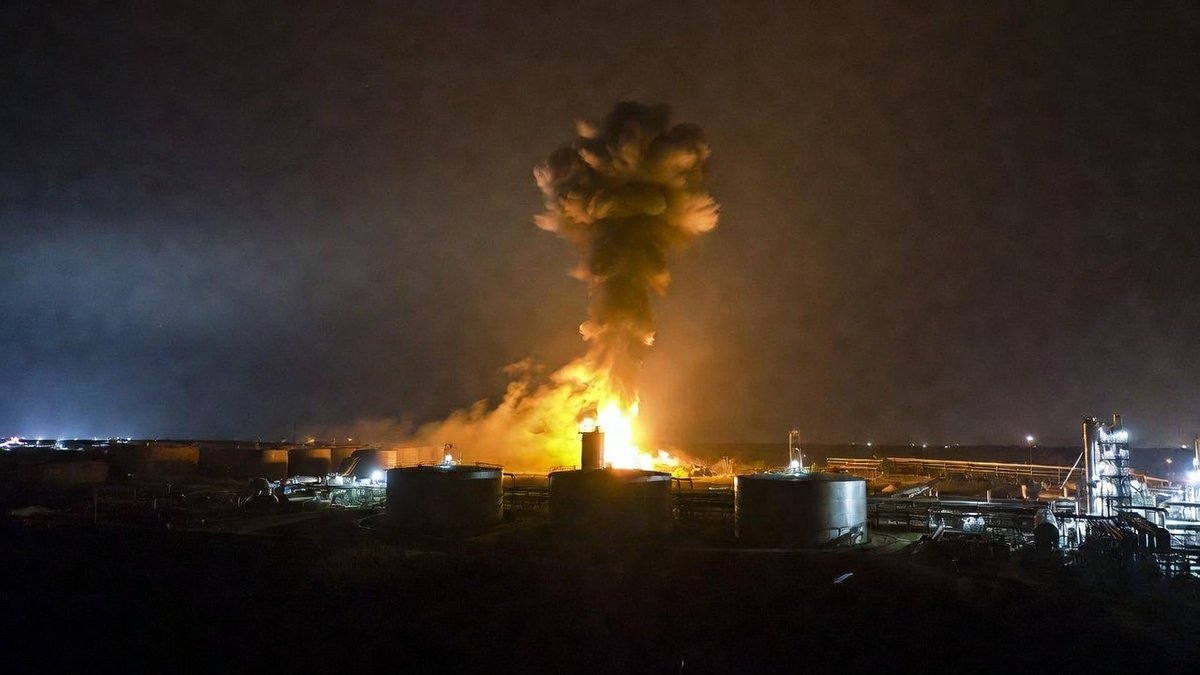
Iran has carried out a direct military strike against the Fujairah oil refinery in the United Arab Emirates — one of the most strategically significant energy facilities in the Gulf region — sending a massive fire engulfing the refinery complex and marking the most significant direct attack on UAE soil in the country's modern history.
The strike represents a dramatic and dangerous escalation in a crisis that has been building since the United States launched military operations against Iran. It is a signal from Tehran that its threats were not rhetoric. It is a message to the UAE — and to every nation that has cooperated with the US-led pressure campaign against Iran — that there are consequences to alignment with Washington. And it is a development that has sent shockwaves through global energy markets, international capitals, and the command centres of every military force operating in the region.
At digital8hub.com, we bring you the full picture of what has happened, what we know, and what comes next in a crisis that is now unambiguously at the edge of regional war.
What We Know: The Attack on Fujairah
The Fujairah refinery — located on the UAE's eastern coast, facing the Gulf of Oman just outside the Strait of Hormuz — was struck in what initial reports describe as a coordinated Iranian military action. The nature of the strike — whether conducted by ballistic missiles, cruise missiles, armed drones, or a combination — is still being confirmed by UAE and US military sources, but the scale of the resulting fire suggests a strike of significant precision and destructive intent.
Footage shared on social media and subsequently verified by international news agencies shows an enormous black plume of smoke rising from the refinery complex, visible for miles across the surrounding coastline. The fire, which emergency services were in the process of attempting to contain, has engulfed significant portions of the refinery infrastructure.
UAE authorities have confirmed the attack and declared a state of emergency in the Fujairah emirate. Evacuation orders have been issued for residential areas within a defined radius of the refinery site. Emergency services — including specialised industrial fire response units — have been deployed from across the UAE.
Casualties have been reported, though the full count is not yet confirmed. The UAE government has stated that emergency medical services are on the ground and that further details will be provided as the situation is assessed.
Iran has not formally claimed responsibility for the attack in official government statements as of the time of this report — but Iranian state media has referenced the strike in terms that amount to implicit acknowledgement, describing it as a response to the US blockade and the complicity of Gulf states in the pressure campaign against Tehran.
Why Fujairah? The Strategic Logic of the Target
The selection of the Fujairah refinery as Iran's target is not arbitrary. It reflects a strategic calculation that goes beyond simple retaliation and sends a carefully chosen message.
The Geography
Fujairah sits on the UAE's eastern coast — outside the Persian Gulf itself, on the Gulf of Oman side of the Strait of Hormuz. This geography has historically made Fujairah attractive as an energy hub precisely because it offers access to global shipping lanes without requiring tankers to transit the Strait of Hormuz. The UAE has invested heavily in Fujairah's oil infrastructure — including a major pipeline connecting Abu Dhabi's oil fields directly to Fujairah — as a strategic bypass of the Strait that provides resilience against exactly the kind of Hormuz closure threat that Iran has been making.
By striking Fujairah specifically, Iran is sending a message that there is no safe harbour from its reach — not even infrastructure deliberately built to operate outside the Hormuz chokepoint. The message is: wherever you build your energy infrastructure in this region, we can reach it.
The UAE's Positioning
The United Arab Emirates has, in the current crisis, maintained a complex position — officially neutral while practically cooperating with the US-led pressure campaign against Iran in ways that Tehran has noted and resented. The UAE hosts US military assets, participates in regional security frameworks aligned with Washington, and has reduced its economic engagement with Iran in response to US sanctions pressure.
The strike on Fujairah is Iran's answer to that positioning — a demonstration that the UAE's cooperation with the American strategy carries a price that UAE leaders must now weigh against the benefits of that alignment.
The Energy Market Signal
Fujairah is not just a refinery — it is one of the world's most important oil storage and bunkering hubs, handling an enormous volume of fuel oil and refined products that supply global shipping. A sustained disruption to Fujairah's operations would affect not just UAE energy production but the global shipping fuel supply chain in ways that have broad economic consequences.
The Energy Market Response: Oil Heads for $140
Global energy markets have responded to the Fujairah attack with the immediate and dramatic repricing that a direct strike on Gulf energy infrastructure demands.
Brent crude — already above $125 per barrel before today's attack — has surged sharply in early trading following confirmation of the strike, with traders pricing in the possibility of sustained disruption to UAE energy production and the heightened probability of further Iranian action against regional energy infrastructure.
The psychological threshold of $140 per barrel — a level not seen since the exceptional circumstances of 2008's peak — is now being discussed by energy traders and analysts as a near-term possibility if the crisis continues to escalate. At $140+ oil, the macroeconomic consequences for the global economy become severe across virtually every sector — from aviation and shipping through manufacturing and agriculture to the consumer inflation that feeds directly into household budgets worldwide.
Central banks that had been cautiously optimistic about the trajectory of inflation will be recalibrating. Finance ministries across the world are activating strategic petroleum reserve protocols. The International Energy Agency has indicated it is monitoring the situation and stands ready to coordinate a collective release of strategic reserves if supply disruption warrants it.
The US Response: Washington Faces Its Moment of Decision
The attack on the Fujairah refinery places the United States in an extraordinarily difficult position — one that will test the coherence and resolve of the Trump administration's Iran strategy in ways that no previous moment in the current crisis has.
The US has a defence commitment to the UAE through the Abraham Accords framework and bilateral defence agreements. American military assets are stationed on UAE soil. And the strike on Fujairah is, in part, a consequence of the US blockade policy that Iran is responding to.
Washington faces a choice between escalation — responding militarily to the Fujairah attack in a way that risks triggering a broader regional conflict — and de-escalation — using the attack as an opportunity to seek a diplomatic off-ramp that neither side has found a way to reach through rhetoric alone.
The signals from Washington in the immediate aftermath of the strike have been characteristically firm in their condemnation and deliberately vague about what specific response is contemplated. President Trump has posted on social media describing the attack as "a massive mistake by Iran" and warning of "consequences the likes of which have never been seen before" — language that is consistent with his rhetorical pattern but that leaves military planners and diplomatic partners equally uncertain about what specific action it presages.
The US Fifth Fleet, headquartered in Bahrain, has moved to an elevated readiness posture. American carrier strike group assets in the region are repositioning. The military architecture for a significant US response is being assembled — whether it will be used is a decision that sits with the President.
The Gulf States: Unity and Fear
The response of the broader Gulf Cooperation Council to the Fujairah attack will be a critical determinant of how the crisis evolves. Saudi Arabia, Kuwait, Qatar, Bahrain, and Oman all have skin in the game — as energy exporters who depend on stable Gulf security, as countries that host US military assets, and as states that must live with Iran as a permanent geographic neighbour regardless of how the current crisis resolves.
Saudi Arabia has issued a strong condemnation of the Fujairah attack, describing it as a "cowardly act of terrorism" and pledging solidarity with the UAE. Kuwait and Qatar have issued similar statements. The unanimity of Gulf state condemnation reflects the genuine alarm with which the attack has been received — a direct strike on a fellow GCC member's energy infrastructure is an attack on the security framework that all of them depend on.
But condemnation is not the same as military commitment. The Gulf states will be watching Washington's response closely before determining how far their own solidarity with the UAE extends to concrete action.
What Comes Next: The Scenarios That Matter
The Fujairah attack has opened a range of possible trajectories for the Gulf crisis, none of them comfortable.
Escalation
A US military response to the Fujairah attack — striking Iranian military facilities or IRGC assets — would mark the most significant direct US-Iran military engagement since the killing of Qasem Soleimani in 2020. Iran would almost certainly respond to any such strike, and the risk of a conflict spiral that draws in multiple regional parties becomes acute.
Controlled Retaliation
The US and UAE may elect to respond through targeted, calibrated military action designed to impose costs on Iran without triggering a broader conflict — a difficult balance to maintain in a situation where miscalculation risks are extremely high.
Diplomatic Opening
Paradoxically, the Fujairah attack may create a diplomatic opening that the preceding weeks of rhetorical escalation could not. Both sides now have a concrete event around which to organise negotiations — Iran has demonstrated its military reach, the US and UAE have absorbed a significant blow, and the conditions for a face-saving diplomatic solution may be more present than they appear.
Strait of Hormuz Closure
The worst-case scenario — Iranian action to close or significantly disrupt the Strait of Hormuz — would trigger an oil price shock of historic proportions and almost certainly a military response of a scale that neither side can fully control. This scenario remains possible if the crisis continues to escalate without a diplomatic off-ramp being found.
The world is watching the Gulf tonight with a combination of fear and the grim recognition that the decisions made in the next 72 hours will determine whether this moment becomes a turning point toward resolution or the opening act of a regional catastrophe.
We will continue to update this story as it develops. For the latest breaking news and in-depth coverage of the Gulf crisis, follow digital8hub.com — your trusted source for the stories that shape our world.
Comments (0)
Please log in to comment
No comments yet. Be the first!