Finance & Business
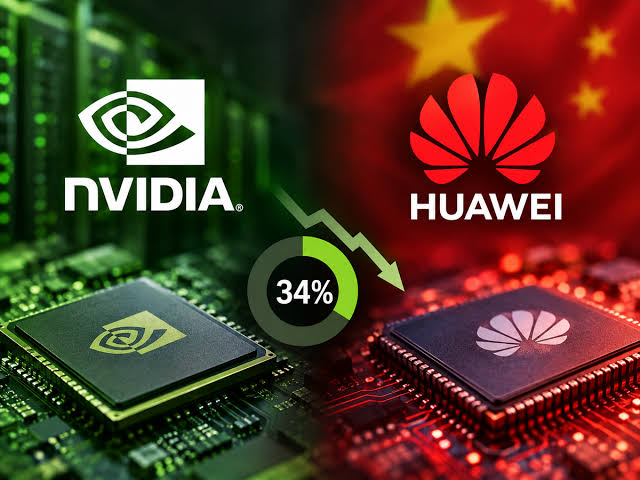
Nvidia’s China AI Chip Share Falls to 34% as Huawei Rises to 28%, IDC Data Show
Nvidia is still the largest seller of AI accelerators in China. It is no longer in a market it can treat as its own.
An IDC report seen by Reuters puts Nvidia’s share of China’s data-center AI-chip market at 34 percent in the first half of 2026. The company shipped 678,000 accelerators from January through June, down 44 percent from a year earlier. Huawei shipped 572,000, up from more than 300,000, for a 28 percent share. The gap between them is six points. Total AI-accelerator shipments in the half were 2.008 million units.
The cause IDC and Reuters name is the one Washington wrote: export controls that limit which Nvidia products can be sold in China, plus Beijing’s push to substitute domestic chips. Nine of the 11 Chinese chipmakers IDC tracks increased shipments. This is not a one-company story with Huawei as the only beneficiary. It is a restricted foreign supplier and a domestic field that is filling the units.
The Rest of the Table
Behind the two leaders, Alibaba’s chip unit T-Head held 7 percent, Cambricon 5 percent, Baidu’s Kunlunxin 4 percent, and Hygon 3 percent. That leaves a long tail. The domestic gain is broad. A buyer in China that cannot get a current Nvidia training GPU has more local options than it did two years ago, and those options are shipping in volume, not in press-release samples.
The mix shifted with the share. GPU shipments — the chips most used to train models — fell 26 percent to 991,000 units, because the supplies eligible for sale on the mainland stayed limited. Other AI accelerators rose nearly 80 percent to 1.016 million and overtook GPUs by volume for the first time. Huawei’s Ascend line and the other Chinese parts sit heavily in that non-GPU bucket. Nvidia’s legal catalog in China does not. A unit share that counts every accelerator will show Huawei closing in faster than a share that counted only the highest-end training GPUs.
What the Number Does and Does Not Measure
These are shipments, not revenue. A Nvidia accelerator that clears the export rule still sells at a higher average price than most domestic parts. A 34 percent unit share can be a larger revenue share. IDC’s table does not give the dollar split, and Reuters did not publish one. Treating 34 and 28 as a profit comparison is a step the data do not support. Treating them as a volume comparison is what the report is.
Nvidia’s own guidance has, in recent quarters, assumed little or no China data-center revenue from the restricted products. A 44 percent drop in units is painful and, on that guidance, partly expected. The strategic damage is the other line: Huawei at 28 percent, with a domestic cohort behind it, in the world’s second-largest AI market. A customer that builds its stack on Ascend does not switch back the quarter Washington loosens a rule. Software, tooling, and purchased hardware have a life measured in years.
The report does not say whether the 34 percent includes any residual sales of higher-end parts that found a legal path, or only the compliant lineup. TokenPost noted that the mix was unspecified. Until IDC publishes the product break, the share is a company total, not a statement about any one chip.
Why the Policy Produced This Split
Washington restricted China’s access to Nvidia’s most powerful AI chips. Beijing told its cloud companies and its state buyers to prefer domestic silicon and funded the capacity to make that preference real. The IDC half is what those two policies look like in a shipment table. Nvidia can still sell. It cannot sell the part the export rule is written to stop, and the buyers who needed that part are taking what Huawei and the others can deliver.
For Nvidia the revenue risk is already in the model. The option risk is not. China was upside if the rules eased and a retained customer base if they did not. A market in which Huawei is six points behind, and in which non-GPU accelerators out-ship GPUs, is a market where the upside is a re-entry into accounts that have already migrated. That is a harder sale than holding share.
For Huawei the number is the opposite proof. More than 300,000 units a year ago, 572,000 now, 28 percent of a 2-million-unit half. The company is still on the U.S. entity list. It is shipping anyway, into a demand pool the export rules enlarged.
What to Watch
Whether IDC or Nvidia gives a revenue share next to the unit share.
Huawei’s second-half shipments, and whether 28 percent was a peak or a step.
Any change in the export rule that would put a newer Nvidia part back on the legal list.
T-Head, Cambricon, Kunlunxin, and Hygon, which together are already larger than the gap between Nvidia and Huawei.
Software lock-in: how many Chinese training jobs now default to a domestic stack.
Nvidia’s China AI-chip share is 34 percent. Huawei’s is 28 percent. The first half’s shipments were 678,000 and 572,000. The drop is the export rule. The rise is the substitution policy. The table is units. The strategic fact is that the second-largest AI market now has a domestic supplier within six points of the American one.
Comments (0)
Please log in to comment
No comments yet. Be the first!