Travel
39 People Dead After Two High-Speed Trains Collide in Spain
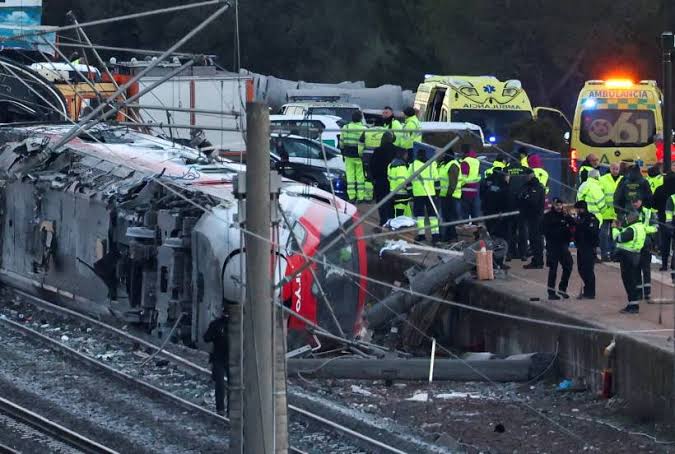
At least 39 people are dead after two high-speed trains collided in central Spain on Wednesday morning. The incident occurred near Urda in Toledo province on the high-speed line between Madrid and Andalusia. Initial reports cited lower casualty figures, but local authorities and media outlets later reported the higher toll as emergency services continued work at the scene. The exact number of injured remains under assessment, and officials have warned that the death toll could rise further.
The collision involved a Renfe AVE train and a train operated by the private company Iryo. Rail infrastructure manager Adif confirmed a rear-end collision and suspended traffic in both directions on the Madrid-Andalusia high-speed line. The crash happened around 8:54 a.m. local time between the towns of Mora, Orgaz, and Urda, at approximately kilometre point 118. Two carriages of the Iryo train derailed and plunged down an embankment, according to early accounts. The Renfe train was traveling from Madrid toward Seville.
Response and Casualties
Emergency services from the Castilla-La Mancha region, including the Civil Guard, firefighters, Civil Protection personnel, and medical teams, responded to the scene. The mayor of nearby Urda stated that emergency services asked local authorities to prepare a sports hall to accommodate the injured. Spanish Prime Minister Pedro Sánchez described the incident as serious and said he was shocked, noting that emergency teams were assisting those affected.
Passenger numbers on the two trains were reported in the hundreds. One account indicated roughly 147 people, including a baby, on the Iryo train and about 397 on the Renfe AVE, for a combined total near 544. Footage and images from the scene showed derailed carriages, debris, and significant damage along the tracks. Eyewitness accounts described a severe impact, with some passengers reporting they saw the other train derail.
Early reports from government sources and Spanish media initially listed at least 10 fatalities. Subsequent updates from regional emergency services and outlets such as Metro and La Voz de Galicia raised the figure to 39 and, in some cases, 46. The discrepancy reflects the ongoing nature of the rescue and recovery effort. Officials have stated that the full extent of casualties and the cause of the collision are still being determined.
Service Disruptions and Context
Adif halted high-speed services between Madrid and Andalusia following the collision. Displays at stations including Madrid’s Atocha showed multiple cancellations. The line is a major corridor connecting the capital with southern Spain. This is the second significant high-speed rail incident in Spain in 2026; an earlier crash in Adamuz in January killed 46 people.
Investigations into the cause are underway. Some Spanish media have cited possible human error, though no official determination has been released. The section of track where the collision occurred reportedly had a reduced speed limit of 80 km/h at the time. Both trains were operating on the Madrid-Seville route.
What to Watch
Updated official casualty figures as rescue and recovery operations conclude.
The outcome of the investigation into the cause of the collision.
When and under what conditions service on the Madrid-Andalusia high-speed line will resume.
Statements from Renfe, Iryo, Adif, and the Spanish government on safety measures.
Support arrangements for injured passengers and families of those killed.
Any additional details on the condition of the trains and track infrastructure.
At least 39 people have been reported dead after two high-speed trains collided near Urda in Toledo province, Spain, on October 28. The Renfe AVE and Iryo trains crashed on the Madrid-Andalusia line, derailing carriages and suspending rail traffic. Emergency services remain at the scene, and the death toll may rise. The incident is the second major high-speed rail accident in Spain this year.
Digital8Hub will update on casualty figures, the investigation, and service restoration.
Comments (0)
Please log in to comment
No comments yet. Be the first!