Finance & Business
U.S. and China Publish Lists for $60 Billion in Reciprocal Tariff Cuts
Washington and Beijing put paper under last week’s handshake.
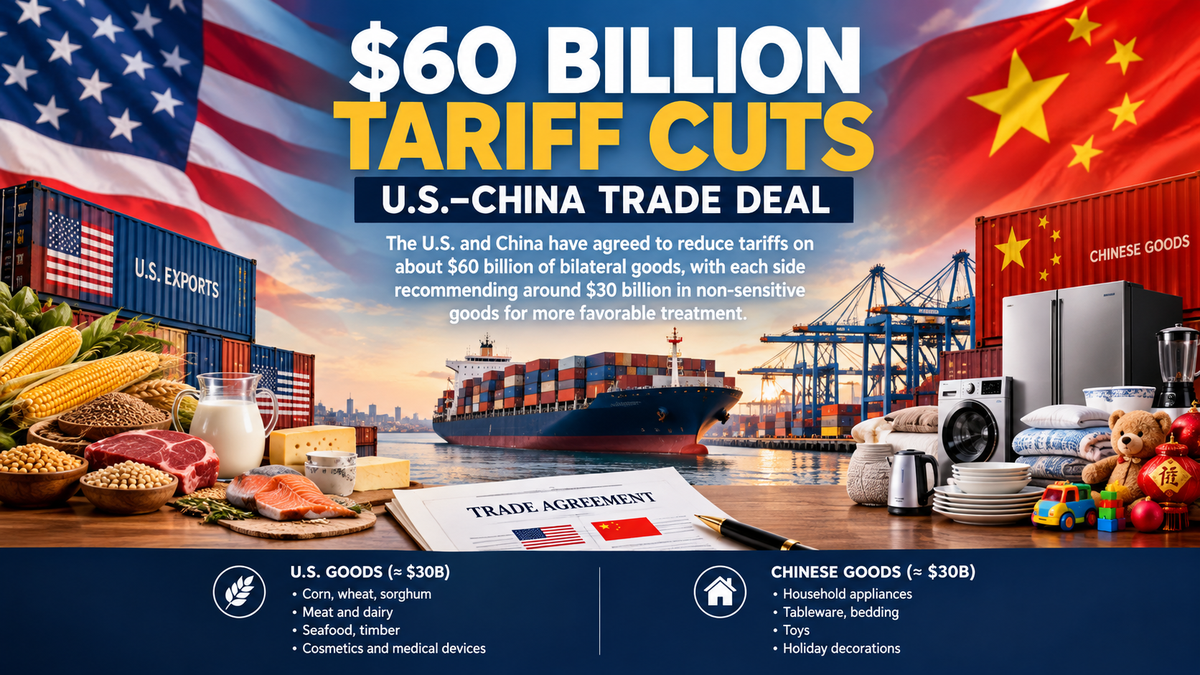
The United States and China have each recommended about $30 billion of two-way trade in non-sensitive goods for more favorable tariff treatment — $60 billion combined. The lists dropped over the weekend and Monday through the U.S.–China Board of Trade, the channel the two governments stood up after Donald Trump’s spring trip to Beijing and advanced during Xi Jinping’s state visit to Washington.
U.S. Trade Representative Jamieson Greer said the American side of the ledger would unlock improved access for roughly 30 percent of U.S. exports to China. China’s commerce ministry described a reciprocal “30-for-30” framework and said the sides would work toward consensus and implement cuts together after each country’s domestic legal steps. Beijing also said about 90 percent of the products on the arrangement would move toward most-favored-nation rates.
That is the announcement. It is not yet a customs bulletin. No line-by-line new duty was published. No effective date was published. Official language still says “recommended,” “could benefit,” and “aiming to reach a consensus.” The goods are named. The discount is not.
What Is on the Lists
The U.S. import list is short and domestic-facing: 77 entries. Small appliances such as coffee makers and toasters, tableware, blankets and bed linens, curtains, rugs, beads, child seats, electric shavers, fireworks, sporting goods, toys, Christmas decorations, microwave ovens, fish hooks, artificial flowers, weighing scales. The political logic is a shopping-cart cut — items American households actually buy — without touching chips, machine tools, or anything either capital calls sensitive.
China’s list of U.S. goods is long: 1,619 lines. Agriculture leads. Corn, wheat, sorghum, meat, dairy, vegetable oils and meals, poultry, eggs, peanuts, noodles, canned tomatoes. Fish and seafood. Logs and wood. Cosmetics. Medical devices, including ultrasound gear. Coal is folded into the same $30 billion frame, with talk of facilitating Chinese purchases of U.S. coal in 2027 and 2028. Oddities that travel well in a headline — foie gras, breeding horses, even camels — sit on the same spreadsheet as feed grains.
Soybeans are the loud absence. That crop has been the symbol of every prior farm fight. Leaving it off this list is how both sides keep a lever and avoid pretending the farm file is closed.
Greer’s 30 percent export-access claim is a share of the U.S. sales mix into China, not a 30 percent cut in the average tariff. China’s 90 percent-to-MFN line is a destination rate for most of the listed codes, not a promise that every code gets there on day one.
How Big $60 Billion Is
Two-way goods trade was on the order of $415 billion in 2025. Sixty billion is real money for the exporters on the list and a rounding error for the relationship. Strategic goods — semiconductors, dual-use electronics, critical minerals processing, large-scale industrial machinery — are not what this package is for. “Non-sensitive” is the filter that made an agreement possible in a week.
A year-long tariff ceasefire was also stretched. Treasury officials said the truce now runs to January 10. Companies get a calendar. They do not get a new architecture.
The Board of Trade is supposed to meet at least quarterly, with principals as needed. An agricultural working group is due to convene before year-end, with purchase targets discussed through 2028. An investment council sits beside it. China said it would look at U.S.-backed financial firms seeking to operate and open branches. Those sentences are process. Process is what a summit produces when the hard files stay hard.
What Last Week’s Summit Did Not Do
Xi’s visit produced an AI dialogue track and language on other geopolitical files. It did not unwind the layered tariffs that still sit on most of the bilateral catalog. It did not settle rare earths. It did not reopen the most restricted technology corridors. The 30-for-30 list is the part that can be printed without a fight in either legislature on day one.
Farm-state politics in the United States will read corn and meat and ask about soy. Coastal retailers will read linens and toasters and ask when the duty actually falls. Chinese appliance and toy exporters will ask the same question in the other direction. Until a rate and a date exist, importers cannot reprice a container.
The Fine Print That Matters
Cuts are to be simultaneous after each side finishes its own procedures. That is how one capital avoids going first. It is also how the package slips if either process stalls.
“Recommended” is not “bound.” A board can add lines later or sit on the ones already named. Coal in 2027–28 is a future cargo, not a 2026 invoice.
Financial-services access for U.S. firms is a separate negotiation dressed as a neighbor of the tariff list. Branch licenses are not coffee makers. They will move on a slower clock if they move at all.
How to Score It
Score it as a confidence package, not a reset. The two largest economies agreed to tax a defined sliver of harmless trade a little less, published the sliver, and extended a ceasefire into mid-winter. That is more than a communiqué and less than a deal that changes the price of a phone or a server.
If the duties actually drop, American grain and protein shippers and Chinese household-goods plants get a measurable lift. If the lists freeze in “recommended” status through January, the story was a summit handout.
Digital8Hub will treat a published rate schedule and an effective date as the moment this becomes trade policy rather than a product catalog.
Comments (0)
Please log in to comment
No comments yet. Be the first!