Finance & Business
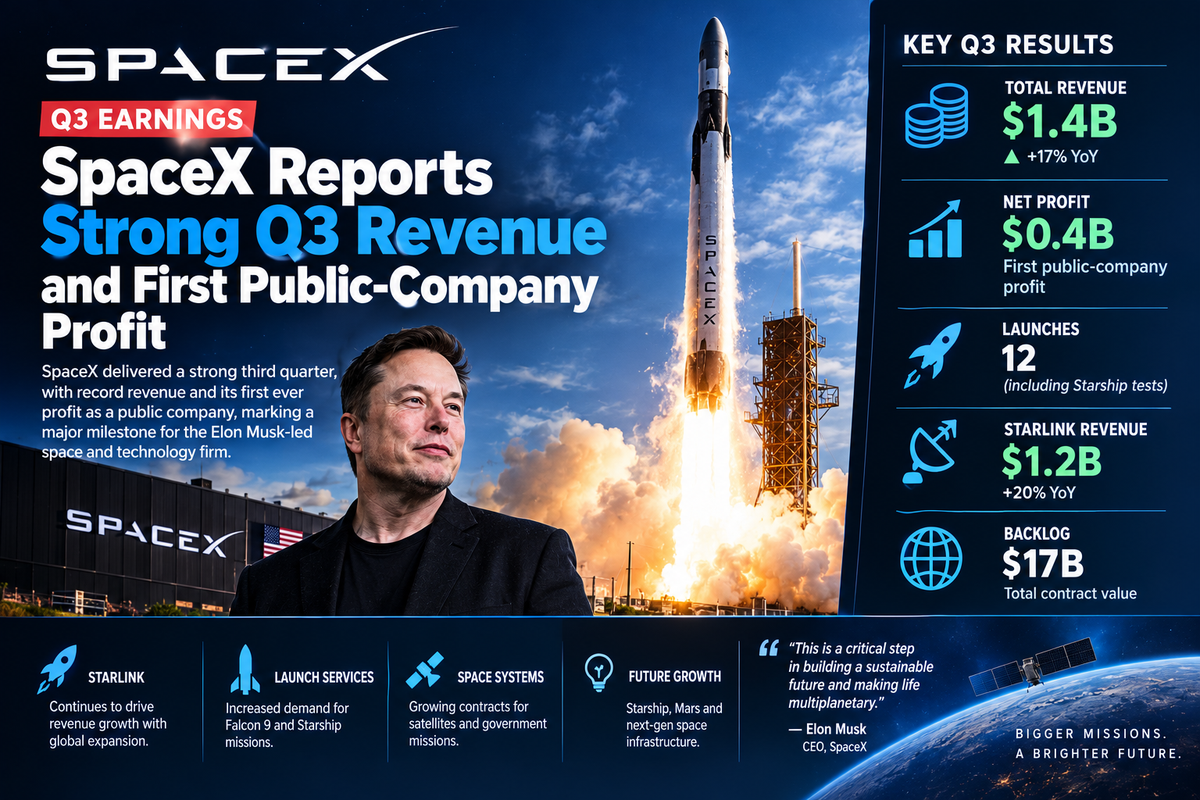
SpaceX Reports $14.6 Billion Q3 Revenue and First Public-Company Profit of $4.4 Billion
SpaceX posted its first quarterly profit as a public company and a sharp acceleration in revenue.
For the quarter ended September 30, 2026, the company reported revenue of $14.6 billion, up 161 percent from $5.6 billion a year earlier. Net income was $4.4 billion, an improvement of $5.5 billion from a net loss of $1.1 billion in the prior-year period. Income from operations was $2.8 billion. Adjusted EBITDA reached $8.8 billion, up 306 percent from $2.2 billion. The results, released after the market close on October 20, beat the revenue and profit expectations that had circulated ahead of the print. The stock had traded under pressure in the weeks before the report amid broader questions about AI infrastructure spending across the sector.
The growth was concentrated in two segments. Super Intelligence (SI) revenue was $7.6 billion, up 195 percent sequentially and 830 percent year-over-year, driven by new cloud services agreements, the Cursor acquisition, and adoption of Grok models and applications including Grok Bot. Connectivity revenue was $5.2 billion, up 22 percent sequentially and 69 percent year-over-year, supported by Starlink consumer and enterprise growth. Space segment revenue was $1.8 billion. Nameplate compute reached 1.7 GW at quarter-end, up from 1.4 GW at the end of June.
Segment Details
Connectivity ended the quarter with 13.6 million Starlink consumer subscribers, an increase of 1.6 million from the prior quarter, and consumer ARPU of $69. Enterprise and government revenue within the segment rose 91 percent year-over-year. More than 3,800 aircraft were equipped with Starlink. The segment produced $2.4 billion in operating income and $3.5 billion in Adjusted EBITDA.
The SI segment generated $431 million in operating income after including $1.2 billion in share-based compensation related to the Cursor acquisition. Segment Adjusted EBITDA was $5.0 billion. Capital expenditure across the company was heavy, particularly in SI, consistent with the build-out of compute capacity and the COLOSSUS II project. Total capex for the quarter exceeded $19 billion.
In the Space segment, SpaceX completed its first revenue-generating Starship mission, delivering 26 Starlink V3 satellites. The company said the mission added roughly ten times the downlink capacity of a typical Falcon 9 Starlink launch. It also signed additional NASA crew and national-security launch contracts and announced plans for a Starbase facility in Louisiana targeting first launch in 2029. Space segment operating results were near break-even for the quarter after prior losses.
What the Profit Means
This is the first quarter in which SpaceX has reported a GAAP net profit since its June IPO. Earlier public results showed revenue growth alongside net losses as the company invested in Starship, Starlink, and the SI infrastructure. The swing to $4.4 billion in net income reflects both the scale of Connectivity profits and the contribution from SI, even after acquisition-related charges. Management commentary emphasized operating leverage from the combination of launch cadence, recurring Starlink revenue, and SI expansion, while noting a focus on capital efficiency and an investment-grade balance sheet.
The results arrive against a market backdrop in which AI-related capital spending has faced scrutiny. SpaceX’s SI segment is one of the larger disclosed infrastructure and model efforts outside the traditional hyperscalers. Investors will parse how much of the $7.6 billion SI revenue is recurring cloud or software versus one-time or capacity-related, and whether the compute build continues at the recent capex rate. The company has previously described using Starlink cash generation to support other investments; the Q3 profit shows that the overall entity cleared the net-income line even with elevated spending.
Operational Milestones
Beyond the financials, the Starship revenue flight is the operational marker. Moving from test flights to a paid satellite deployment on the vehicle is the transition the program has targeted. The 26 V3 satellites represent a step-change in capacity per launch relative to Falcon 9. Additional customer launch wins and the Louisiana spaceport plan extend the multi-year launch roadmap. Starlink subscriber additions of 1.6 million in the quarter continue the growth that has underpinned Connectivity margins.
What to Watch
Full 10-Q detail on SI revenue composition and customer concentration.
Whether the stock reaction holds after the initial move.
Capex trajectory in the fourth quarter and any update on compute capacity targets.
Starship flight cadence following the first revenue mission.
Starlink Mobile spectrum acquisition progress and regulatory timing.
SpaceX reported $14.6 billion in third-quarter revenue, up 161 percent year-over-year, and a $4.4 billion net profit — its first as a public company. Adjusted EBITDA was $8.8 billion. Super Intelligence and Connectivity drove the growth. The company also flew its first revenue-generating Starship mission. The print shows scale and a profit inflection after earlier investment-heavy quarters.
Comments (0)
Please log in to comment
No comments yet. Be the first!