Finance & Business
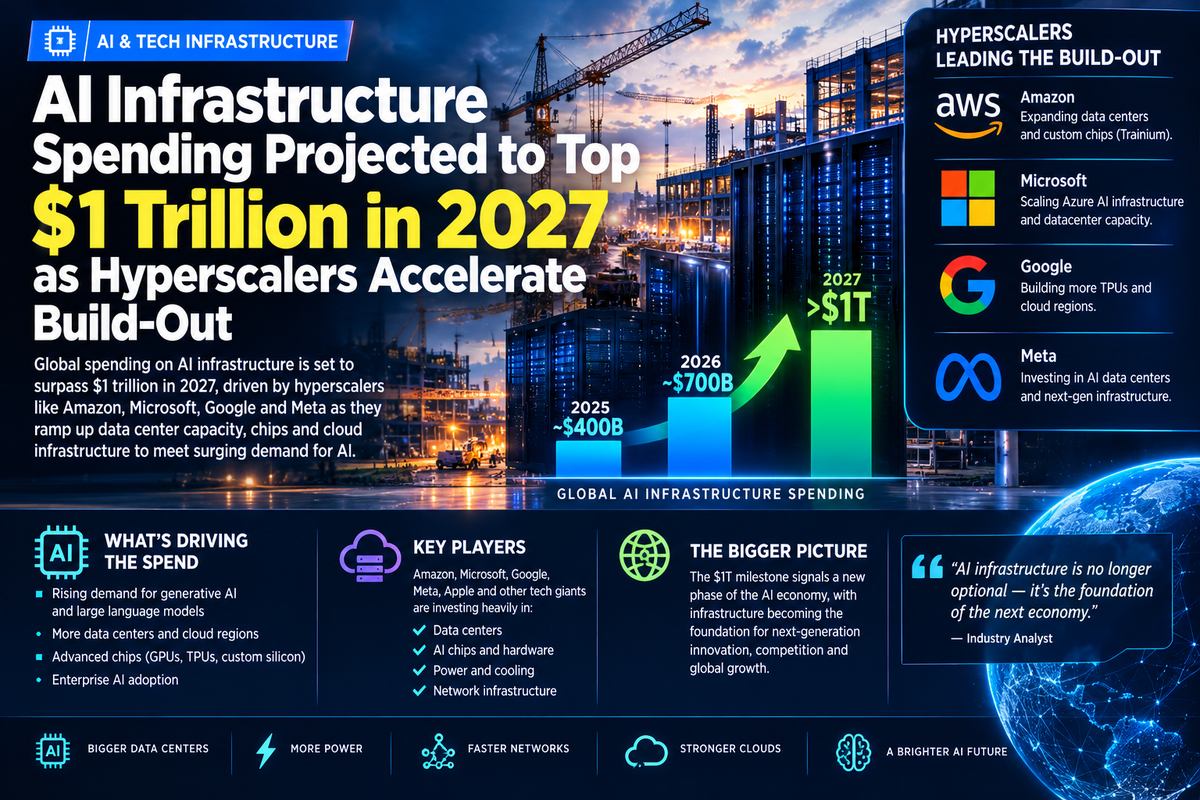
AI Infrastructure Spending Projected to Top $1 Trillion in 2027 as Hyperscalers Accelerate Build-Out
Wall Street and credit analysts now expect AI infrastructure spending by the largest technology companies to cross $1 trillion annually, with one prominent forecast putting the 2027 total above $1.3 trillion.
S&P Global Ratings said in an August analysis that combined capital expenditure by a group of major hyperscalers — Alphabet, Amazon, Microsoft, Meta, Oracle, and SpaceX — is projected to exceed $1.3 trillion in 2027, compared with about $870 billion in 2026. The firm expects negative free operating cash flow across much of the group as the build-out continues. Separate estimates from Wall Street analysts and research notes have described total AI capital expenditures climbing above $1 trillion in 2027, following successive upward revisions to company guidance. Goldman Sachs has published work showing global AI investment, broadly defined, on a path to exceed $1 trillion as early as 2026 when non-hyperscaler and non-U.S. spending is included.
The figures are aggregates of company plans and analyst models, not a single coordinated budget. They reflect the cumulative effect of multi-year commitments for GPUs and custom accelerators, data-center construction, power infrastructure, and networking. Compute remains the largest line. Data centers and the electricity to run them are the next. The projections have risen through 2026 as individual companies raised their own capex ranges and as new capacity agreements were announced.
Where the Money Is Going
The largest share is expected to go to accelerated computing — Nvidia GPUs, custom silicon from the hyperscalers themselves, and related systems. S&P and other notes highlight that the 2027 step-up includes both continued GPU purchases and the ramp of in-house chips. Data-center construction and fit-out form the second major bucket. Power generation and transmission, including deals for nuclear, gas, and renewable capacity dedicated to AI loads, are increasingly visible in the totals. Networking, cooling, and land round out the infrastructure stack.
Company-level guides already point in this direction. Meta has discussed 2026 capex in a range that analysts have extrapolated higher for 2027. Amazon, Microsoft, and Alphabet have each described multi-year AI infrastructure programs measured in the tens to hundreds of billions. Oracle and others have signed large cloud capacity agreements. SpaceX’s Super Intelligence segment has disclosed substantial compute build-out. Adding the disclosed and estimated figures for the core group produces the $1 trillion-plus totals. The precise mix between 2026 and 2027 depends on delivery schedules for chips and the pace of data-center energization, both of which have faced constraints.
Cash Flow and Return Questions
S&P’s note flags that free operating cash flow is expected to stay negative for most of the hyperscalers through the period. Revenue from AI products and cloud AI services is growing, but the capex is front-loaded relative to the monetization. Investors have spent much of 2026 debating whether the spending produces adequate returns. Recent market pressure on AI-linked stocks has coincided with questions about the sustainability of the capex trajectory. A $1.3 trillion 2027 figure implies that the debate continues rather than resolves in the near term.
Not every dollar is pure AI training or inference capacity. Some portion supports general cloud growth, enterprise agreements, and non-AI workloads that share the same facilities. Analysts attempting to isolate “AI-only” spend produce lower but still very large numbers. The $1 trillion threshold is crossed under either a narrow or a broad definition in the more aggressive forecasts.
Supply Constraints and Timing
Chip availability, power interconnection queues, and construction timelines are the practical limits on how fast the spending can be deployed. Several forecasts note that 2026 already reflects an acceleration, so the 2027 total assumes those constraints ease enough for the higher run-rate to be achieved. If power or GPU supply remains tight, some of the projected 2027 spend could slip into 2028. Conversely, if new capacity comes online faster than expected, the annual figure could be reached earlier. The direction of revisions through late 2026 and early 2027 will show which outcome is materializing.
Gartner and others have separately warned that infrastructure spending by AI providers could outpace near-term revenue by a wide margin over a multi-year window, creating a gap that pressures returns. Those analyses sit alongside the capex forecasts rather than contradicting them. High spending and uncertain near-term payback are the paired observations.
What to Watch
Company capex guidance in the current earnings cycle and any 2027 preliminary ranges.
Updates from S&P, Goldman, and other forecasters as 2026 actuals are reported.
Power purchase agreements and data-center completion rates.
Free-cash-flow trajectories for the major spenders.
Any slowdown signals from chip orders or canceled capacity.
AI infrastructure spending by major hyperscalers is projected to top $1 trillion in 2027, with S&P Global Ratings estimating more than $1.3 trillion for a core group of companies. The total covers compute, data centers, and power. Free cash flow is expected to remain under pressure. The forecasts have risen with company plans. Whether the spending produces the revenue to justify it is the question the market is still pricing.
Comments (0)
Please log in to comment
No comments yet. Be the first!