Finance & Business
Google Launches Gemini Agent, an Enterprise Assistant That Works Across Mail, Docs, and Business Systems
Google wants the work agent to have an email address.
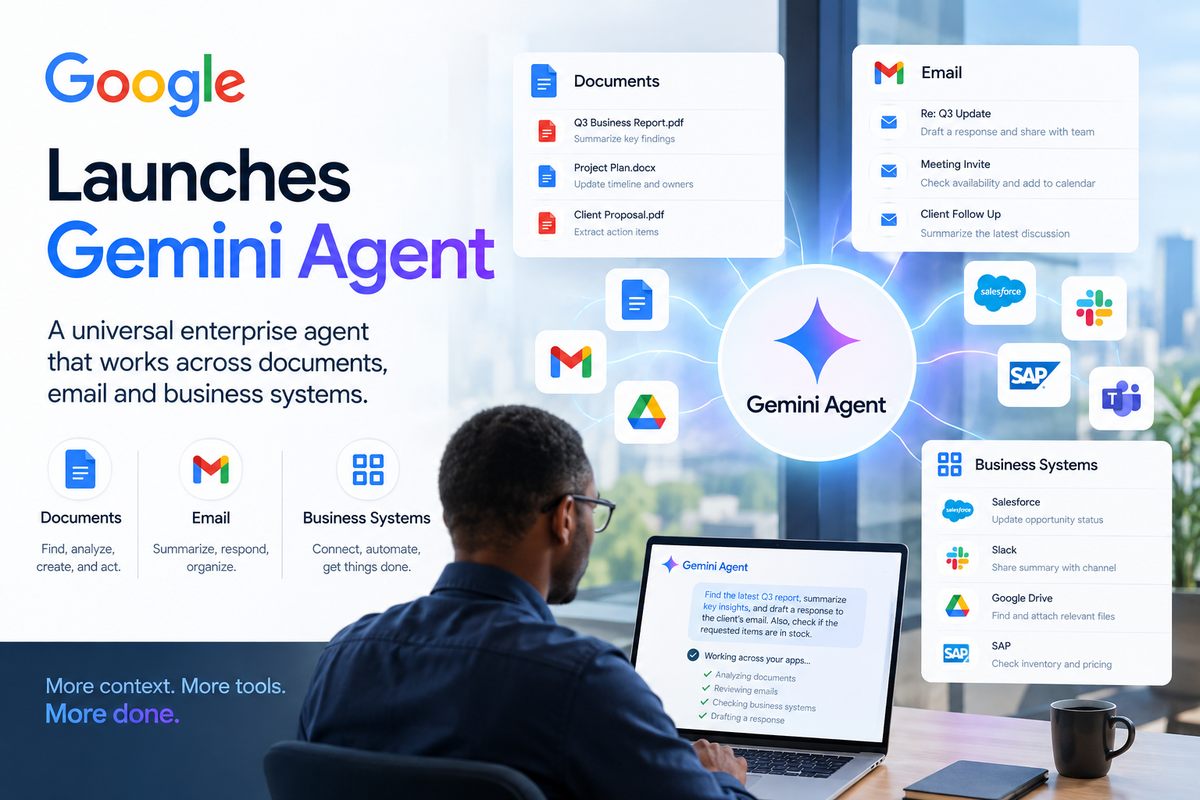
At its Gemini at Work event on Thursday, Google Cloud introduced Gemini Agent, which it called a single, universal agent for work. It lives in the Gemini Enterprise app and inside Workspace. A user assigns an objective. The agent is supposed to plan the steps, open the systems, and return the finished thing. Thomas Kurian, Cloud’s chief executive, put the pitch as “objectives, not instructions.” Sundar Pichai opened the event with the scale claim: Gemini has more than a billion monthly active users, and nearly 90 percent of the Fortune 100 now use Gemini Enterprise.
The product is in private preview for a selected set of enterprise customers. Wider availability is promised for Workspace customers on certain Business and Enterprise plans, with no date. Google told VentureBeat the agent will be built into Gemini Enterprise and included at no additional charge where that subscription already exists. It is not a consumer feature, and it is not generally available.
What It Is Supposed to Touch
Inside Google’s own stack the list is Gmail, Drive, Docs, Sheets, Slides, Chat, and Calendar. An @Gemini mention in those apps invokes it. One example Google gave: a manager emails asking for the latest project update as a slide deck, Workspace flags the request as something that can be delegated, and one click hands it to the agent. Another: ask for a meeting with the usual regional event leads next week, without names or addresses. The agent is supposed to read the chat space and the last event thread, check calendars, and start an email thread, including with people outside the company.
Outside Workspace, the connectors named on Thursday include Microsoft 365, Slack, Jira, Confluence, Git, Salesforce, ServiceNow, BigQuery, Databricks, Postgres, and Snowflake, plus files on a desktop. It can be reached from the web, iOS, Android, Windows, Mac, and a command line. An API lets it run inside another application as a headless agent, with no Gemini window of its own. Context is meant to follow the user because the work runs in Google’s cloud, not on one laptop.
Job-specific versions were part of the pitch. A financial-services agent draws on FactSet and LSEG and ships with more than 50 skills. A legal version ties into document systems including NetDocuments and iManage. Early testers named by Google included On, Shopify, and PayPal. Customers cited on the existing Enterprise platform included BNP Paribas, Bradesco, Merck, Orange Spain, Santee Cooper, SOMPO, Ulta Beauty, and Wesfarmers. Those names are for the platform, not proof that the new agent has finished a quarter of their work.
The Coworker Account
The detail that separates this from a chatbot in a sidebar is the identity. Google said the agent can hold its own Workspace account, its own email at an @agents.company.com address, its own calendar, and a place in the company directory. Sub-agents can be spun out with their own identities and their own storage. The parent agent is supposed to keep one memory across channels: session memory of a task that runs for hours or days, procedural memory of how a job is done, including skills it writes for itself, and episodic memory of what it has done before. It picks the model it thinks fits the job.
That is a different permission problem from a prompt box. An agent with a mailbox can receive work and send it. It can also send the wrong deck to the wrong list, or book a meeting the principal did not want. Google’s control story is the same one every enterprise agent launch uses: the company’s data boundary, admin policy, and an audit trail. Thursday’s event did not publish a customer incident or a completed security review. The preview is where that gets tested.
Who It Is Aimed At
Pichai’s billion users are the consumer Gemini app. The agent is the work product. Microsoft has been putting agents in 365 and Windows. OpenAI and Anthropic sell coding and office agents that already sit in Slack and GitHub. Google’s advantage, if the connectors work, is that the mail, the doc, and the directory are already in one login for a large share of the companies it is selling to. The disadvantage is the same login. A firm that lives in Microsoft 365 and Slack is being asked to let a Google agent into both, which is a procurement conversation, not a demo.
“No additional charge” matters only if the plan already includes Gemini Enterprise. A company on a lower Workspace tier does not get this by updating the app. Private preview also means the examples on stage — the slide deck, the meeting thread — are scripted paths, not a measured reduction in hours.
What to Watch
A date for the Business and Enterprise rollout beyond “soon.”
Whether the coworker mailbox can be turned off by an admin.
Which connectors are real at preview exit, versus named on a slide.
Any customer, beyond On, Shopify, and PayPal, willing to say what the agent finished.
How Microsoft and OpenAI answer a Google agent that claims the same inbox.
Gemini Agent is Google’s attempt to make one work assistant that reads the mail, builds the deck, and writes back from its own address. It launched into private preview on October 8. It is not in the consumer app. The test is whether a company will let it send the email.
Digital8Hub will update when Google sets a general date or publishes a customer result.
Comments (0)
Please log in to comment
No comments yet. Be the first!