Technology
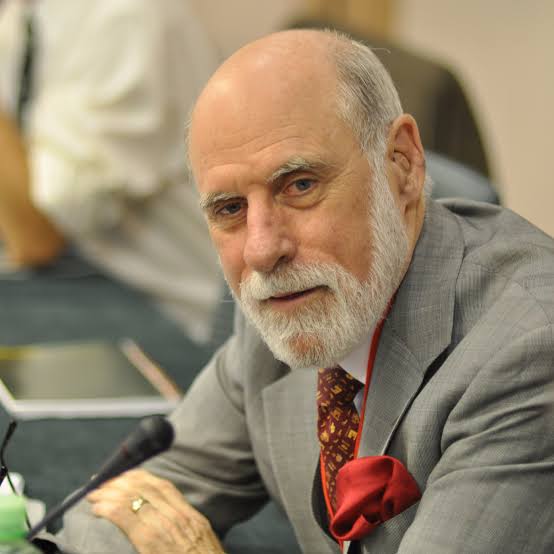
Vint Cerf, the Man Who Built the Internet, Is Finally Retiring at 83
Vint Cerf co-invented TCP/IP in the 1970s — the foundational rules that let the internet work — and has spent the last 20+ years as Google's Chief Internet Evangelist. Next week, at 83, he's stepping down.
Content:
Vinton "Vint" Cerf, the computer scientist widely credited as one of the architects of the modern internet, will retire from Google next week, ending one of the most consequential careers in the history of technology. The announcement came not through a press release but through an offhand remark at a conference: Dave Patterson, a UC Berkeley professor and computing pioneer in his own right, mentioned Cerf's retirement while recognizing him via video at the Open Frontier conference hosted by the Laude Institute. "Vint has been at Google more than 20 years, and he is retiring a week from today," Patterson told the room, prompting a round of applause. Google did not respond to a press request for comment by the time of publication.
Who Vint Cerf is — and why the title is complicated
Cerf, now 83, is frequently described as the "Father of the Internet," a label he has long pushed back on with characteristic generosity. "That's not quite right," he has said. "I was part of a team working with Bob Kahn on the ARPANET, the predecessor of the Internet." In Cerf's own telling, Kahn deserves equal credit — arguably more, since it was Kahn who started the "Interneting" program and went looking for someone to help build it. What became TCP/IP — the Transmission Control Protocol and Internet Protocol, the foundational rules that allow different computer networks to recognize and communicate with each other — emerged from papers Cerf and Kahn developed together beginning in 1973, presented to the International Network Working Group, and refined into a landmark specification published in 1974. Cerf has said, with some self-awareness, that the reason he ended up with the "Father" label rather than Kahn is less about relative contribution than about how culture assigns heroes: "I have stayed more focused within the Internet and Bob has gone on to do other things. This culture we live in needs heroes; as a result I think I ended up with more attention."
What he built, in rough chronological order
The scope of Cerf's career across five decades is genuinely difficult to compress. Starting from his PhD work at UCLA in Leonard Kleinrock's networking group — where he helped connect the first two nodes of the ARPANET — Cerf spent the 1970s at Stanford and then DARPA, co-designing TCP/IP and funding the research teams that would deploy it. In the 1980s, at MCI, he helped engineer MCI Mail, which in 1989 became the first commercial email service connected to the internet. In 1992, he and Kahn co-founded the Internet Society, the global nonprofit that remains one of the primary bodies for internet standards and policy. In 2005, he joined Google as Vice President and Chief Internet Evangelist — a role explicitly designed around advocacy, prediction, and public engagement rather than engineering management.
In that role, Cerf became as well known for where he thought the internet was going as for where it had been: his predictions on artificial intelligence, IPv6 adoption, the transformation of television delivery, and what he called the risk of a "digital Dark Ages" — the possibility that future generations might not be able to read today's digital records if the software and formats used to create them become obsolete — have been widely cited across two decades of technology journalism. He has also served on the board of trustees of Gallaudet University, a university for the education of the deaf, a cause with personal significance: Cerf has worn hearing aids since childhood and his wife Sigrid has been deaf since the age of three.
The honors that accumulated along the way
The list of formal recognition Cerf has received is long enough to be its own article. It includes the Turing Award — computing's equivalent of the Nobel Prize, shared with Kahn in 2004 — the Presidential Medal of Freedom, the National Medal of Technology, the Marconi Prize, and membership in the National Academy of Engineering, along with numerous honorary degrees from universities around the world. The Turing Award citation specifically credited the pair's work on TCP/IP as enabling "the basic protocols that make the internet possible."
Why his retirement lands the way it does
Cerf's departure is one of those moments that carries a weight beyond the individual. The internet he helped build in the 1970s — as a research experiment funded by the US military, running between a handful of university computers — now connects more than five billion people and underpins essentially every aspect of modern economic and social life. The gap between that 1974 paper and today's internet is so vast that it barely registers as the same thing, and yet the core TCP/IP logic Cerf and Kahn wrote is still, at bottom, how the global network moves data.
There is also a particular irony in the timing. Cerf is retiring at the precise moment that the internet's next structural shift — toward AI systems that act as autonomous agents, transact with each other, generate content at scale, and increasingly intermediate how people find and consume information — is raising questions about what the open, interoperable, public-interest internet he spent his career advocating for actually means in practice. He has not been quiet on those questions: Cerf has spoken repeatedly about the threats posed by internet fragmentation, centralized platform control, and the erosion of net neutrality — positions that put him at some tension with the business interests of the company that employed him for more than two decades.
His retirement closes the chapter on a generation of internet architects who built the infrastructure of the modern world largely before there was any commercial interest in doing so — before the web, before search engines, before social media, before smartphones. That generation is now mostly gone from active roles in the industry. Cerf, characteristically, lasted the longest.
Comments (0)
Please log in to comment
No comments yet. Be the first!