Technology
Google’s Willow Chip Produces Magic States at 99.99% Fidelity, Cutting a 20-Year Quantum Bottleneck
Google has shown, on real hardware, a way to make one of the most expensive ingredients in a fault-tolerant quantum computer.
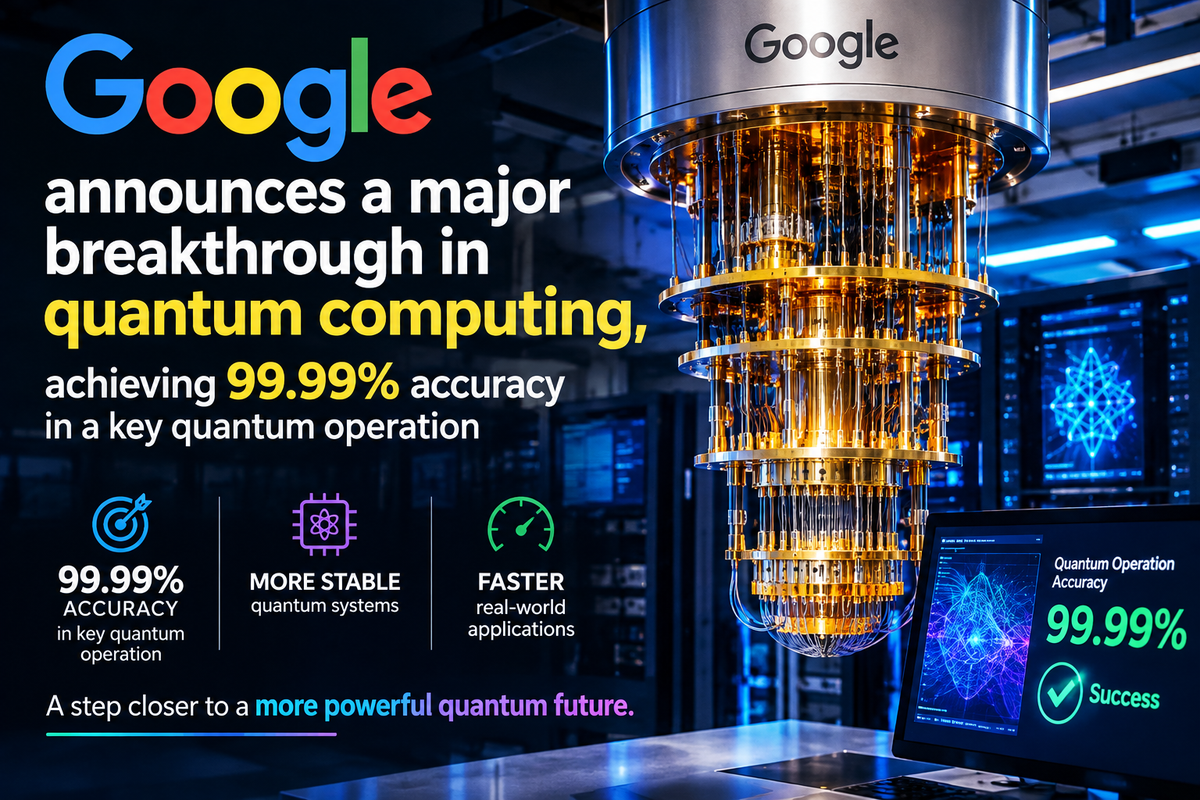
In a paper published in Science and described on the company blog on October 15, Google Quantum AI demonstrated magic-state cultivation on its Willow superconducting processor. The protocol cut errors about 40-fold compared with uncultivated states and produced T-states — a type of magic state — with a reported logical fidelity of 99.99%, or an error rate at or below 0.0001. It is the first physical implementation of a technique the same group outlined in theory in 2024. Emma Rosenfeld and Craig Gidney are among the authors. The blog’s line is that this opens a bottleneck that has sat in the literature since 2004.
Magic states are single-use resources. Universal, fault-tolerant quantum computation needs non-Clifford operations, and the standard way to get them has been to distill magic states from noisier ones. Estimates have put that distillation at 90 to 95 percent of a machine’s physical-qubit budget. A method that produces cleaner states with fewer qubits changes the size of the computer you have to build. It does not, by itself, build it.
What the Experiment Did
Cultivation filters a prepared state through checks that discard the bad copies and keep the good ones. On Willow, about 8 percent of attempts passed every check. The chip throws away more than nine tries in ten to keep one clean state. That yield is the cost of the fidelity. The surviving states were then moved, via a fault-tolerant code switch, from a distance-3 color code into a distance-5 surface code — grafting the cultivated state into a stronger error-correcting code. The team also built a self-referential metrology protocol to bound the fidelity in the presence of drift and low-frequency measurement noise, which is why the 99.99% figure comes with a parenthetical uncertainty in the more technical write-ups: 99.99(1)%.
Forty-fold fewer errors than the uncultivated baseline is the comparison that matters inside the paper. The 99.99% is the absolute number on the T-states that survived. Both are on Willow, the same processor Google has used for earlier error-correction threshold results. Neither is a claim that every operation on the chip now runs at that accuracy.
What It Does Not Yet Do
Code-breaking estimates are the place this result gets over-read. Gidney’s 2025 figure — that RSA-2048 might fall to under a million noisy qubits, down from a 20-million estimate in 2019 — uses cultivation as one of the assumptions. Breaking that encryption would still need magic states with error rates near one in 10 billion, orders of magnitude beyond 99.99%. The paper suggests further distillation may never be needed in practice for some workloads. It does not say the distillation problem is solved for cryptography, and it does not say Willow can run a useful algorithm at this fidelity end to end.
Scaling remains the open problem Google’s own coverage names. A distance-5 surface code is a laboratory code, not a machine that stays corrected while it does chemistry or optimization. The yield of 8 percent means you need many physical attempts per logical state. Multiplied across a large computation, that overhead is still a design constraint. Cultivation shrinks it relative to older distillation. It does not remove it.
Why the Bottleneck Mattered
Since 2004 the field has known that Clifford operations — the ones that are easier to correct — are not enough for a universal computer, and that the non-Clifford piece would dominate the qubit count if you made it the old way. Every roadmap that promised a useful machine in a data center rather than a warehouse was implicitly betting on a better magic-state factory. Google’s 2024 theory paper was one such bet. The Science paper is the bet cashed on hardware: the factory can be built, it rejects most of its output, and the output it keeps is clean enough to graft into a surface code.
Competitors are on the same problem with different hardware. Ion-trap and neutral-atom groups have published their own high-fidelity state preparations. Superconducting is Google’s lane, and Willow is the device. A result in Science on that device is a milestone for that architecture. It is not a ranking of which architecture wins.
What to Watch
Whether the 8 percent yield improves in a follow-up, which is the practical limiter.
Independent reproduction or a detailed methods supplement that lets another lab bound the same fidelity.
How the result is folded into Google’s next qubit-count estimate for a useful algorithm.
Any claim that ties this fidelity directly to a cryptographically relevant error rate — those claims are not in the paper.
The next Willow error-correction paper, which will show whether cultivated states survive inside a longer computation.
Google’s Willow processor has produced magic states at 99.99% logical fidelity and cut errors about 40-fold with a technique called cultivation. The work is in Science. It addresses a 20-year resource bottleneck. It does not deliver a fault-tolerant computer, and the fidelity is still far from what code-breaking estimates require. The step is real. The distance left is larger.
Comments (0)
Please log in to comment
No comments yet. Be the first!