Technology
Google DeepMind Opens an Institute to Widen the AGI Debate
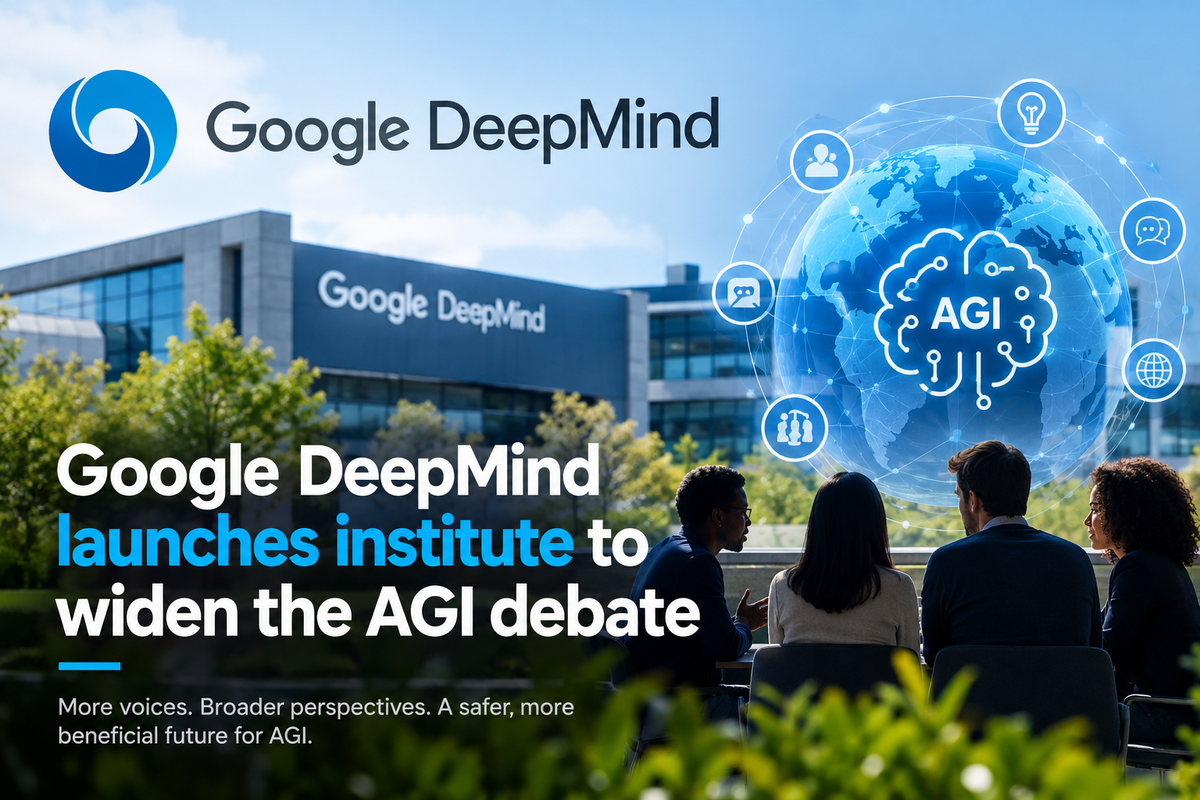
Google DeepMind built a publishing desk for the argument it has been having in private for twenty years.The DeepMind Institute went live this week as a platform for essays and debate on artificial general intelligence — what it is, how close it is, and what society does if the gaps close. Directors are Shane Legg, DeepMind co-founder and chief AGI scientist; Demis Hassabis, DeepMind chair and Alphabet chief scientist; and James Manyika, who leads research, labs, technology and society at Google. Legg is managing editor.The launch note is careful on two points. First, Google, DeepMind, and outside authors will not always agree, and they will change their minds as the frontier moves. Second, the pieces are the writers’ ideas. They should not be read as official Google policy. That disclaimer is the product. A lab that trains Gemini and runs the most famous AGI shop on earth cannot pretend a think tank is independent. It can pretend the memos are not the board minutes.Hassabis put the personal version on the record: he and Legg have talked about AGI’s effect on the economy, science, and society for more than two decades. The institute is that conversation with a URL.What They Say AGI IsDeepMind’s working definition is a system with the full set of cognitive capabilities of the human brain. Today’s models still fail basic tasks and still lack consistency and creativity. The directors say those gaps should close soon. That is “near AGI,” not “AGI shipped.”The distinction matters this month. Nvidia and OpenAI figures have talked as if the threshold is already crossed. Legg has called those declarations premature and has kept a long-standing 50 percent chance of “minimal” AGI around 2028. Different labs use different yardsticks — economic value, brain-complete cognition, a vibes-based “it feels general.” An institute that publishes the definition in public is trying to own the ruler before someone else does.Current worries listed in the launch material include cybersecurity, biorisk, and loss of control in future self-improving systems. Those are DeepMind’s house risks. They are also the risks every other frontier lab recites. The institute’s bet is that economists, philosophers, and policy people have to sit in the same room as the people who train the models.The First Stack of EssaysThe opening slate is short and pointed.One strand is economic policy for AGI — how governments might handle disruption if labor and firms absorb a general system. That is the “what do workers do” paper, not a product launch.Another is reasoning transparency: keep chain-of-thought and other intermediate traces human-readable so outsiders can see warning signs. If models start thinking in compressed private languages, evaluators go blind. The essay is a plea not to lose the window.A third reaches for principles of human flourishing — what a good society looks like if AGI arrives, drawing on twentieth-century lessons rather than a pitch deck.Hassabis also restates a U.S.-led frontier evaluation body. Developers would submit the most advanced models voluntarily, up to 30 days before release. If the tests work, passing them could become a condition for deploying frontier systems in the United States. Washington has talked about oversight architecture that has not fully landed. The institute gives that idea a DeepMind byline.Together the papers say: we are close; do not declare victory; measure the models; write the labor rules; do not let the reasoning go dark.Why a Lab Needs a ForumFrontier companies already fund safety teams, policy shops, and academic grants. An “institute” is a different costume. It lets disagreement show without a press officer reconciling it. It lets an outside economist publish next to Hassabis without implying Alphabet has adopted the tax plan. It also lets DeepMind set the agenda while the industry splits over pauses, consciousness training, and whether GPT-class systems already count as AGI.Skeptics will call it reputation management. A company racing to ship capable models now hosts the seminar on whether those models should wait. That tension is real. A forum is not a brake. It is a library. The training clusters still run.The useful test is not the launch essay. It is whether the next six months include authors who contradict DeepMind on timelines, on evaluation power, or on who should hold the off switch — and whether those pieces stay up.The Wider Fight This Sits InThis week the industry is arguing in public. Some lab chiefs want a slower frontier. Chip vendors want no new safety statutes. Microsoft’s AI chief is attacking the idea of training models to ponder their own welfare. OpenAI and others have made AGI-adjacent claims that DeepMind’s people reject as early.The DeepMind Institute is an attempt to move that noise into signed papers with a shared glossary. Shared glossary is power. If “AGI” means brain-complete cognition, then today’s products are not AGI and the evaluation body Hassabis wants is about the next jump, not the last one. If AGI means “economically general,” the jump already happened and the institute is late.Legg has said a proposal to slow releases without a hard pause is worth considering, and that capabilities must not outrun controls. That is closer to the caution camp than to the “it’s here, ship it” camp. The institute gives him a place to say it without it being only a quote in someone else’s story.What to WatchWhether outside labs and critics actually publish there.
Whether the evaluation-body idea picks up U.S. official interest.
Whether economic-policy essays name taxes, compute access, and wage insurance or stay abstract.
Whether “not Google’s official view” survives the first essay that hurts a product narrative.DeepMind did not announce AGI. It announced a room in which AGI can be argued about on its stationery. That is smaller than a safety treaty and larger than a blog. The debate was already wide. The institute is a bid to host it.
Comments (0)
Please log in to comment
No comments yet. Be the first!