Technology
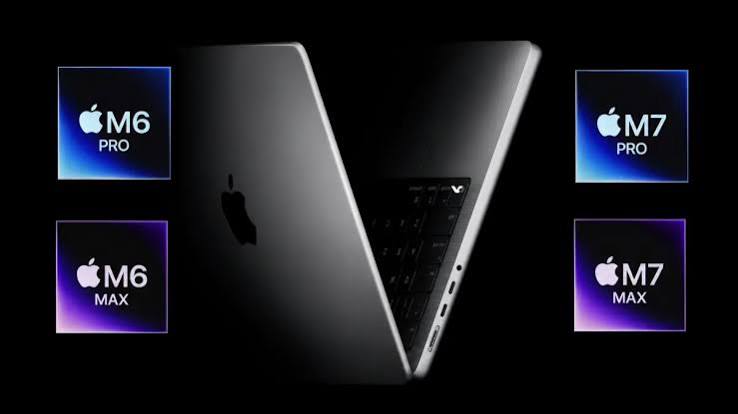
Apple Reportedly to Skip M6 Pro and M6 Max Chips, Fast-Tracking AI-Focused M7 Line
Apple is preparing one of the biggest shake-ups to its Mac silicon roadmap since the Apple Silicon transition began in 2020. According to a new Bloomberg report from Mark Gurman, Apple will release a base M6 chip for entry-level Macs later this year, but will skip higher-end M6 Pro and M6 Max variants entirely — something it has never done in any chip generation since switching away from Intel processors.
Instead, Apple plans to move straight to an AI-focused M7 generation, fast-tracking those chips by as much as six months to fill the gap left by the absent M6 Pro and Max.
What's Coming With the Base M6
The base M6 chip, internally codenamed Komodo (or H18G), is reportedly already being tested in a refreshed entry-level 14-inch MacBook Pro, with a launch expected as early as this fall. Bloomberg's reporting points to several concrete upgrades over the current M5:
Memory bandwidth increasing to roughly 200 gigabytes per second, up from 153 GB/s on the M5 — a meaningful jump that matters significantly for AI workloads, which depend on moving large volumes of data quickly
GPU core count rising to as many as 12 cores, up from 10 on the M5, aimed at AI rendering and other parallel processing tasks
An upgraded Neural Engine, Apple's dedicated AI processing component
Improvements to video encoding and decoding performance
A new memory architecture underpinning the bandwidth gains
Beyond the MacBook Pro, the M6 is also expected to eventually reach the Mac mini, iMac, and MacBook Air lineups.
Why Skip the Pro and Max?
Under Apple's established cadence since 2020, a base M-series chip has always been followed roughly six months later by Pro and Max variants with additional CPU and GPU cores for higher-performance machines. This time, Bloomberg reports Apple is bypassing that step entirely, redirecting the engineering effort toward accelerating the M7 generation instead.
The reasoning, according to the report, centers on AI. "The M7 line is designed primarily around major advancements to on-device AI processing," Bloomberg reported, noting the base M7 chip alone is targeted to support around 240 GB/s of memory bandwidth — a 20% increase over the M6 and roughly 57% higher than the current M5. The shift would let Apple bring its most AI-capable silicon to market about half a year sooner than its traditional release rhythm would have allowed, as the company works to keep pace with surging demand for on-device AI and increasingly graphics-intensive software.
The change also comes as Apple navigates an industrywide memory shortage that has already forced it to raise prices across portions of its Mac and iPad lineups — a supply backdrop that may be informing some of the broader strategic recalculation.
The M7 Roadmap
Under the revised plan, the base M7 (codenamed Delos, or H19G) is expected to arrive as early as the first half of 2027 — right around when an M6 Pro/Max would normally have launched under the old schedule. The M7 Pro and M7 Max (collectively referred to internally as Andros, with model codes H19S and H19C) would then follow in late 2027, with an M7 Ultra (H19D) targeted for 2028.
That would mark Apple's first Ultra-tier chip since the M3 Ultra, as the company has not released an Ultra variant during either the M4 or M5 generations.
One More M5 Chip Before the Transition
Before the shift to M7 takes effect, Apple is still expected to ship one additional chip in the current M5 family: the M5 Ultra, codenamed Sotra D (or H17D). Bloomberg reports Apple is targeting a release as early as this year as part of a new Mac Studio, with specifications that would make it one of the most powerful chips available in a mainstream computer — around 36 CPU cores and 80 GPU cores. Apple has also reportedly tested support for up to 768 gigabytes of memory in the M5 Ultra Mac Studio configuration, though component constraints could complicate that ceiling making it to a final shipping product. The Mac Studio refresh had previously been delayed amid these same supply and cost pressures.
Leadership Context
The adjusted silicon strategy falls under Johny Srouji, who recently took over all of Apple's hardware engineering as the company's new Chief Hardware Officer, a reorganization that coincided with John Ternus's move into the CEO role. Srouji's remit now also extends to other previously reported silicon initiatives, including rumored 2-nanometer iPhone chips and custom silicon being developed for Apple's anticipated foldable iPhone and a 20th-anniversary iPhone model.
What It Means for Buyers
For consumers and professionals weighing a Mac purchase, the practical implication is straightforward: anyone who typically waits for the Pro or Max tier of a given chip generation will need to wait roughly a full extra cycle, skipping past the M6 generation's higher-end models entirely and landing on M7 Pro or M7 Max machines instead in late 2027. It's also unclear whether the M6 MacBook Pro previously rumored to potentially include Apple's first touchscreen laptop display will still arrive on its original timeline given this roadmap shake-up.
As with all unannounced product roadmap reporting, Apple has not commented on the plans, and Bloomberg's account is based on unnamed sources described as people with knowledge of the matter. The timeline and specifications should be treated as Apple's current internal plans rather than confirmed product details until the company makes official announcements — typically expected to begin with the base M6 chip's debut later this year.
Comments (0)
Please log in to comment
No comments yet. Be the first!