Technology
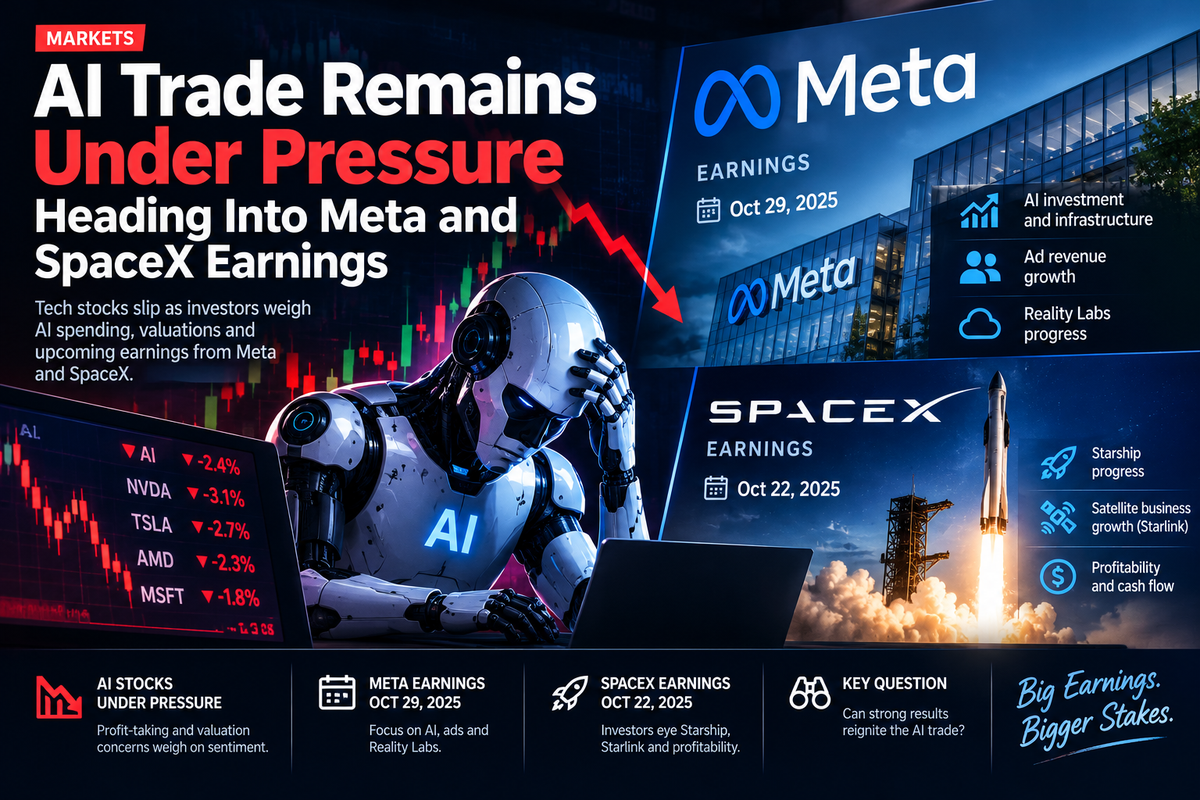
AI Trade Remains Under Pressure Heading Into Meta and SpaceX Earnings
The AI trade that has carried the bull market is wobbling into the reports that are supposed to justify it.
Reuters’ week-ahead note framed the setup: technology shares have pulled back after a big run, with sharp declines in semiconductor companies and hardware names such as Dell. The S&P 500 and Nasdaq have broken support levels in recent sessions. The coming week’s calendar puts the pressure on a short list of results — Meta Platforms, Lam Research, Texas Instruments, SpaceX, Tesla, and Netflix — to show whether the spending that defined the rally is still being rewarded.
Meta is the cleanest test among the hyperscalers. Goldman Sachs has the five largest AI infrastructure spenders on track for about $1.2 trillion in combined capital expenditure next year. Meta’s own 2026 guide has been cited in the $130 billion to $145 billion range, nearly double the prior year. Investors have been willing to fund that buildout on the promise of advertising gains, new model products, and eventual compute revenue. They have been less willing, in the last two weeks, to fund it without a nearer-term sign that free cash flow is not the permanent casualty. One preview put Meta’s third-quarter free cash flow at a negative figure in the high single-digit billions, with capex near $41 billion for the quarter. Revenue estimates cluster around $63 billion, up more than 20 percent year on year. Earnings-per-share estimates vary by source, from the mid-$6 range to near $6.85. The stock’s average one-day move after earnings has been about 8 percent in either direction.
What Meta Has to Show
The advertising engine is the part of Meta that already monetizes AI. Better ranking and creative tools have been the company’s stated driver of revenue growth. Muse, the new model family, business agents, and any compute-rental revenue are the parts that are still mostly promise. A print that shows ad growth holding while capex stays elevated will be read as the bull case continuing. A print that shows ad growth slowing while capex is reaffirmed or raised will be read as the bear case the recent selloff has been pricing. The fourth-quarter outlook matters as much as the third-quarter number. Guidance that implies the spending peak is near, or that revenue from AI products is measurable, is the comment that can stabilize the group. Guidance that simply repeats the $130–145 billion range without a return metric is the comment that can extend the pressure.
Options were pricing a move in line with Meta’s historical post-earnings range. That is not a prediction of direction. It is a statement that the market expects the report to matter.
SpaceX and the Other Musk Print
SpaceX reports late Tuesday, its second earnings release since the June IPO. Analysts expect earnings around $0.14 a share and revenue near $12.9 billion, though estimates differ by source. The questions are Starlink growth, the AI business, and launch cadence after Starship Flight 14. Starlink has been the profit engine. The AI segment has been the spending engine. One earlier read had AI capital spending consuming the bulk of the company’s capex, with expectations that the AI business’s revenue would rise sharply while its investment rose faster. A public company with a valuation that has already compressed from its IPO print has less room to treat AI capex as an unexamined line. Musk’s commentary on whether Starlink can fund both the AI build and the launch program is the sentence the tape will trade.
Tesla reports in the same window. It is not an AI hyperscaler, but it is a signature stock of the same bull market, and the Roadster demo earlier in the week already moved the premarket. Delivery and margin numbers will either confirm that the core auto business is stable enough to support the multiple, or they will not. Netflix is the consumer-discretionary check on whether households are still paying for streaming while tech multiples compress.
Why the Trade Is Under Pressure Now
The fourth anniversary of the bull market arrived with the leaders tired. Semiconductor stocks that had run hard — Lam Research and Texas Instruments among the names reporting Wednesday — gave back ground. Hardware names tied to AI server builds sold off. The narrative that every dollar of hyperscaler capex is a dollar of chip and component demand is intact as a multi-year story. It is less intact as a reason to pay peak multiples into a week when two of the biggest spenders report and the indexes have already broken support.
Broadcom’s earlier warning that capital, not chips, could be the constraint, and the IMF’s note on an AI slowdown spilling into markets, are the macro versions of the same question. Earnings are the micro version. Meta and SpaceX either show that the spending is attached to revenue and a path to cash, or they show that the spending is still the story and the returns are later. The market has spent two weeks voting for later.
What to Watch
Meta’s capex guide and any quantified AI revenue, after the close on October 21.
SpaceX’s AI segment revenue versus its AI capex, late Tuesday.
Lam Research and Texas Instruments on Wednesday for the semiconductor demand read-through.
Whether the Nasdaq holds or loses the support it broke.
Tesla’s margins, which will color the same session as the AI prints.
The AI trade remains under pressure heading into Meta and SpaceX earnings. Chips and hardware have sold off. Hyperscaler spending is still projected near $1.2 trillion next year. The reports this week are the market’s chance to see whether that spending is producing the returns the rally assumed. Until those numbers print, the pressure is the position.
Comments (0)
Please log in to comment
No comments yet. Be the first!