World & Politics
Trump Says Taiwan Is a 'Very Small Island' and China Is '59 Miles Away' — Why His Words Are Sending Shockwaves
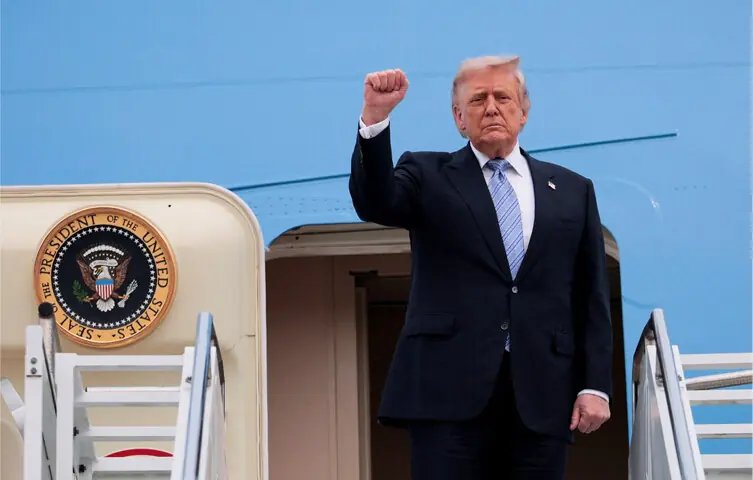
In the skies somewhere over the Pacific, aboard Air Force One heading home from Beijing, President Donald Trump said out loud what many U.S. adversaries have long hoped to hear — and what many American allies have long feared.
Speaking to reporters on May 15, 2026, after concluding his two-day summit with Chinese President Xi Jinping, Trump offered a remarkably candid assessment of the Taiwan situation — one that set off alarm bells in Taipei, Tokyo, Seoul, and Washington's own national security community.
"You know, when you look at the odds," Trump said, "China is a very, very powerful, big country. That's a very small island. Think of it, it's 59 miles away. 59 miles. We're 9,500 miles away. That's a little bit of a difficult problem."
He then added: "Taiwan would be very smart to cool it a little bit. China would be very smart to cool it a little bit. They ought to both cool it."
For analysis on the geopolitical stories shaping 2026 — and what they mean for business, technology, and global stability — visit Digital8Hub.
What Trump Said: The Full Picture
Trump's Taiwan comments came in two settings — aboard Air Force One and in a Fox News interview with Bret Baier, taped in Beijing and aired Friday evening. Together, they paint one of the most significant shifts in U.S.-Taiwan posture in years.
On the $14 billion arms sale to Taiwan — a package that both Republicans and Democrats in Congress have called on Trump to approve — the president was deliberately noncommittal.
"I haven't approved it yet. We're going to see what happens," Trump told Baier. Then came the line that rattled allies: "I'm holding that in abeyance, and it depends on China. It depends. It is a very good negotiating chip for us, frankly."
The president also confirmed that he and Xi discussed Taiwan "in great detail" — and that the arms sale was part of those discussions. This in itself was extraordinary. The U.S. has been bound since 1982 by a policy known as the "Six Assurances" — a commitment not to consult with China on arms sales to Taiwan. When asked about this, Trump dismissed it: "What am I going to do, say I don't want to talk to you about it because I have an agreement wrote in 1982? No, we discussed arms sales."
When reporters then asked the most direct question of all — would the United States defend Taiwan militarily if China attacked? — Trump declined to answer. "There's only one person that knows that, you know who it is? Me, I'm the only person," he said. Then he revealed something remarkable: "That question was asked to me today by President Xi." Xi asked Trump directly whether America would fight for Taiwan. Trump told reporters he had not answered.
The Geography Argument — and Why It Matters
Trump's invocation of geography — 59 miles vs. 9,500 miles — is not just casual observation. It is a strategic framing with significant implications.
For decades, U.S. policy has rested on the principle of strategic ambiguity: Washington neither confirms nor denies that it would defend Taiwan militarily, with the idea being that uncertainty deters both a Chinese attack and a Taiwanese declaration of independence. Ambiguity has kept the peace in the Taiwan Strait for over 40 years.
What Trump did aboard Air Force One was subtly but meaningfully shift that framing — from ambiguity toward a geography-based rationale for non-intervention. By emphasising how far the U.S. is from the strait and how close China is, he was making the implicit argument that this conflict, if it came to pass, would be China's backyard and America's distant concern.
Analysts were quick to respond.
CNN's chief national security analyst described Trump's refusal to commit to Taiwan arms sales as a clear "win for China." The network noted that while Trump could still change course and approve the arms deal, the opening he created — the hesitation, the "we'll see" — hands Beijing a psychological and diplomatic victory regardless of what ultimately happens.
Hawks on Capitol Hill have long argued that robust U.S. support for Taiwan — weapons, political commitments, clear military guarantees — is precisely what deters Chinese aggression. Some analysts, however, have countered that strong U.S. pledges may actually make Beijing more likely to act before the window closes. Trump's comments suggest he finds the latter argument more compelling, or at least more convenient given the broader context of his summit goals.
What Xi Said — and What Trump Repeated
One of the most striking moments of Trump's Air Force One press availability was when he appeared to relay, almost approvingly, a key piece of Chinese Communist Party historical narrative.
Trump told reporters that Xi had argued China had Taiwan "for thousands of years" — a central plank of Beijing's claim to the island — and that Trump conveyed this framing without visible pushback. Historians and Taiwan's own government would strongly contest this characterisation. Taiwan has been self-governing since 1949 and was under Japanese, not Chinese, control for the 50 years before that.
Given that Trump has appeared receptive to Russian President Vladimir Putin's argument that Ukraine belongs to Russia, analysts noted Xi may have sought to make a similar argument regarding Taiwan — and that this approach appeared to find a willing audience.
Taiwan's government released a formal statement in response to Trump's comments, though its content was notably restrained — Taipei choosing diplomatic caution over open confrontation with Washington at a moment of acute sensitivity.
Japanese Prime Minister Sanae Takaichi, who had staked out a hawkish position on Taiwan, found herself increasingly at odds with the direction of U.S. policy — a sign of how broadly Trump's comments are reverberating among America's Indo-Pacific allies.
"Nothing Has Changed" — But Has It?
When Fox News's Baier asked Trump directly whether the people of Taiwan should feel less secure after his Beijing summit, the president responded with a single word: "Neutral."
He then elaborated: "Nothing's changed. I will say this: I'm not looking to have somebody go independent. And we're supposed to travel 9,500 miles to fight a war. I'm not looking for that. I want them to cool down. I want China to cool down."
Republicans and Democrats on Capitol Hill have called on Trump to move ahead on the $14 billion arms sale. Trump remained noncommittal.
The tension in Trump's position is real: he says nothing has changed, while simultaneously treating a legally mandated arms sale as a "negotiating chip" with Beijing, declining to commit to defending Taiwan, and framing the conflict as geographically impractical for the United States.
Whether nothing has changed depends entirely on what you thought U.S. policy was before he boarded that plane to Beijing.
The Bigger Picture: Taiwan in the Context of the Iran War
Trump's comments on Taiwan did not emerge in a vacuum. The United States is currently engaged in an active war with Iran — a conflict that began on February 28, 2026 — and the president made clear that avoiding another front is a governing priority.
"I think the last thing we need right now is a war that's 9,500 miles away," Trump told reporters aboard Air Force One. With U.S. military resources stretched, domestic public appetite for further conflict limited, and the Iran war dominating the foreign policy agenda, Trump's reluctance to make strong commitments on Taiwan is, at minimum, tactically understandable.
Chinese sources familiar with the Beijing talks told CNN that Beijing viewed the Iran war as having strengthened its negotiating position — aware that a Washington distracted by one war is less likely to commit to fighting another.
This is the geopolitical moment Xi has been patient for. Whether Trump's comments represent a genuine strategic recalibration or tactical flexibility he will walk back in the weeks ahead remains to be seen. But the words are on the record. Xi heard them. Taipei heard them. Tokyo heard them. The world heard them.
What Happens Next
The Taiwan question has been, in Xi's own words at the summit, the "most important" issue in U.S.-China relations. Trump confirmed this framing when speaking to Fox News, saying Taiwan was the single biggest issue Xi raised throughout their two days of talks.
Several things to watch in the coming weeks:
The $14 billion arms sale decision — Trump said he'd make a determination in "a short period of time." Whether he approves it, reduces it, or quietly lets it lapse will be the clearest signal yet of where U.S. Taiwan policy is actually headed.
Congressional reaction — Both parties have been vocal about the arms sale. Expect significant pushback if Trump delays or cancels it, potentially complicating his domestic political position.
Taiwan's own response — Taipei has been measured so far. But a formal announcement that arms sales are being withheld could force Taiwan's government into a far more difficult public posture.
Xi's September U.S. visit — With the Chinese president arriving in the United States on September 24, Taiwan will almost certainly feature prominently in those discussions too.
The Taiwan Strait has been called the most dangerous flashpoint on Earth. This week, the man responsible for managing it described it as "a difficult problem" — and got back on his plane.
For sharp, grounded coverage of the geopolitical and business stories that define our world in 2026, visit Digital8Hub.com.
Comments (0)
Please log in to comment
No comments yet. Be the first!