World & Politics
Trump Departs Beijing After Historic Summit With Xi — Here Are All the Deals Made
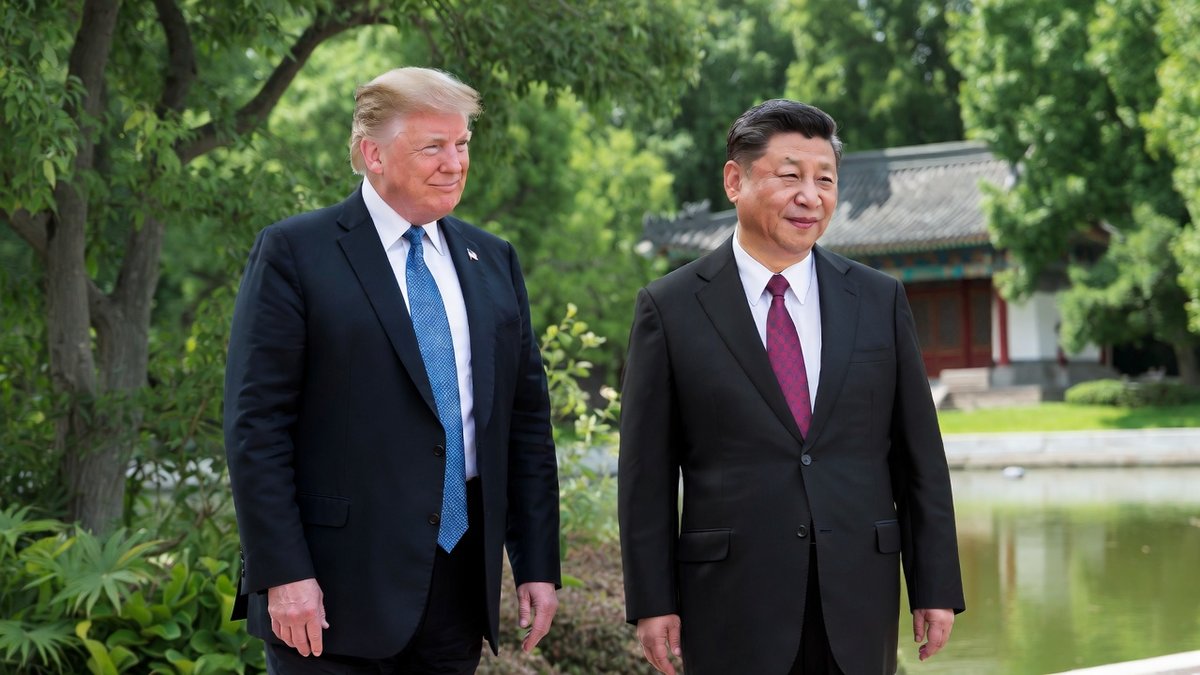
President Donald Trump has officially departed Beijing, wrapping up a landmark two-day summit with Chinese President Xi Jinping that concluded on May 15, 2026. Air Force One lifted off from Beijing Capital International Airport as hundreds of enthusiastic onlookers — amateur photographers, live streamers, and ordinary citizens — gathered to watch the famous presidential plane take to the skies.
The visit was the first by a sitting U.S. president to mainland China in nearly a decade, and it marks one of the most consequential diplomatic meetings of Trump's second term. Before boarding, Trump told reporters: "This has been an incredible visit. I think a lot of good has come of it, and we've made some fantastic trade deals. Great for both countries."
For the latest analysis on global business, trade policy, AI innovation, and the deals shaping 2026, visit Digital8Hub — your source for smarter takes on the world.
What Was This Summit About?
The Trump-Xi Beijing Summit took place against a complex backdrop. The two countries have been locked in a trade war for nearly a decade, with U.S. tariffs on Chinese goods averaging 47.5% — up from just 3.1% before Trump's first term — while China's average tariff on U.S. goods stood at 31.9%. Two-way goods trade has fallen sharply, from a 2022 peak of roughly $690 billion to around $415 billion in 2025.
A fragile truce reached at a Trump-Xi meeting in South Korea in October 2025 — which lowered U.S. tariffs in exchange for China pausing its rare earth export restrictions — was set to expire later this year. This Beijing summit was widely seen as the defining moment: would the two nations stabilise their relationship, or let tensions spiral again?
Trump arrived with a power delegation unlike any previous presidential trip. Joining him were some of the most influential executives in the world: Elon Musk (Tesla), Tim Cook (Apple), Jensen Huang (Nvidia), Larry Fink (BlackRock), and Kelly Ortberg (Boeing). The message was clear — this was not just diplomacy, it was business.
The Deals: What Was Agreed
1. Boeing: 200 Jets
The most concrete headline deal of the summit was China's agreement to order 200 Boeing commercial aircraft — exceeding Boeing's own initial ask. Trump confirmed the order in a Fox News interview, saying with evident relish: "Boeing wanted 150. He got 200." The deal breaks what Boeing CEO Kelly Ortberg described as a "yearslong drought" for the U.S. planemaker in the Chinese market and represents billions of dollars in future revenue.
2. Agriculture: Double-Digit Billions
U.S. Trade Representative Jamieson Greer told Bloomberg that an agreement for China to purchase "double-digit billions" of dollars in U.S. agricultural products annually over the next three years is expected to be formalised. This covers soybeans, beef, and other commodities — the "beans and beef" that analysts had predicted as the summit's most achievable deliverable.
3. Nvidia AI Chips: H200 Licensing Cleared
In a major tech development, the U.S. cleared sales of Nvidia's H200 AI chips to approximately ten major Chinese technology firms during the summit, according to Reuters. This represents a significant shift from the previous "presumption of denial" framework that had effectively blocked Chinese commercial access to the chips. Nvidia CEO Jensen Huang — a last-minute addition to the U.S. business delegation — was described as "the walking, talking symbol of the AI race." Nvidia's most advanced Blackwell chips remain restricted, but the H200 pathway opens meaningful new revenue channels for the chip giant.
4. AI Governance Dialogue
Both sides agreed to explore some form of emergency communication or cooperation framework to prevent non-state actors from weaponising powerful AI systems — what Treasury Secretary Scott Bessent described as a potential shared interest in AI safety. China's approach to AI governance is far stricter domestically (all new generative AI models must be registered with the government before release), while the U.S. favours a lighter regulatory touch. A formal bilateral AI governance framework was discussed but the details remain thin.
5. Strait of Hormuz: China Offers Help
Beyond trade, China offered to help negotiate an end to the U.S.-Israel war with Iran and assist in reopening the Strait of Hormuz — the critical maritime chokepoint through which roughly a fifth of the world's oil normally passes. Iran has largely blocked the strait since the outbreak of war on February 28, causing significant disruption to global energy markets. Chinese vessels have already begun passing through the strait following an understanding over Iranian management protocols, Iranian state media reported. Secretary of State Marco Rubio confirmed Trump discussed the strait with Xi, though Trump did not formally ask China to intervene.
6. Xi to Visit the U.S. in September
In a significant diplomatic signal, Trump extended — and Xi accepted — an invitation for the Chinese president to visit the United States on September 24. The two leaders may also meet at APEC and G20 events later in the year, setting up continued high-level engagement through the end of 2026.
What Xi Warned Trump About: Taiwan
Not everything at the summit was smooth. In direct language, President Xi warned Trump that mishandling China's claims on Taiwan could cause "clashes and even conflicts" between the two superpowers. The warning came as Taiwan had been a major point of contention — the U.S. announced an $11.1 billion arms sale to Taipei just months prior, and Trump had told reporters before the trip that he would "have that discussion" about whether the U.S. should continue selling weapons to Taiwan.
Xi also invoked the concept of the "Thucydides Trap" — the historical pattern whereby tensions between a rising and ruling power often result in war — and asked directly whether the U.S. and China could avoid it. Trump, for his part, called Xi a "friend," described their relationship as one of the most consequential in world history, and said the two leaders had held "extremely positive and constructive discussions."
What Analysts Are Saying
The consensus view among analysts is measured: the summit delivered stabilisation, not transformation.
There were no sweeping, landmark breakthroughs on the thorniest issues — Chinese EVs remain blocked from the U.S. market, rare earth export controls have not been fully reversed, and the tariff standoff remains structurally unchanged. The trade truce forged in South Korea will likely be extended, but on essentially the same terms.
"The big word will be stabilization," said Graham Allison, Harvard professor and former assistant secretary of defence, speaking on CNBC. "The truce that the two parties negotiated will, I suspect, become a formal agreement."
Scott Kennedy of the Center for Strategic and International Studies added an important note of context: "China comes into this meeting far more confident than in 2017, when it feared even a small rise in U.S. tariffs. In the last year, Xi has been able to push back and neutralize much of Trump's actions."
The energy crisis caused by the Iran war has also complicated the picture — giving China leverage as Iran's largest trade partner and top buyer of its oil, even as Beijing faces its own pressures from U.S. technology restrictions.
Why This Summit Matters for Business and Technology
For businesses and investors tracking the intersection of geopolitics, technology, and global trade, the outcomes of this summit send several important signals.
The Nvidia H200 licensing development is particularly significant for the AI industry — a market worth hundreds of billions of dollars annually. U.S. chip export policy has been one of the central battlegrounds of the tech cold war between Washington and Beijing, and any relaxation, however conditional, reshapes the competitive landscape for AI infrastructure globally.
The Boeing deal reinforces commercial aviation's role as a diplomatic instrument — and as a bellwether for broader U.S.-China economic relations. China is the world's largest aviation market, and Boeing's exclusion from it had cost the company dearly.
At Digital8Hub, we cover how these macro developments in trade, AI, and global business connect to the technology trends and investment opportunities that matter to you. From AI chipmakers going public to the deals reshaping global supply chains, the stories are moving fast — and we're keeping pace.
The Bottom Line
Trump's Beijing visit did not produce the kind of sweeping, transformational agreements that some had hoped for. But it delivered something arguably more durable: a renewed framework for the world's most consequential bilateral relationship, a roster of concrete commercial wins, and the groundwork for continued engagement through the rest of 2026.
The world's two largest economies remain rivals — in technology, in trade, in geopolitical influence. But for now, they've chosen the summit table over the trade war trenches.
As Trump's Air Force One climbed into the Beijing sky, watched by hundreds of citizens on the ground — including one 22-year-old in a red MAGA hat who simply wanted to wave goodbye — it carried with it more than a presidential party. It carried the fragile, consequential hope that the G2 relationship can still be managed, deal by deal, summit by summit.
For all the context, analysis, and business intelligence you need on the stories shaping 2026, visit Digital8Hub.com.
Comments (0)
Please log in to comment
No comments yet. Be the first!