World & Politics
The World's Second Chokepoint: Yemen's Houthis Warn They Will Shut the Bab al-Mandeb Strait
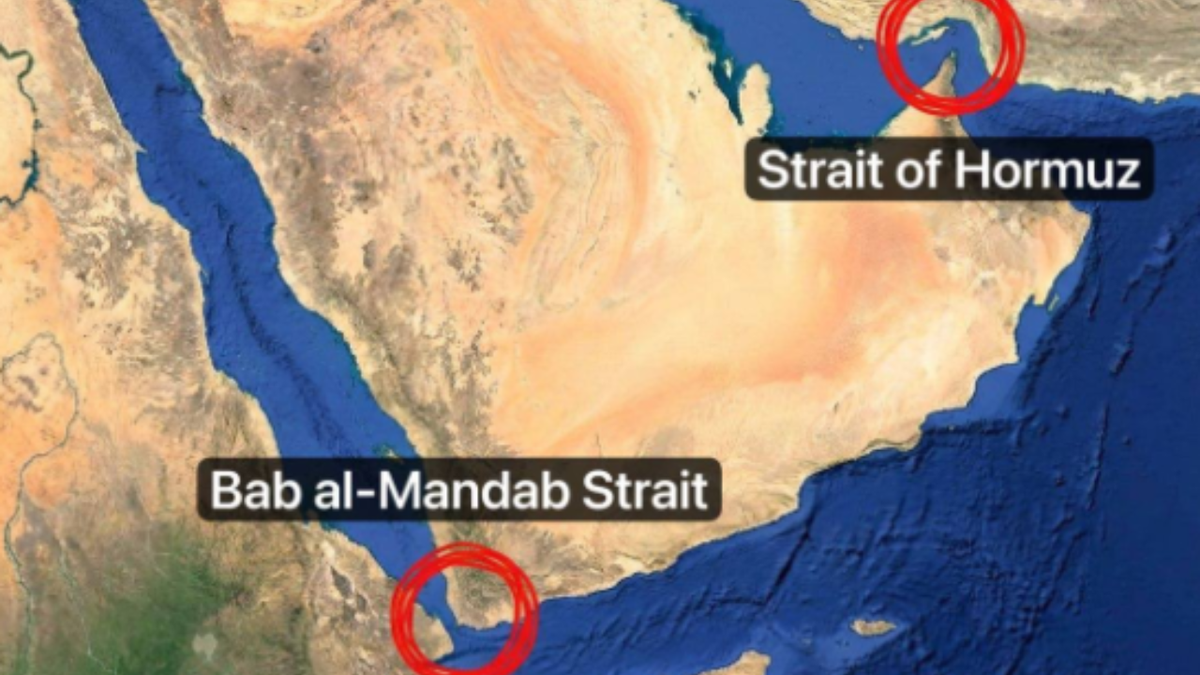
With the Strait of Hormuz effectively blockaded by the United States Navy and Iran's grip on global energy supplies still tightening, the world is now watching a second maritime chokepoint with growing alarm. Yemen's Houthi movement — the Iran-backed armed group controlling much of northern Yemen and the country's Red Sea coastline — has issued a stark warning: if the United States continues to obstruct a peace settlement in the region, they will close the Bab al-Mandeb Strait.
If carried out, the move would compound one of the most severe global trade disruptions in modern history, cutting off the second of two critical waterways through which the world's energy and goods flow between East and West.
What Is the Bab al-Mandeb Strait?
The Bab al-Mandeb — Arabic for 'Gate of Grief' — is a narrow maritime corridor just 29 kilometres wide at its narrowest point, situated between Houthi-controlled Yemen to the northeast and Djibouti and Eritrea in the Horn of Africa to the southwest. It connects the Red Sea to the Gulf of Aden, which opens into the Indian Ocean, and serves as the critical gateway for cargo and energy shipments moving between Asia and Europe via the Suez Canal.
In normal times, the strait handles roughly 12% of global seaborne oil trade and facilitates the movement of an estimated $1 trillion in goods annually. Around 10% of all global trade passes through the Red Sea, making the Bab al-Mandeb one of the most strategically important waterways on Earth. Its importance has grown further since Iran's effective closure of the Strait of Hormuz in late February — pushing more energy and cargo flows toward Red Sea routes and raising the stakes of any disruption there enormously.
What the Houthis Have Threatened
Houthi military official Abed al-Thawr stated in late March that closure of the Bab al-Mandeb would be among the primary options the group could exercise if the conflict continued to escalate. 'We will use the trump card of closing the Bab al-Mandab Strait to American and Israeli ships and the naval and air blockade of Israel and America,' he said, according to Iranian state media.
Houthi Deputy Information Minister Mohammed Mansour reinforced the warning: 'The option of closing the Bab el-Mandeb Strait is a Yemeni option that can be implemented should the aggression against Iran and Lebanon escalate savagely, or if any Gulf state becomes directly involved in military operations.' Mansour added that such a closure would 'strangle the European economy.'
The threat was further amplified by Iran's own senior officials. Ali Akbar Velayati, a top adviser to Iran's newly appointed Supreme Leader Mojtaba Khamenei and former Foreign Minister, posted on X that 'the unified command of the Resistance front views Bab al-Mandeb as it does Hormuz. If the White House dares to repeat its foolish mistakes, it will soon realize that the flow of global energy and trade can be disrupted with a single move.'
The Connection to Trump and Peace Talks
The Houthi threat is explicitly tied to the trajectory of diplomatic efforts between the United States and Iran. Following the collapse of peace talks in Islamabad on April 12 — after 21 hours of negotiations led by Vice President JD Vance failed to produce an agreement — President Trump announced a full US naval blockade of Iranian ports, a move the Houthis and their Iranian backers have described as proof that Washington is obstructing a genuine peace settlement.
Iran's demands throughout the negotiations have included lifting sanctions, a permanent ceasefire across the region — including in Lebanon — and the release of frozen assets abroad. Tehran has maintained that its positions represent a path to peace; Washington has characterised Iran's conduct, including its chokehold on the Strait of Hormuz and transit toll demands, as 'WORLD EXTORTION.' The Houthis have framed their own threatened escalation as a defensive response to what they describe as continued US aggression against the Axis of Resistance.
Saudi Arabia, deeply exposed to any disruption of the Bab al-Mandeb — which serves as one of its key alternative export routes now that the Strait of Hormuz is disrupted — has reportedly asked Washington to end the Hormuz blockade, in part out of concern it could trigger exactly the Houthi retaliation that Riyadh most fears. Iran-backed analyst Arash Azizi told the Jerusalem Post that while the Houthis may be planning for Bab al-Mandeb closure as a contingency, Iran's general direction 'is toward a deal, not escalation.'
What a Closure Would Mean for the World
The economic consequences of a Bab al-Mandeb closure — particularly simultaneous with the ongoing Strait of Hormuz disruption — would be severe. Al Jazeera analysis notes that if both straits were closed simultaneously, a quarter of the world's energy supply would be blocked. The Bab al-Mandeb handles approximately 12% of global seaborne oil trade, and its closure in 2023–2024 during the Gaza conflict forced major shipping lines including Maersk and Hapag-Lloyd to reroute vessels around the Cape of Good Hope — adding weeks to journey times and billions to global logistics costs.
Ship-tracking data already shows daily transits through the Bab al-Mandeb running at roughly half of typical pre-crisis levels — underscoring that the route is already strained even before any renewed escalation. 'Once that risk is there, shipping companies decide not to take it,' former Fifth Fleet commander Vice Admiral Kevin Donegan told Fox News. 'It's less about what they can actually do and more about the threat.'
Closing the strait, analysts warn, would not only harm global trade and energy markets — it would devastate Yemen itself. The country relies on imported food and medicine through the same ports the Houthis control. A full closure risked worsening an already catastrophic humanitarian situation, potentially worse than that seen during the civil war years.
Can the Houthis Actually Do It?
The short answer is yes — and they have done it before. During the Israel-Hamas conflict in 2023–2024, the Houthis caused severe disruption to Red Sea shipping through ballistic missile and drone attacks on commercial vessels. Security analyst Paul Khoury noted that 'all they have to do is fire at a couple of ships coming through, and that would lead to the arrest of all commercial shipping through the Red Sea.' A May 2025 US-Houthi ceasefire reopened the Bab al-Mandeb, but that ceasefire's durability now hangs in question.
The Houthis field a substantial arsenal — ballistic and cruise missiles, anti-ship weapons, and drones, much of it derived from Iranian designs. While supply chains may be constrained by the broader conflict, analysts at the IISS note that the Houthi-Iran relationship is a partnership rather than a direct command structure, meaning the group retains meaningful operational independence in deciding when and how to act.
The Bigger Picture
The Bab al-Mandeb threat represents the latest dimension of a Middle East crisis that has already pushed global oil prices above $90–100 per barrel, prompted IMF downgrades to the 2026 global growth forecast, and triggered emergency meetings among G7 finance ministers and central bank governors. With Iran declaring the Strait of Hormuz open on April 17 while the US maintains its naval blockade of Iranian ports, the geopolitical situation remains in a highly volatile state — and the Bab al-Mandeb stands as the next flashpoint the world cannot afford to ignore.
For ongoing coverage of the Strait of Hormuz crisis, the Houthi threat, global energy markets, and the diplomatic developments shaping the Middle East in 2026, follow Digital8Hub at digital8hub.com.
Comments (0)
Please log in to comment
No comments yet. Be the first!