World & Politics
Macron Announces €23 Billion Investment at Africa Forward Summit in Kenya
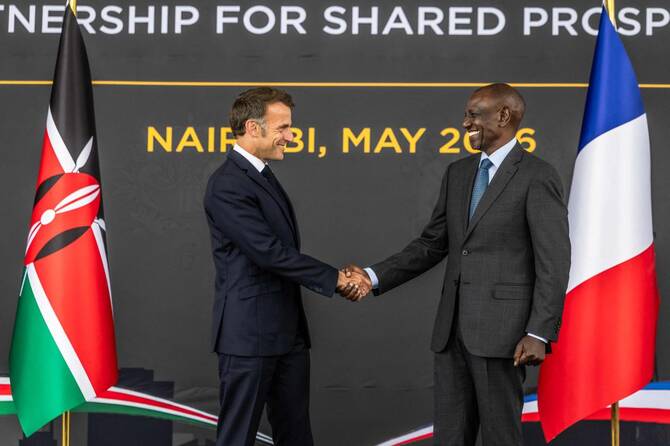
Macron Announces €23 Billion Investment at Africa Forward Summit in KenyaFrench President Emmanuel Macron delivered a major policy speech at the Africa Forward Summit in Nairobi, Kenya, on May 8, 2026, announcing a ambitious €23 billion ($27 billion) investment package aimed at deepening France’s partnership with African nations over the next five years.The announcement represents one of the largest single financial commitments France has made to the African continent in recent decades. Delivered in front of African heads of state, business leaders, and development partners, Macron framed the package as a “new chapter” in Franco-African relations — one based on mutual respect, co-development, and shared prosperity rather than outdated aid models.Details of the Investment PackageThe €23 billion will be deployed through a mix of public funding, development finance, and private sector mobilization. Key focus areas include:Renewable Energy & Green Transition: €8 billion allocated to solar, wind, and green hydrogen projects, with a strong emphasis on helping African countries leapfrog fossil fuel dependency.
Digital Infrastructure & Technology: €5 billion to expand broadband access, data centers, and digital skills training across the continent.
Health Sovereignty: €3 billion to support local pharmaceutical manufacturing and strengthen healthcare systems.
Sustainable Agriculture & Food Security: €4 billion targeting climate-resilient farming, irrigation, and agribusiness value chains.
Education & Youth Employment: Significant funding for vocational training and higher education partnerships.
Transport & Connectivity: Investments in roads, ports, and regional trade corridors.
Macron stressed that a large portion of the funds would be channeled through public-private partnerships, encouraging French companies like TotalEnergies, Orange, Bolloré, and Danone to expand their operations in Africa.Strategic ContextThis announcement comes at a critical time. France has faced declining influence in parts of West and Central Africa due to political shifts, military withdrawals (notably in Mali, Burkina Faso, and Niger), and growing competition from China, Russia, Turkey, and Gulf states.By hosting the Africa Forward Summit in Kenya — a country traditionally seen as more anglophone and less within France’s historical sphere — Macron is signaling a deliberate pivot. Kenya, under President William Ruto, has positioned itself as a hub for innovation and private-sector-led development, making it an ideal venue for this new approach.Macron stated: “The time of unilateral decisions is over. Africa will not be a playground for external powers. We want to be your partner of choice — reliable, respectful, and ambitious.”African ReactionsThe response from African leaders has been cautiously positive. Kenyan President William Ruto welcomed the package, describing it as “a significant vote of confidence in Africa’s future.” Several other heads of state, including those from Senegal, Côte d’Ivoire, and Ghana, expressed support for the investment focus on green energy and digital transformation.However, not all reactions have been enthusiastic. Some civil society organizations and youth movements have voiced skepticism, questioning whether the funds will truly benefit ordinary Africans or primarily serve French corporate interests. Critics also pointed to France’s historical record, where similar large pledges have sometimes under-delivered due to bureaucratic delays or tied conditions.Geopolitical SignificanceThe €23 billion commitment is widely viewed as part of a broader Western effort to counter China’s massive Belt and Road Initiative (BRI) investments across Africa. While China has focused heavily on infrastructure, France is attempting to differentiate itself by emphasizing “quality investments,” technology transfer, and sustainability.The timing is also notable. With the European Union pushing its Global Gateway strategy and the United States expanding its Partnership for Global Infrastructure and Investment (PGII), Macron’s announcement positions France as a key player in this new era of competitive development finance.Challenges and OpportunitiesFor the package to succeed, several challenges must be addressed:Implementation: Past French commitments have sometimes suffered from slow disbursement.
Local Ownership: African governments and private sectors must play a leading role in project selection and execution.
Transparency: Clear monitoring mechanisms will be essential to build trust.
Security: Investments in unstable regions could face risks from political instability or insurgencies.
On the opportunity side, Africa’s young population, rapid urbanization, and vast renewable energy potential make it one of the most attractive investment destinations for the coming decades. If successfully executed, this package could generate significant returns for both French companies and African economies.A New Chapter in Relations?Macron’s speech and investment pledge reflect a clear strategic evolution in French foreign policy toward Africa. Gone (at least rhetorically) are the days of Françafrique — the controversial network of political and business ties that defined relations for decades. In its place, France is attempting to build a more modern, transactional, and mutually beneficial partnership.Whether this shift proves successful will depend on delivery over the next five years. For now, the €23 billion announcement has set a bold marker and reinvigorated dialogue between France and African nations at a pivotal moment in global geopolitics.As the Africa Forward Summit continues in Nairobi, all eyes will be on how African leaders respond and whether this initiative can truly mark the beginning of a new, more equitable era of cooperation.
Comments (0)
Please log in to comment
No comments yet. Be the first!