Parenting & Family
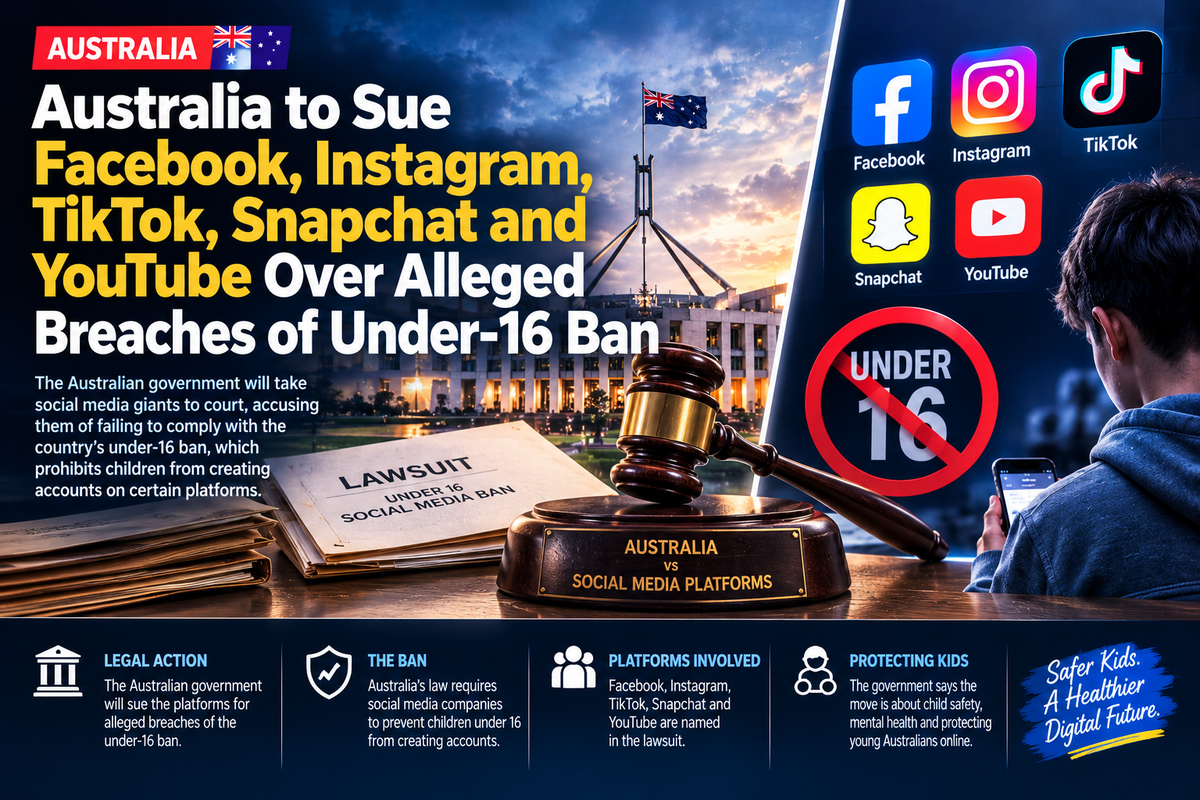
Australia to Sue Facebook, Instagram, TikTok, Snapchat, and YouTube Over Alleged Breaches of Under-16 Ban
Australia is preparing to take the major social platforms to court over a ban it says they have not enforced.
Communications Minister Anika Wells said in an interview that the government expects legal action against Facebook, Instagram, TikTok, Snapchat, and YouTube for alleged non-compliance with the nationwide rule that bars under-16s from holding social media accounts. The eSafety Commissioner has been investigating those five — Facebook and Instagram under Meta, plus TikTok, Snapchat, and Google’s YouTube — since March. The law requires the companies to take reasonable steps to stop underage users from having accounts. A July eSafety report found that most underage users were still able to keep existing accounts or create new ones, largely because the platforms lacked effective age checks. Some relied on self-declaration. Some applied photo-based checks only after a user tried to change an age, not at sign-up. The regulator’s conclusion was that many Australian children under 16 could open accounts by stating they were older.
The ban took effect on December 10, 2025. It was the first national prohibition of its kind. Since then the government has doubled the maximum penalty for breaches to A$109.2 million and given eSafety Commissioner Julie Inman Grant stronger investigative powers, including the ability to demand documents and to summon current or former employees. Wells said the evidence was being built so the commissioner could go to the Federal Court and win. As of the October 19 interview, the suits had not yet been filed in the public record. The minister’s statement is that they are expected to proceed against the five platforms.
What the Law Requires and What the Report Found
The obligation is “reasonable steps,” not a perfect block. A platform can argue that its age-assurance methods meet that standard even if some under-16s get through. eSafety’s July findings undercut that argument for the companies under investigation: most underage users retained or created accounts, and the methods in use were, in the regulator’s view, insufficient. Age inference from online behavior was underused. Age assurance at the point of account creation was inconsistent. The practical result, the report said, was that a child who typed an older birthdate often succeeded.
That finding is the core of any Federal Court case. The government will need to show that the steps taken were not reasonable under the statute, and that the failures were systemic rather than isolated. The platforms will need to show that their tools — self-declaration plus later checks, or whatever mix each uses — meet the legal test, and that residual underage accounts are the unavoidable remainder of any system short of universal identity verification. Australia has not mandated a single national digital ID for this purpose. The gap between “reasonable steps” and zero underage accounts is where the case will be argued.
Penalties and Powers
A$109.2 million is the new ceiling per breach, not an automatic fine. A court would determine the amount if liability is found. Multiple breaches, or ongoing non-compliance after a finding, could multiply exposure. The enhanced powers — document demands and compelled testimony from employees — are how eSafety has spent the months since March assembling the file Wells described. Those powers matter because internal age-check policies and their actual performance are not fully visible from outside.
Meta, TikTok, Snapchat, and Google have not, in the reporting available Monday, issued detailed public responses to the impending suits. Each has previously said it is working to comply with the Australian rule. Compliance claims and the July report’s findings are the two records a judge would weigh.
Where This Sits Internationally
Other governments have watched Australia’s ban as a test. Age-restriction proposals in Europe, the United Kingdom, and U.S. states have cited it. A Federal Court loss for the platforms would strengthen the argument that “reasonable steps” can be enforced with large penalties when self-declaration is the main gate. A win for the platforms would suggest that, without a mandated identity system, the standard is hard to fail. Either result will be read outside Australia. The case is also separate from the constitutional challenge two teenagers filed against the ban itself, arguing it infringes an implied freedom of political communication. That challenge attacks the law. The suits Wells described attack compliance with the law. Both can proceed.
eSafety’s list of age-restricted services is broader than the five under investigation. It includes Reddit, X, Twitch, Threads, and Kick, among others. The March probe and the expected court action focus on the five largest. Action against others has not been announced.
What to Watch
The filing dates in the Federal Court and the precise claims against each platform.
Whether any of the five settles or changes its age-check system before a hearing.
The penalty range the government seeks, against the A$109.2 million maximum.
How the teenage constitutional challenge interacts with the compliance cases.
Whether other jurisdictions cite an Australian judgment in their own age-restriction bills.
Australia is set to sue Facebook, Instagram, TikTok, Snapchat, and YouTube for allegedly failing to keep under-16s off their platforms. The ban has been in force since December 2025. A July report found most underage users could still hold or create accounts. The maximum penalty is A$109.2 million. The suits have been signaled by the communications minister and are not yet, in the public record, filed. The court will decide whether the steps the companies took were reasonable. That is the question the rest of the world is watching Australia answer.
Comments (0)
Please log in to comment
No comments yet. Be the first!