Finance & Business
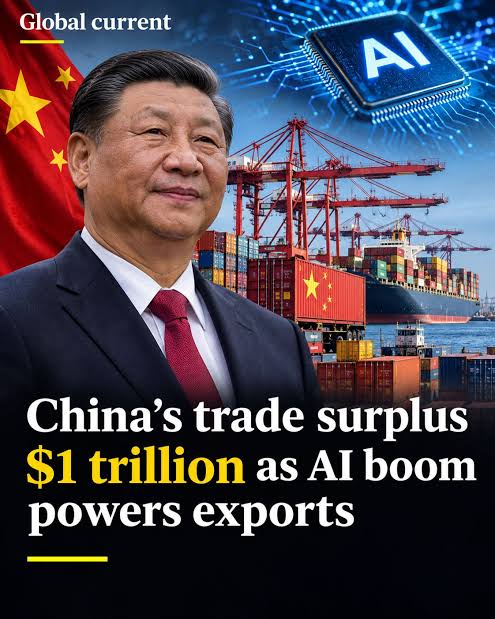
China’s Trade Surplus Tops $1 Trillion as AI Boom Powers Exports
China’s trade surplus surpassed $1 trillion in the first 10 months of 2026, reaching $1.04 trillion as strong overseas demand for high-tech products tied to the global artificial intelligence infrastructure build-out offset weak domestic consumption. Customs data released on November 10 showed the country crossed the milestone for a second consecutive year, and did so a month earlier than in 2025, when the full-year surplus ultimately hit a record $1.2 trillion.Reuters
Exports in October rose 35.2 percent year-on-year in U.S. dollar terms, only slightly slower than September’s 36.3 percent gain and above economists’ forecasts of roughly 33.5 percent. Imports jumped 41.6 percent, the fastest pace since 2021, narrowing the monthly surplus to $105.3 billion—the smallest since May—but not enough to prevent the year-to-date total from climbing past $1 trillion. The cumulative surplus is nearly 9 percent larger than in the same period of 2025.
AI Infrastructure Demand Drives High-Tech Exports
Much of the export strength has come from products linked to the worldwide race to expand AI computing capacity. Semiconductor exports surged more than 111 percent year-on-year in value terms over the first 10 months, while overall high-tech product shipments rose 47.9 percent. Chips, computer parts, data-center servers, and networking equipment have seen particularly sharp gains as data-center investment accelerates globally. In volume terms, broader high-tech categories—including electric vehicles, batteries, solar panels, and industrial robots—have also contributed, according to analysis from Goldman Sachs and other observers.Theprint
China’s role as a major processing and assembly hub for electronics means some of the AI-related trade involves imported components that are re-exported, limiting the net addition to the trade balance relative to the headline export figures. Still, the volume and value increases have provided a clear boost to external demand at a time when domestic consumption and the property sector remain subdued.
Domestic Weakness and External Reliance
The data underscore Beijing’s continued reliance on overseas markets to support growth. Subdued household spending, a prolonged property-market downturn, and excess capacity in several industries have kept internal demand relatively soft, even as import volumes rose more than expected in October—partly on higher crude-oil purchases. Officials have argued that China would import more high-tech goods if foreign restrictions were eased, while emphasizing that the country offers a large market for global suppliers. The surplus figures, however, continue to highlight the imbalance.
Trade Partner Reactions and Geopolitical Context
The expanding surplus is expected to keep tensions elevated with major trading partners. The European Union accounts for a substantial share of the imbalance; China’s surplus with the 27-nation bloc exceeded $310 billion in the first 10 months. EU leaders have already pursued measures on Chinese hybrid vehicles and are discussing further steps to address what they view as economic-security risks and market distortions. Shipments to the United States also rose strongly in October (around 33 percent in some reports), coinciding with an extension of a temporary trade truce between Washington and Beijing. Exports to ASEAN countries and other markets have remained robust as well.
Analysts note that further tariffs or non-tariff barriers remain possible in 2027 if the surplus stays elevated and Chinese manufacturers continue expanding overseas. At the same time, the sustainability of the AI-driven demand is a key variable: a slowdown in global data-center investment or a correction in electronics prices could moderate export growth later in 2027, after base effects from the current boom fade.
What to Watch
Full-year 2026 figures will show whether China exceeds last year’s $1.2 trillion surplus. The trajectory of AI infrastructure spending worldwide will heavily influence export momentum into 2027; most observers currently expect demand for Chinese technology products to remain solid through at least the first part of next year. Any new trade measures from the EU, the United States, or other partners—and Beijing’s response—will shape the external environment. Domestically, progress (or the lack of it) in boosting household consumption and stabilizing the property sector will determine how dependent growth remains on the export channel.
The October data illustrate both the strength of China’s manufacturing position in the current technology cycle and the structural challenges of an economy still heavily oriented toward external demand. As the AI infrastructure wave continues, the interplay between Chinese export competitiveness, partner-country policy responses, and the durability of global technology investment will remain central to the trade outlook.
Comments (0)
Please log in to comment
No comments yet. Be the first!