Technology
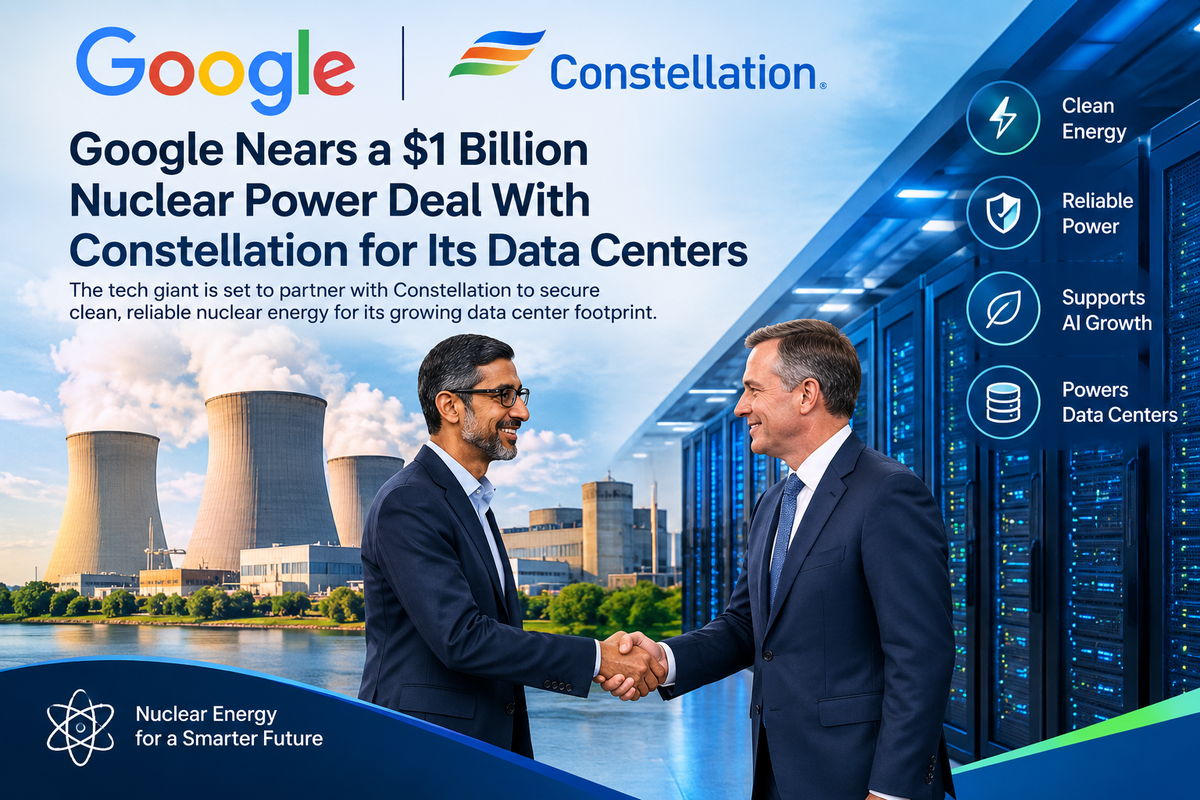
Google Nears a $1 Billion Nuclear Power Deal With Constellation for Its Data Centers
Google is about to put another nuclear contract on the board.
Alphabet is nearing a multi-year deal to buy nuclear energy from Constellation Energy for $1 billion or more, Bloomberg reported, citing people familiar with the discussions. An announcement could come as soon as this week. Reuters said Constellation declined to comment and Google could not be reached outside business hours. The plants and the megawatts are not in the report. Until a filing or a press release names them, this is a price and a counterparty, not a site plan.
Constellation is the largest nuclear operator in the United States. It already sells power to Amazon and Microsoft. A Google contract would put the three biggest cloud buyers on the same fleet. That is the story. The $1 billion is the size of the check over the life of the agreement, not a single-year bill and not a construction budget.
What Google Already Signed
This would not be Alphabet’s first nuclear contract. It is the latest in a year of them.
In Iowa, Google is the buyer behind NextEra’s plan to restart the Duane Arnold plant, shut since 2020. The U.S. Department of Energy closed a $1.9 billion loan for that restart in September. Target for power is the first quarter of 2029. Google’s share sits against a 615-megawatt plant, with a local cooperative taking the rest, under a 25-year power purchase agreement signed in October 2025.
In September, Georgia Power, a Southern Company unit, said it had signed with Google to support upgrades at Vogtle and Hatch that could add about 96 megawatts. The work is turbines, pumps, motors, and cooling systems on existing reactors. Google’s subscription is projected to produce about $900 million in customer benefits over the life of the units. The Georgia Public Service Commission still has to approve it. Non-participating customers are supposed to be shielded from the upgrade cost.
In Finland, a September agreement with Fortum covers up to half the output of Loviisa from 2030 to 2049, with deliveries aimed at 2028. In Tennessee, Google’s path runs through the Tennessee Valley Authority to a 50-megawatt Kairos Power fluoride-salt reactor at Oak Ridge, a binding deal aimed at a first-of-a-kind machine rather than an operating plant.
A Constellation contract sits in the operating-fleet column, next to Duane Arnold and the Georgia uprates, not next to Kairos. Existing reactors are the only nuclear megawatts a data center can actually schedule this decade.
Why the Check Is This Large
AI data centers want power that does not stop when the wind drops or the sun sets, and that does not show up as a carbon line on the sustainability report. A gas plant can do the first. A nuclear plant can do both. The queue for a new reactor is measured in years and in regulatory hearings. The queue for a slice of an operating plant is a contract.
That is why the deals look alike. Microsoft is paying to bring Three Mile Island Unit 1 back; Constellation’s plan has pointed at 2027 for that Pennsylvania restart. Meta has 20-year arrangements tied to Constellation’s Clinton plant and to Vistra units in Ohio and Pennsylvania. Amazon has bought from Susquehanna, Comanche Peak, and Calvert Cliffs, including 690 megawatts in one package that takes in an uprate at the Maryland plant. One industry tally puts Amazon, Google, Meta, and Microsoft at roughly 8.5 gigawatts of output from operating, restarting, and uprated U.S. reactors. Conditional small-reactor agreements are a separate, larger, and less certain pile.
A billion dollars over several years is meaningful and, against a single large data-center campus, not extravagant. A one-gigawatt campus can draw on the order of a billion dollars a year in electricity depending on price and load factor. The Constellation figure is a multi-year offtake, not the power bill for Google’s whole fleet. Without megawatts, no one outside the talks can say what share of a campus it covers.
What Can Still Slip
People familiar with the talks are not a signed page. Constellation has declined to comment. Price, term, delivery point, and whether the power is a specific unit or a system sale can all move before an announcement. State regulators do not have to bless every corporate nuclear contract, but they do when the deal funds an uprate that other customers might be asked to carry. Georgia is the template. If the Constellation deal is a plain offtake from an operating unit, the path is shorter. If it pays for a life extension or a power uprate, it is longer.
Grid interconnection is the other gate. A contract for clean megawatts does not move electrons to a new campus in northern Virginia or Texas by itself. Transmission, behind-the-meter arrangements, and local opposition to data centers are the constraints that have already slowed several of these pairings.
What to Watch
Whether the announcement lands this week, and at what headline number above or below $1 billion.
Which Constellation units are named.
Megawatts and term, set against the 96 megawatts in Georgia and the Duane Arnold restart.
Any uprate or life-extension spending folded into the price.
How Amazon and Microsoft respond with their own Constellation extensions.
Google is not building a reactor this week. It is trying to buy a piece of one that already runs, from the company that runs the most of them, for a data-center load that the grid was not planned around. The $1 billion is the reported price of getting in line.
Comments (0)
Please log in to comment
No comments yet. Be the first!