Technology
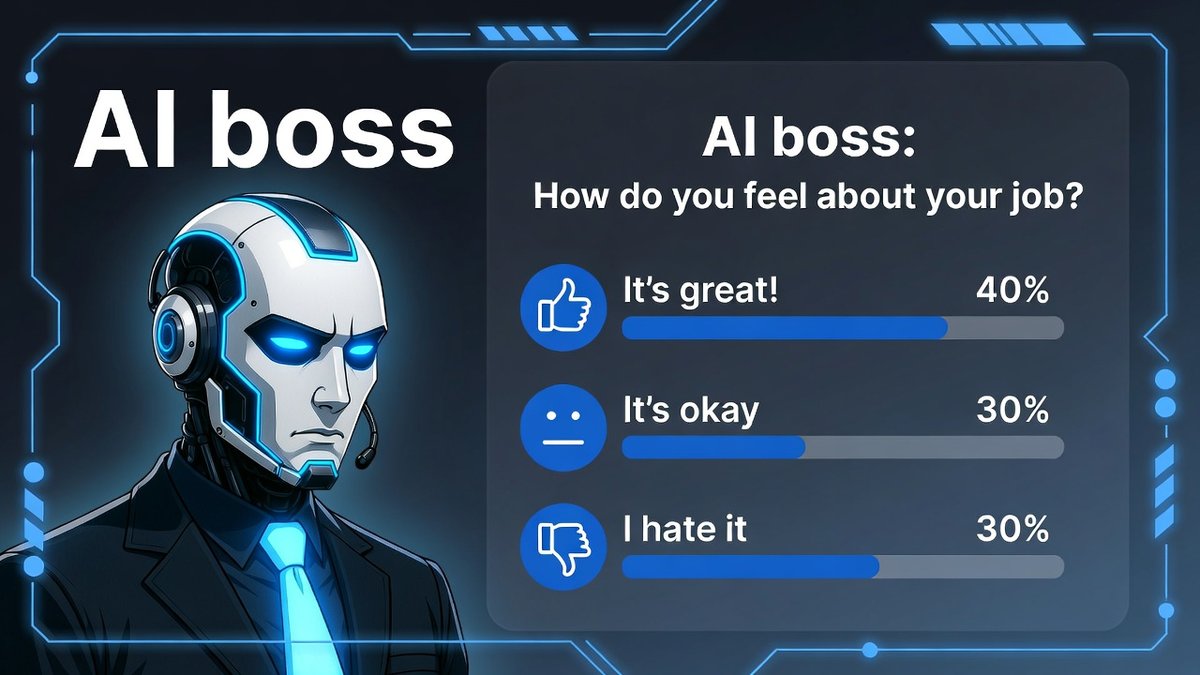
15% Say Yes to an AI Boss — But What Does the Other 85% Tell Us?
A new national poll has put a number on one of the most debated questions in the modern workplace — and the answer is stark. Just 15% of Americans say they would be willing to work in a job where their direct supervisor was an AI program that assigned tasks and set schedules. A resounding 80% say they would not.
That is the headline finding from a major new survey conducted by Quinnipiac University — released today, March 30, 2026 — which polled 1,397 adults across the United States between March 19 and 23. The results paint one of the most detailed portraits yet of how ordinary Americans feel about AI: using it, trusting it, working alongside it, and — emphatically — not working for it.
At digital8hub.com, we've been tracking public sentiment around AI throughout 2026. This poll is essential reading for anyone trying to understand where the technology is actually headed — not in Silicon Valley's imagination, but in the lived reality of American workers.
The AI Boss Question: Why 80% Said No
The Quinnipiac poll's most arresting finding — that four in five Americans would refuse an AI supervisor — arrives at a moment when AI is already quietly performing management functions across major corporations.
Companies like Workday have launched AI agents that can file and approve expense reports on behalf of employees. Amazon has deployed new AI workflows to replace some of the responsibilities of middle management, laying off thousands of managers in the process. The AI boss is not a hypothetical. In many workplaces, it is already partially here. The majority of American workers, it turns out, are not ready for it — and their reluctance goes far deeper than mere discomfort with novelty.
The resistance reflects something fundamental about how humans relate to authority, accountability, and judgment. Management is not just task assignment and schedule setting. It is the exercise of discretion — the ability to understand context, extend empathy, recognise exceptional circumstances, and make calls that cannot be reduced to an algorithm. The 80% who said no are, on some level, making a philosophical argument: that the relationship between a worker and a supervisor is irreducibly human, and that replacing it with software — however sophisticated — strips the workplace of something essential.
The Job Fear Is Real — And Growing
Behind the AI boss question lies a much broader and more pervasive anxiety. The majority of respondents — 70% — said they believe advances in AI will lead to a decrease in the number of job opportunities for people. Among employed Americans, 30% were either very concerned or somewhat concerned that AI would make their job specifically obsolete. GBHackers
That 30% figure for individual job concern represents a significant increase from 21% last year — a nine percentage point jump in twelve months. The direction of travel is unmistakable. As AI becomes more capable, more visible, and more deeply embedded in the tools people use every day, the abstract fear of automation is becoming a personal one.
Entry-level job postings in the US have sunk 35% since 2023, and AI leaders like Anthropic CEO Dario Amodei have warned that the tech will wipe out jobs. Total Apex Entertainment For young workers entering a contracting market, the anxiety is not theoretical — it is the lived experience of sending applications into a void.
The Generational Paradox: Fluency Without Optimism
One of the most striking findings in the Quinnipiac data is a generational paradox that runs counter to conventional assumptions about young people and technology.
"Younger Americans report the highest familiarity with AI tools, but they are also the least optimistic about the labour market," said Tamilla Triantoro, a professor of business analytics and information systems at Quinnipiac. "AI fluency and optimism here are moving in opposite directions." Total Apex Entertainment
Gen Z — the generation that grew up with smartphones, social media, and now AI — is simultaneously the most likely to use AI tools daily and the most worried about what those tools will do to their futures. Among Gen Z respondents, 81% expect AI advancements to lead to fewer job opportunities. GBHackers The young people who know AI best are the ones most convinced it will hurt them.
This is not the story the AI industry likes to tell. The standard narrative positions AI as a productivity amplifier — a tool that frees workers from drudgery and creates new opportunities at higher levels of value creation. The Quinnipiac data suggests that younger Americans, who are closest to the technology, are not buying it.
Trust Is Collapsing — Even as Usage Grows
Perhaps the most damaging finding for the AI industry is the combination of rising usage and collapsing trust. Fifty-one percent of Americans said they use AI to research topics, up from 37% last year. Twenty-seven percent said they have never used AI, down from 33%. Despite increased use, 76% said they trust AI-generated information only some of the time or hardly ever, while just 21% said they trust it most or almost all of the time. GBHackers
More Americans are using AI. Fewer of them trust what it produces. That is a remarkable combination — and it reflects a sophisticated, experience-based scepticism rather than simple technophobia. People are using these tools enough to understand their limitations. They have encountered hallucinations, confident errors, and AI-generated content that sounds authoritative and turns out to be wrong. And they have updated their trust levels accordingly.
Two-thirds of respondents said businesses aren't doing enough to be transparent about their AI use. That same percentage also says the government isn't doing enough to regulate AI. Total Apex Entertainment The demand for accountability — from companies and from government — has never been louder.
The Harm vs. Good Divide
Fifty-five percent of Americans say AI will do more harm than good in their day-to-day lives — an 11% increase since last April. CBR Only a third say it will do more good than harm. Nearly two-thirds — 64% — said AI will do more harm than good in education specifically. Opinions on healthcare were more divided, with 45% saying AI will do more harm than good and 43% saying it will do more good than harm. GBHackers
The healthcare finding is particularly instructive. It is the one domain where Americans are genuinely torn — reflecting a real tension between the promise of AI-assisted diagnosis, drug discovery, and personalised medicine on one hand, and fears about dehumanised care, liability, and algorithmic error on the other.
Only a paltry 6% were "very excited" about AI, while 62% were either not so excited or not at all excited. Those numbers are basically flipped when we talk about concern: 80% are either very concerned or somewhat concerned about AI. Total Apex Entertainment
80% concerned. 6% very excited. The gap between the AI industry's enthusiasm and the public's apprehension has never been wider.
What This Means for the Companies Building AI
"Americans are not rejecting AI outright, but they are sending a warning," said Professor Triantoro. "People seem more willing to predict a tougher market than to picture themselves on the losing end of that disruption — a pattern worth watching as the technology moves deeper into the workplace." Total Apex Entertainment
That warning deserves to be heard — not dismissed as technophobia or resistance to change. The people most worried about AI are not the least informed. In many cases, they are the most informed. They are the workers who have already watched AI reshape their industries, the young people who have graduated into a market where entry-level roles are disappearing, and the everyday users who have learned through experience that AI is a powerful but deeply imperfect tool.
The 15% who say yes to an AI boss are not wrong. The 80% who say no are not Luddites. They are people making a reasonable assessment of what they are being asked to accept — and communicating, with remarkable clarity, that the terms of the deal are not yet good enough.
The AI industry would do well to listen.
Stay across every development in technology, AI, and the stories that shape our working lives exclusively at digital8hub.com — your trusted source for the insights that matter.
Comments (0)
Please log in to comment
No comments yet. Be the first!