World & Politics
IRGC Issues Evacuation Warning Across Dubai & Doha as Iran Threatens to Set All US-Linked Industry on Fire Within Hours
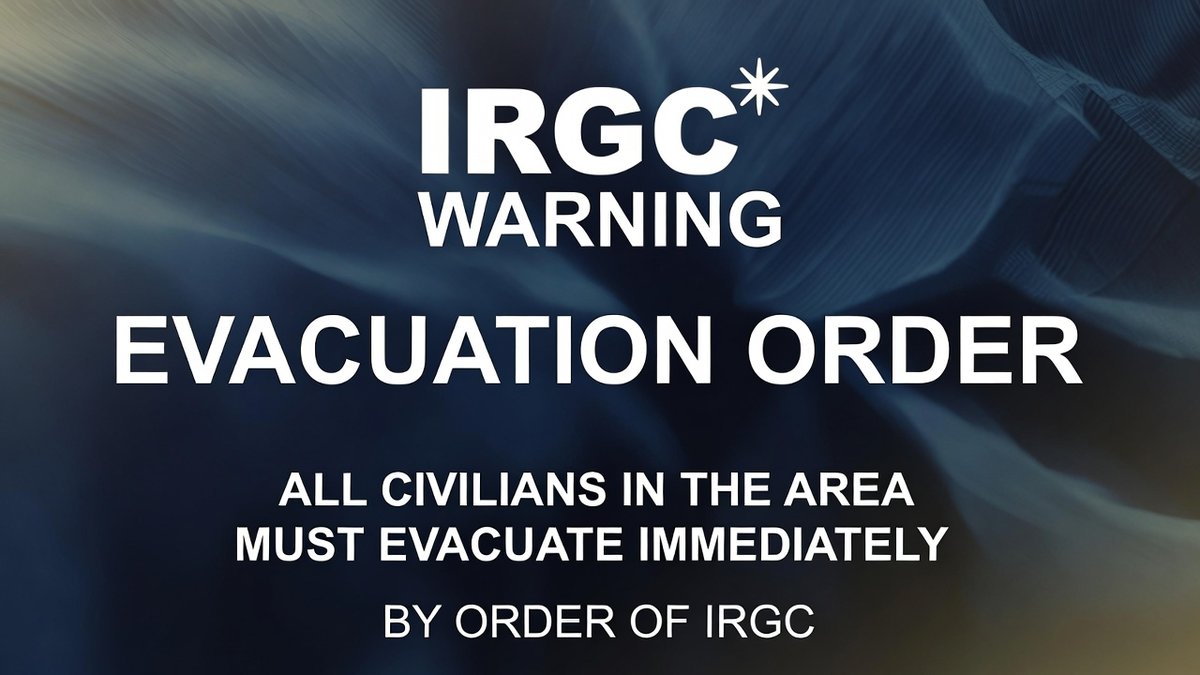
The warning that Gulf residents have been dreading since Operation Epic Fury began sixteen days ago arrived on Monday March 16 in the most direct form imaginable. Iran's media operations centre — broadcasting via state television and the IRGC's official channels — warned residents in specific areas of Dubai and Doha that US military personnel are present in those locations and that the surrounding areas could be targeted in the coming hours. "Evacuate immediately," the statement said. The IRGC's broader industrial warning, carried by Iran's semi-official Fars News Agency, was equally unambiguous: industries connected to the United States across the region could become targets within hours, and civilians and workers located near such sites were urged to leave the surrounding areas to avoid harm. Iran's armed forces issued the most sweeping threat of the entire conflict simultaneously: "If this happens, all oil and gas infrastructure in the region in which the US and its allies have interests will be set on fire and destroyed." The context for that statement was the US bombing of Kharg Island — Iran's critical oil export hub — which as digital8hub.com reported on Saturday targeted more than 90 military installations on the island. Iran claimed no damage to oil infrastructure. The US said it had deliberately preserved the oil infrastructure while destroying military targets. Iran said the distinction was irrelevant. The threat stands regardless.
Jebel Ali, Khalifa Port & Fujairah: The Gulf's Most Critical Ports Named
The three ports specifically named in Iran's evacuation and targeting warnings represent the backbone of Gulf maritime trade — and their simultaneous naming constitutes the most serious direct threat to civilian and commercial infrastructure in the Middle East since the conflict began. Jebel Ali — located in Dubai — is the largest port in the Middle East and the ninth-largest container port in the world. It handles approximately 14 million twenty-foot equivalent units of cargo per year and is the primary gateway for goods entering and leaving the UAE, serving as a logistics hub for the entire broader Gulf region. Khalifa Port in Abu Dhabi is the UAE's most modern container terminal — designed to handle the world's largest container ships and operating as the emirate's primary gateway for both imports and exports. Fujairah, as digital8hub.com reported earlier today, was struck again this morning in a drone attack that set the Oil Industries Zone ablaze and suspended oil loading operations for the second time in three days. The naming of all three ports simultaneously — on top of specific residential areas in Dubai and Doha where Iran claims US military personnel are sheltering — signals Iran's intention to escalate from targeted energy infrastructure strikes to a comprehensive disruption of Gulf commercial maritime activity. Hours after the warning, no attack on Jebel Ali or Khalifa had materialised. But as digital8hub.com has reported, Iran has consistently used pre-strike evacuation warnings as a psychological warfare tool — sometimes following through with strikes, sometimes using the warnings themselves as instruments of economic disruption and civilian panic.
The NATO Incident: Iranian Missile Enters Turkish Airspace, Lands in Hatay Province
The single most geopolitically significant development of Day 16 — beyond the IRGC's industrial targeting warning — is a NATO incident that has the potential to fundamentally alter the conflict's trajectory. A ballistic missile launched from Iranian territory was intercepted by NATO integrated air defence systems as it entered Turkish airspace — with the remnants landing in Dörtyol, Hatay Province, in southern Turkey, a NATO member state. Turkey immediately asserted its right to self-defence. NATO Secretary General Mark Rutte confirmed the alliance was committed to defending Turkey. Iran officially denied intentionally targeting Turkey, describing the event as a "technical anomaly." The potential invocation of NATO's Article 4 — which allows any member to call for consultations when its security is threatened — became the focal point of urgent diplomatic discussions between Turkish Foreign Minister Hakan Fidan and allied leadership. The incident represents the first time in the conflict that a NATO member state has been directly struck by Iranian ordnance — a threshold crossing whose legal, political, and military implications are being processed in real time across the alliance's 32 member capitals. Switzerland separately confirmed it had refused two US requests to fly over its territory in operations linked to the current Middle East war — citing its neutrality under international law — underlining the growing international discomfort with the conflict's geographic and institutional expansion.
Lebanon: 800 Dead, 850,000 Displaced, Israel Expands Ground Operation
The human cost of the conflict's Lebanese dimension reached a new threshold on Day 16. Over 800 people have now been killed and 850,000 displaced in Lebanon as Israel launched fresh waves of strikes against Iran-backed Hezbollah militants — with Israeli Defence Minister Israel Katz confirming an expanded ground operation in southern Lebanon and stating that "hundreds of thousands" of evacuated residents would not return to areas south of the Litani River until northern Israel's security could be assured. A drone strike killed a French soldier in Iraq's autonomous Kurdistan region — France's armed forces ministry confirmed — marking France's first military death in the Middle East war. The US Embassy in Iraq renewed its Level 4 security alert and urged all American citizens to leave the country immediately: "Iran-aligned terrorist militias have encouraged and conducted indiscriminate attacks on US citizens and targets associated with the United States throughout Iraq — and may continue to target them." As digital8hub.com has reported, Mojtaba Khamenei — the wounded successor to the killed Supreme Leader — was described by US Secretary of Defence Pete Hegseth as "likely disfigured" and unable to effectively lead, casting serious doubt on Iran's internal command coherence as the conflict enters what Trump's four-week timetable suggests should be its final days. The IRGC is issuing evacuation warnings across two of the world's wealthiest cities. Iran's armed forces are threatening to set every US-linked energy facility in the region on fire. A NATO ally has been struck by an Iranian missile. And the war is sixteen days old. For the latest coverage of Operation Epic Fury Day 16 and all developments across the conflict, follow digital8hub.com.
Comments (0)
Please log in to comment
No comments yet. Be the first!