World & Politics
Iran Targets Shin Bet & Israeli Air Bases as Day 13 Pushes the War Into Lebanon, Kuwait & $100 Oil
Operation Epic Fury entered its thirteenth day on Thursday March 12 with Iran making the most politically targeted strikes of the entire conflict — announcing it had directed drones at three of Israel's most symbolically significant intelligence and military installations simultaneously. "The Palmachim and Ovda air bases of the Zionist regime as well as the headquarters of Shin Bet were targeted by drones from the Islamic Republic of Iran's army," the Iranian military said in a statement carried by state television. The choice of targets is deliberate and calculated. Shin Bet — Israel's internal security service, responsible for counterterrorism operations, border security, and the protection of senior Israeli officials — is not a military target in the conventional sense. Targeting it is a statement of intent. Palmachim Air Base, south of Tel Aviv on the Mediterranean coast, is one of Israel's most sensitive air installations — home to fighter squadrons, satellite launch infrastructure, and classified programmes. Ovda is Israel's largest air base by area, located in the Negev desert and used as a major fighter jet training and operational facility. Whether the drones penetrated Israeli air defences and caused damage was not immediately confirmed by the IDF.
Beirut Seafront Strike: 7 Dead in the Heart of Lebanon's Capital
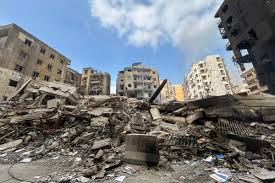
While Iran directed its drone campaign at Israeli air bases, Israel expanded its own offensive northward — striking central Beirut's seafront in an operation that killed at least seven people in the heart of Lebanon's capital. The strike came as Iran-backed Hezbollah escalated its rocket and drone campaign against northern Israel — with sirens sounding in areas from the southernmost tip of the country through the Galilee and the northern border with Lebanon. The IDF responded with overwhelming speed and force: within 30 minutes of the Hezbollah launches, Israel struck 10 Hezbollah command and control headquarters in the Dahieh area of Beirut's southern suburbs — hitting intelligence HQs, a Radwan unit command centre, and additional operational command posts. "During the strikes, the IDF eliminated dozens of Hezbollah terrorists while they were preparing launches," the IDF said. As digital8hub.com has reported, the Lebanon front has been building throughout Operation Epic Fury — with Hezbollah opening fire on Israel in the conflict's opening days and Israel conducting periodic strikes on Hezbollah infrastructure since. Day 13 represents the most concentrated Israeli action against Hezbollah since the conflict began — and the Beirut seafront strike, carried out in the heart of a civilian neighbourhood rather than the southern suburbs that have historically borne the brunt of Israeli targeting, signals a geographic and psychological escalation.
Kuwait Airport Again, Dubai Al Bada'a, Oil Back Above $100
The Gulf-wide campaign continued without pause on Day 13. Drone strikes caused damage at Kuwait International Airport for the second consecutive day — with Kuwait's Defence Ministry confirming an Iranian drone struck a residential building, injuring two people. Dubai authorities reported a drone incident in the Al Bada'a neighbourhood — a residential area in the city's urban core — with an AFP correspondent on the ground reporting explosions and small clouds of smoke before the situation was contained. "Dubai authorities are responding to a minor drone incident in the Al Bada'a area. No injuries have been reported," the Dubai government media office confirmed. The cumulative effect of Day 13's strikes — Israel, Lebanon, Kuwait, Dubai, Bahrain, and the ongoing targeting of commercial shipping — pushed Brent crude back above $100 per barrel, erasing most of the price relief that the IEA's record 400 million barrel reserve release had provided just 24 hours earlier. As digital8hub.com reported on Wednesday, the IEA's Fatih Birol said global energy markets are at a "critical turning point" — a characterisation that Day 13's events appear to have validated. Analysts who had cautioned that the reserve release addressed volume but not routing were proven correct within a single trading session.
The Iran-China Oil Pipeline: 18.5 Million Barrels & Counting
As digital8hub.com reported on Wednesday, Iran has been running its own shadow oil export operation throughout the conflict — shipping crude to China through the very Strait of Hormuz it has nominally closed to the rest of the world. The figure has now been updated by commodities intelligence firm Kpler: Iran has loaded an estimated 18.5 million barrels of oil for shipment since Operation Epic Fury began on February 28 — up from the 11.7 million barrels confirmed by TankerTrackers earlier this week. The discrepancy between the two figures reflects the methodological difficulty of tracking dark voyages in a conflict zone — with vessels operating without AIS transponders and loading at the Jask terminal as well as Kharg Island. Every barrel loaded is revenue for a regime that is simultaneously funding a 13-day war, absorbing the economic consequences of the most comprehensive sanctions enforcement in modern history, and maintaining a missile and drone production programme that has consumed tens of thousands of munitions in less than two weeks.
The Strategic Picture: No Endgame, Escalating Costs, Hezbollah Rising
The question that Dafydd Townley — Teaching Fellow in International Security at the University of Portsmouth — identified as the war's most striking feature remains unanswered on Day 13: there is a gap between clear military action and ambiguous political strategy. Iran has lost both its Supreme Leader and his designated successor. Its missile and drone capabilities have been severely degraded. Its naval forces have been devastated. Its oil industry is on fire. Yet it is still launching coordinated, multi-front strikes across thirteen countries, targeting intelligence headquarters, air bases, airport fuel tanks, residential neighbourhoods, and commercial shipping simultaneously. Dr. Rouzbeh Parsi of Lund University offered the most coherent explanation for why: Iran's decision-making power does not lie with whoever nominally holds the Supreme Leader title. It lies with the Revolutionary Guards and the broader security establishment — who have their own institutional interests, their own command structures, and their own definition of what constitutes an acceptable outcome. For the latest coverage of Operation Epic Fury Day 13 and all developments across the conflict, follow digital8hub.com.
Comments (0)
Please log in to comment
No comments yet. Be the first!