World & Politics
Iran Just Fired at Diego Garcia
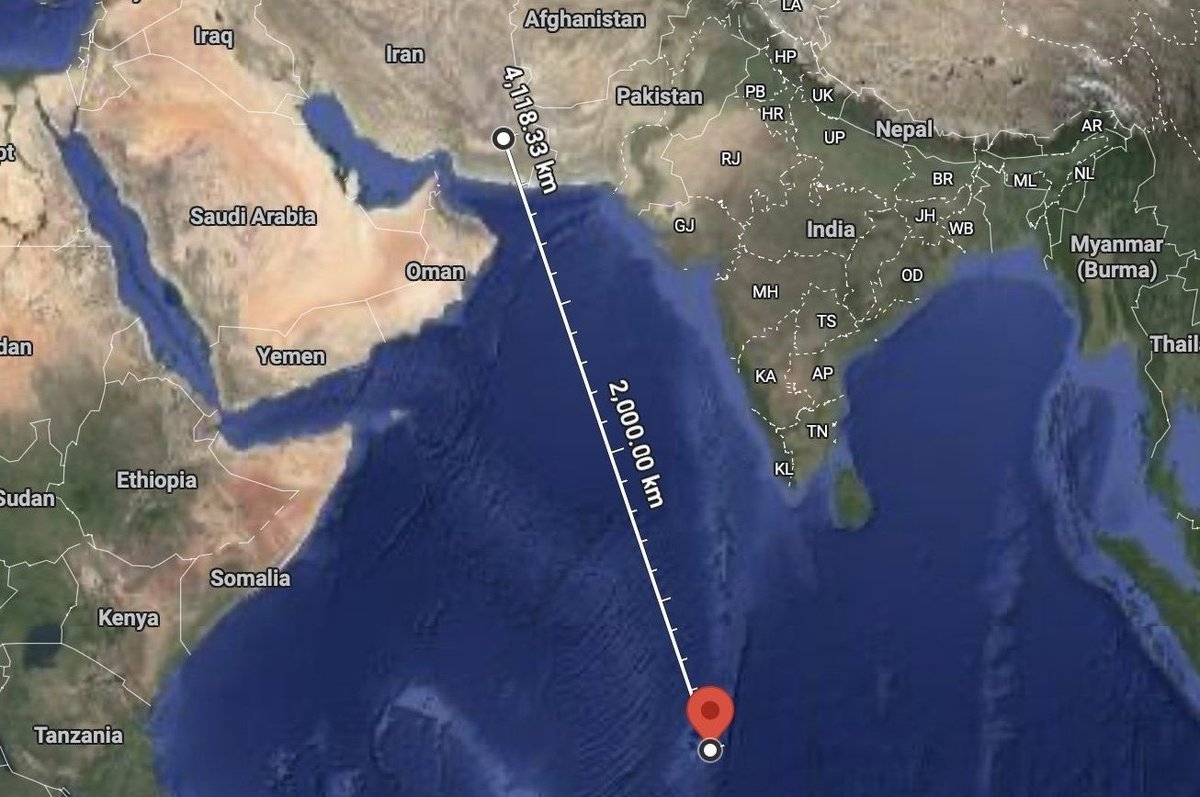
No country in the history of warfare has ever attempted to strike Diego Garcia. The remote coral atoll in the middle of the Indian Ocean — 4,000 kilometres from Iran, 7,000 kilometres from London, equidistant from the wars of the Middle East and the peace of the Southern Hemisphere — has existed as a kind of sacred untouchable in the geography of American military power: the base from which B-2 Spirit stealth bombers have launched against Iraq, Afghanistan, and Libya; the dock where nuclear submarines and guided-missile destroyers resupply in absolute security; the platform from which the United States projects power across three continents simultaneously. No enemy of the United States has ever targeted it. On Saturday March 21, 2026 — Day 21 of Operation Epic Fury — Iran did. The Islamic Revolutionary Guard Corps fired two intermediate-range ballistic missiles at the joint US-UK military base on Diego Garcia, according to multiple US officials cited by the Wall Street Journal. Neither missile hit the base. One failed mid-flight. A US warship in the Indian Ocean fired an SM-3 interceptor at the other — the outcome of that intercept not yet fully confirmed. The base is safe. The precedent is shattered.
What Diego Garcia Is & Why It Has Never Been Touched
Diego Garcia is the centrepiece of the British Indian Ocean Territory — a group of islands that Britain leased to the United States in 1966 and that has housed a joint US-UK military installation ever since. The base hosts some of the most sensitive and strategically consequential assets in the American military inventory. B-2 Spirit stealth bombers — the same aircraft that have been conducting strikes against Iran throughout Operation Epic Fury — operate from Diego Garcia's runway, the only facility in the Indian Ocean capable of supporting them. Nuclear-armed submarines dock and resupply at Diego Garcia's harbour, maintaining a continuous undersea deterrent posture across the Indian Ocean. Guided-missile destroyers — including the Arleigh Burke-class ships that have been intercepting Iranian missiles throughout the conflict — are stationed and rotated through the base. It is, in the military's own assessment, one of the two or three most strategically important US installations on Earth — and its remoteness has always been considered its greatest protection. 4,000 kilometres from Iran. 1,500 kilometres from the nearest landmass. No enemy has come close. Until today.
The Missile Revelation: 4,000km — Double What Iran Claimed
The strategic significance of Saturday's Diego Garcia strike attempt extends beyond the fact of the attack itself into what the attack reveals about Iran's actual military capabilities. Iranian Foreign Minister Abbas Araghchi stated publicly last month that Iran had deliberately limited the range of its ballistic missiles to 2,000 kilometres — a self-imposed constraint, he said, that reflected Iran's defensive rather than offensive military posture. Diego Garcia is 4,000 kilometres from Iranian territory. The two missiles fired at it — intermediate-range ballistic missiles, the first confirmed operational use of IRBMs by Iran in the conflict — travelled twice the range that Iran's own foreign minister claimed its missiles could achieve. As digital8hub.com has reported, Iran's semi-official Mehr News Agency confirmed the attack and described it as "a significant step that shows the range of Iran's missiles is beyond what the enemy previously imagined." That is a precise description of what Saturday's launch demonstrated — and its implications ripple far beyond Diego Garcia. If Iran's IRBMs can reach 4,000 kilometres, they can reach European military bases. They can reach American installations in Djibouti, in the Gulf, and across the broader Indian Ocean theatre. The geographic theatre of this conflict has just expanded by a factor of two.
The Broader Day 21 Picture: Cluster Bombs Over Israel, Putin Calls Tehran & Trump Hints at Wind-Down
The Diego Garcia launch was not the only extraordinary development of Saturday March 21. Iran fired a ballistic missile carrying a cluster bomb warhead at central Israel — striking at Rishon Lezion, with bomblets damaging an empty daycare, three separate residential sites, and creating craters visible in drone footage shared by Israeli rescue services. The IDF announced it was striking regime targets in Tehran in response. Saudi Arabia intercepted at least 20 Iranian drones in its eastern region. Russia's President Vladimir Putin called Tehran — his office confirming that "Russia stands by Iran" — the most explicit statement of Russian solidarity with Iran since Operation Epic Fury began. Against this backdrop, two pieces of news provided the conflict's most dissonant counterpoint. President Trump posted on social media Friday night that the United States was considering "winding down" military operations and suggested the conflict could conclude in "four to six weeks." Hours later, Iran fired at Diego Garcia. As digital8hub.com reported across our continuous Day 1-21 coverage, the war's cost has now exceeded $25.5 billion in direct US military expenditure. More than 2,000 people have been killed since February 28. More than 200 US troops have been wounded, 140 of them with Traumatic Brain Injuries. And on Day 21, Iran revealed it has missiles that can reach any American base in the Eastern Hemisphere. For the latest coverage of Operation Epic Fury Day 21 and all developments across the conflict, follow digital8hub.com.
Comments (0)
Please log in to comment
No comments yet. Be the first!