World & Politics
Iran Hits Fujairah Again — The UAE's Only Hormuz Bypass Is Now a War Target & Oil Just Hit $106
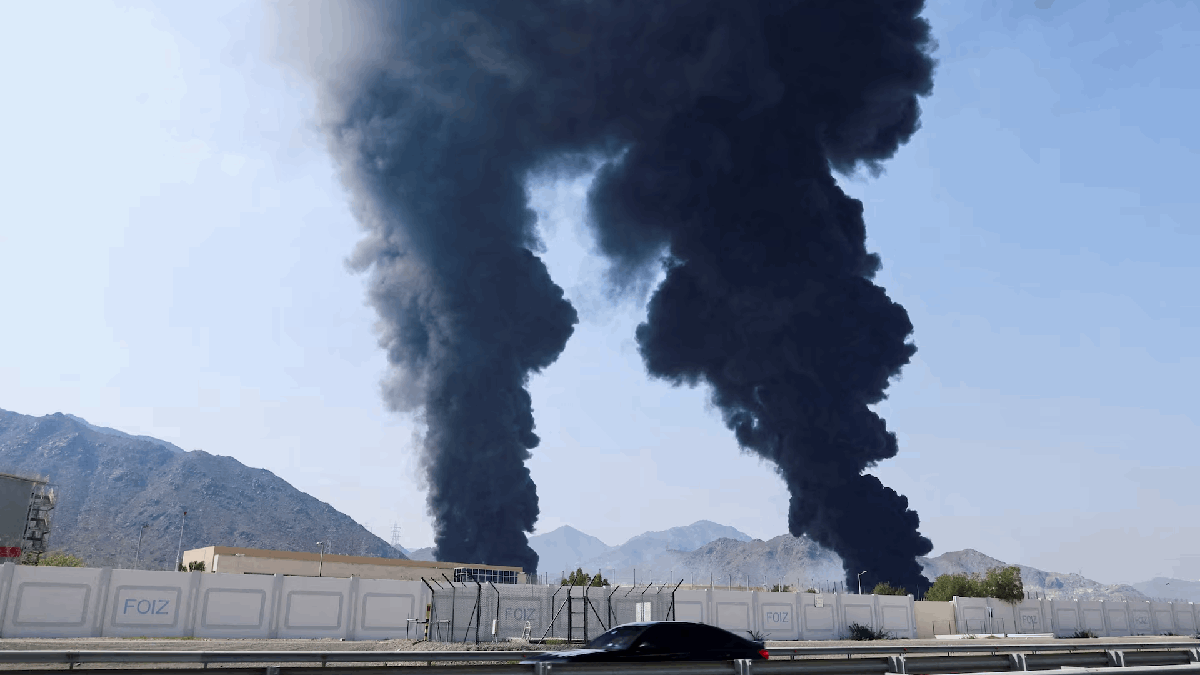
Iran has struck Fujairah twice in three days — and the strategic implication is impossible to overstate. On Monday March 16, the Fujairah Media Office confirmed that a major fire had broken out at the Fujairah Oil Industries Zone following a drone strike. Civil defence teams responded immediately and were working to bring the blaze under control. No injuries were reported. Oil loading operations at the port — one of the world's largest bunkering hubs and the terminal point of the UAE's Abu Dhabi Crude Oil Pipeline — were suspended for the second time in 72 hours. The previous strike on Saturday March 14 had already forced a suspension that lasted until Sunday, when operations briefly resumed before Monday's fresh attack ended them again. The significance of Fujairah as a target is precisely its significance as a solution. As digital8hub.com reported in its comprehensive Strait of Hormuz explainer, the 248-mile Abu Dhabi Crude Oil Pipeline that terminates at Fujairah — on the UAE's eastern coastline, facing the Gulf of Oman rather than the Persian Gulf — is the UAE's only meaningful bypass around the Strait of Hormuz. It moves approximately 1.5 million barrels per day. It represents, in the current crisis, the difference between the UAE being able to export oil at all and the UAE being completely landlocked by the conflict. Iran is hitting it deliberately. The message is clear: there is no safe harbour.
The UAE's Day 16: Dubai Airport, Abu Dhabi Missile & 1,800 Attacks
The Fujairah fire was not the only incident across the UAE on Monday. Dubai International Airport — the world's busiest international airport, which as digital8hub.com reported was struck by an Iranian drone on Saturday — confirmed it had resumed only a limited flight schedule after a drone attack hit a fuel tank in the airport's vicinity, causing a fire that civil defence teams successfully contained. Some flights were diverted to Al Maktoum International Airport as a precautionary measure. In Abu Dhabi, the emirate's media office reported a missile strike on a civilian vehicle in the Al Bahyan area — killing one person of Palestinian nationality. It was the kind of casualty that does not make major international headlines but that accumulates, day by day, into a human toll that the UAE government's official count has now placed at six deaths since the war began on February 28 — four civilians and two military personnel. Against that human backdrop, the scale of what Iran has directed at the UAE is staggering. Iran has fired more than 1,800 missiles and drones at the UAE since February 28 — more than at any other country in the conflict. UAE air defences have intercepted the vast majority. But the mathematical reality of 1,800 inbound projectiles directed at a country of 9 million people, including the world's busiest international airport, the global financial hub of the DIFC, and the only Hormuz bypass pipeline in the region, defines what is at stake in every hour that the war continues.
Kharg Island, Ruwais & the Systematic Destruction of Gulf Energy
Monday's Fujairah strikes arrived in the context of a systematic campaign against Gulf energy infrastructure that has been intensifying throughout Day 16. On Friday March 13, as digital8hub.com reported, President Trump confirmed he had directed US Central Command to carry out bombing raids hitting military targets on Iran's Kharg Island for the first time — the terminal that handles approximately 90% of Iran's crude exports and has a loading capacity of roughly 7 million barrels per day. The IRGC responded within hours by declaring that US interests in the UAE — including ports, docks, and military locations — were legitimate targets, and directing strikes at Fujairah within hours of that declaration. ADNOC — the Abu Dhabi state oil company — separately shut its Ruwais refinery after a fire at a facility within the complex following a drone strike, further disrupting the UAE's domestic energy processing capacity. The pattern is now clearly established and mutually reinforcing: every US or Israeli strike on Iranian energy infrastructure generates an Iranian counter-strike against Gulf energy infrastructure, in a cycle of escalation that is systematically destroying the oil production and export capacity of the world's most important energy-producing region.
Oil at $106: Brent Hits Highest Since 2022 as Fujairah Burns
The oil market's response to Monday's developments was immediate and brutal. International benchmark Brent crude futures traded at $106.18 per barrel — up 3% on the day — while US West Texas Intermediate advanced 2% to $100.66. Both contracts have now surged more than 50% over the past month, reaching their highest levels since 2022. The IEA's record 400 million barrel strategic reserve release — which as digital8hub.com reported on March 11 provided a brief moment of price relief — has been completely absorbed by the market. Iran's warning that Jebel Ali port in Dubai, Khalifa port in Abu Dhabi, and Fujairah itself may all be targeted in the coming hours has added a fresh premium to every barrel being priced in London and New York today. "The IRGC is sending a message that there is no safe harbour in this rapidly expanding conflict," one senior energy analyst said. "The fact this comes hours after the US strike on Kharg Island also signals that Tehran will not let Washington control the terms of escalation and impose dominance." Oil loading at Fujairah has been suspended. Dubai Airport is operating a limited schedule. Abu Dhabi's Ruwais refinery is shut. The world's most important Hormuz bypass is on fire. And the war is in its sixteenth day. For the latest coverage of Operation Epic Fury Day 16, the UAE crisis, and global energy markets, follow digital8hub.com.
Comments (0)
Please log in to comment
No comments yet. Be the first!