World & Politics
The Lights Are Back On in Cuba — But 10 Million People Were in the Dark for 29 Hours & the Crisis Is Far From Over
The lights came back on at 6:11pm. After 29 hours of total darkness — 29 hours in which 10 million Cubans could not refrigerate food, pump water, access medical care, or charge the devices that connect them to the outside world — Cuba's national electricity grid came fully back online on Tuesday evening, March 17, after grid workers successfully restarted the Antonio Guiteras power plant, the ageing oil-fired behemoth that underpins the entire island's electricity system. The restoration is real. The relief it provides is not. As Cuba's own energy officials acknowledged in the same breath as announcing the grid's return, electricity generation across the island remains far below what is necessary to meet demand. Most Cubans — including those in the capital Havana — were already experiencing 16 or more hours of blackout per day before Monday's total grid collapse. The collapse itself was not a surprise. It was an inevitability — the product of a convergence of forces that have been building for months: crumbling infrastructure decades past its useful life, catastrophic fuel shortages triggered by the US disruption of Cuba's Venezuelan oil supply, and a geopolitical confrontation between Washington and Havana that has reached its most acute point since 1962.
How Cuba Got Here: Maduro's Arrest, Venezuela's Oil & the US Blockade
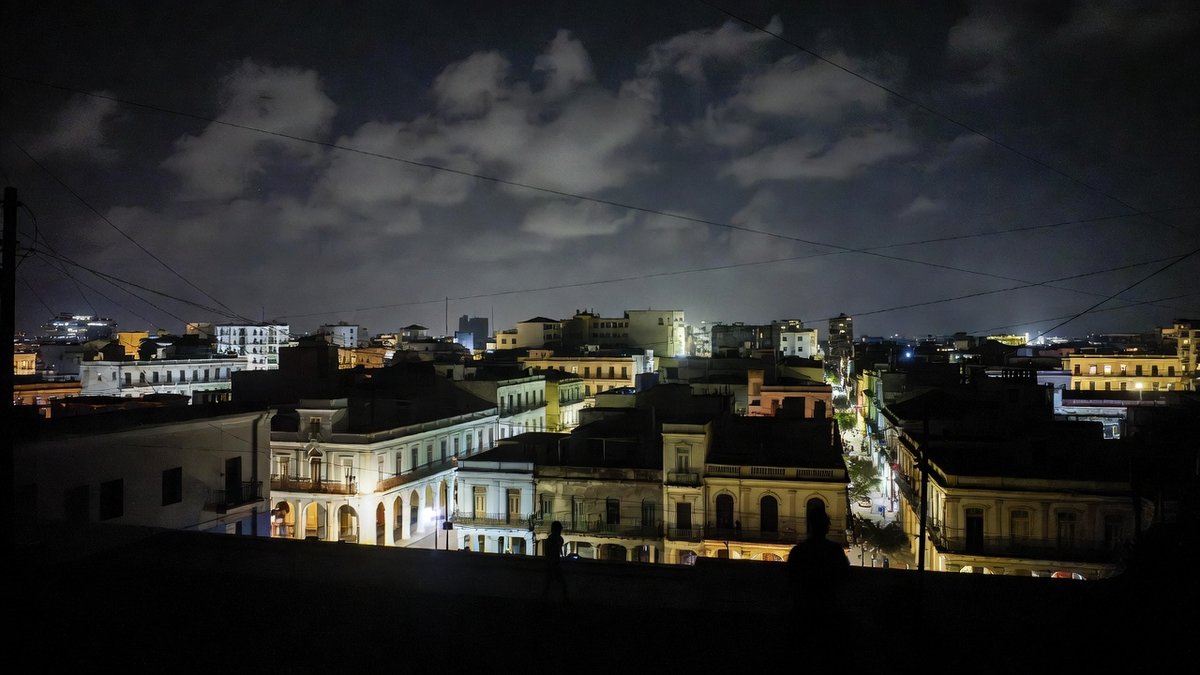
The chain of events that produced Monday's blackout begins not in Cuba but in Venezuela. In early January 2026, the United States carried out what US officials described as a counter-narcotics and democracy-restoration operation in Venezuela — resulting in the arrest of President Nicolás Maduro and the installation of a transitional government. Venezuela under Maduro had been providing Cuba with heavily subsidised oil under terms established by Hugo Chávez in the early 2000s — a supply relationship that had become the backbone of Cuba's electricity generation system. With Maduro removed and Venezuela's new government aligned with Washington, Cuba's Venezuelan oil supply was immediately cut off. The Trump administration subsequently threatened to impose tariffs on any nation that shipped fuel to Cuba — a deterrent that has substantially reduced the island's ability to source replacement supply from alternative partners including Russia and Mexico. Cuba produces approximately 40% of its own petroleum — but that domestic production is entirely insufficient to meet demand, particularly for a power grid that was already chronically underpowered and operating equipment described by American University professor William LeoGrande as "way past its normal useful life." On nearly every street corner in Havana, conversations centre on blackout schedules. At night, the stars are clearly visible over most of the city — because most of the city is in near-total darkness.
The Human Cost: $9 Petrol, Hospitals Cutting Services & Food Rotting in the Dark
The statistics that define Cuba's energy crisis are devastating in their specificity. Fuel on the unofficial market now costs approximately $9 per litre — meaning a full tank of petrol costs more than $300, a figure that exceeds the monthly salary of most Cuban workers. Government-run petrol stations have severely restricted sales — only tourists, diplomats, and Cubans allocated an online booking slot are permitted to fill up, after waits that typically last hours. Hospitals across the island have cut services in response to fuel and equipment shortages. Refuse collection has collapsed in multiple neighbourhoods as dump trucks sit idle without fuel. During the 29-hour blackout, water pumps failed across Havana — because Cuba's water distribution infrastructure depends on electrical pumps that cannot function without grid power. Food stored in refrigerators and freezers spoiled. Medical equipment that requires continuous power was threatened. Schools and workplaces operating on emergency reduced schedules fell silent entirely. As digital8hub.com has reported this week, the global oil crisis triggered by Operation Epic Fury — with Brent crude above $100 per barrel and the Strait of Hormuz effectively closed to commercial shipping — has made alternative fuel sourcing for Cuba even more expensive and logistically difficult than it would otherwise be. The energy weapon that the United States has deployed against Cuba is operating in the context of a global energy system already under historic stress.
Trump's Rhetoric & the Quiet Diplomacy Happening Behind It
The political backdrop to the blackout has been shaped by a remarkable contrast between Trump's public rhetoric and the quiet diplomacy reportedly underway behind it. On Monday — as Cuba went dark — Trump told reporters he could do "anything he wanted" with Cuba, and suggested the US would be "doing something with Cuba very soon." He later used the phrase "honor of taking" the island — language that Cuban officials described as a direct echo of 19th-century American imperial rhetoric and that provoked fury in Havana. The Cuban Deputy Foreign Minister Carlos Fernández de Cossío captured the government's response with measured bitterness: "Officials in the US government must be feeling very happy by the harm caused to every Cuban family." Yet simultaneously, both sides have confirmed that US-Cuba negotiations are underway — the most substantive direct talks in years — aimed at defusing a crisis that neither government has publicly acknowledged in full. Cuba extended what appeared to be a gesture of goodwill by inviting Cuban-Americans and exiles to invest in and own businesses on the island — a significant ideological concession from a Communist government — on the same day the grid collapsed. A Hong Kong-flagged tanker that may be carrying fuel to Cuba resumed navigation on Tuesday after weeks of suspension in the Atlantic. The lights are back on at 6:11pm. For how long, and at what cost to the 10 million people who endured 29 hours of darkness, remains the question that neither Washington nor Havana has answered. For the latest coverage of the US-Cuba crisis, global energy, and all breaking international news, follow digital8hub.com.
Comments (0)
Please log in to comment
No comments yet. Be the first!