Travel
Shot on iPhone, From the Moon: Astronaut Reid Wiseman Shares a Breathtaking 'Earthset' Video
Nine days after returning from the Moon, Artemis II Commander Reid Wiseman posted a video on Sunday that stopped the internet in its tracks. Filmed from inside the Orion spacecraft — through the narrow glass of the docking hatch window — the clip captures one of the rarest sights in human experience: an Earthset. The entire blue marble of our planet, slowly slipping behind the edge of the Moon. Shot on an iPhone 17 Pro Max, from 406,770 kilometres away.
It is the first time anyone has witnessed an Earthset in over half a century — and the first time one has ever been captured on a consumer smartphone.
What Is an Earthset?
An Earthset is the lunar equivalent of a sunset — the moment when Earth disappears below the Moon's horizon, as seen from beyond the Moon. Because the Moon is tidally locked to Earth, Earthset can only be observed from the far side of the Moon, or from a spacecraft that has travelled around it. It has been seen by only the 24 humans who flew Apollo missions between 1968 and 1972 — and now, by the four crew members of Artemis II.
Wiseman described the moment on X with characteristic understatement: 'Only one chance in this lifetime… Like watching sunset at the beach from the most foreign seat in the cosmos, I couldn't resist a cell phone video of Earthset.' The post has since gone viral, drawing tens of millions of views within hours of being published.
The Video: 50 Seconds of Raw History
The clip runs for approximately 50 seconds of unedited footage, captured through the fifth docking hatch window of the Orion spacecraft — a narrow pane of glass that Wiseman noted the iPhone was 'the perfect size to catch the view' through. Larger camera equipment would not have fit the tight angle.
At the start of the video, Earth appears as a bright, vivid sliver against the absolute blackness of deep space, with the Moon's cratered grey surface visible in the lower corner of the frame. Slowly, silently, the sliver shrinks — until nothing remains but darkness and stars. The visual is, as Wiseman put it, 'like watching sunset at the beach from the most foreign seat in the cosmos.'
The audio makes the video even more striking. In the background, the rapid mechanical clicking of a Nikon camera can be clearly heard — mission specialist Christina Koch, positioned at a larger window just a few feet away, hammering away with a 400mm lens on three-shot bracketing to capture high-resolution still photographs of the same moment. Two astronauts. Two tools. The same unrepeatable view.
The iPhone That Went to the Moon
The device responsible for the footage is an iPhone 17 Pro Max — and its presence on the mission was not a given. According to TechEBlog, it was only a few weeks before the April 1 launch that NASA engineers gave the go-ahead for personal phones to be taken aboard, after evaluating the risks: radiation exposure, extreme temperature swings, the vacuum of space, and the vibrations of launch and reentry. The iPhone 17 Pro Max handled all of it.
The video's quality — clear, stable, and properly exposed despite the extreme contrast between the bright Earth and the pitch-black lunar sky — is a testament to the iPhone's computational photography capabilities, which automatically balance exposure and light in conditions that would challenge professional broadcast cameras. For Apple, the footage is the most extraordinary product demonstration in the company's history.
The Artemis II Mission: Context
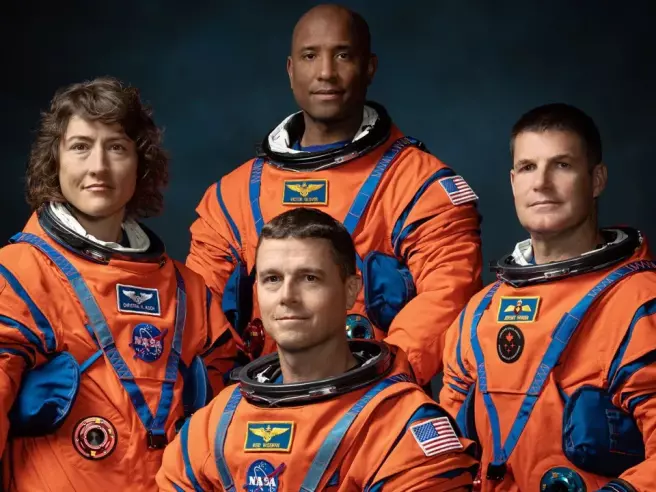
Artemis II launched on April 1, 2026, from Launch Pad 39B at Kennedy Space Center aboard NASA's Space Launch System rocket. The four-person crew — Commander Reid Wiseman, Pilot Victor Glover, Mission Specialist Christina Koch, and Canadian Space Agency Mission Specialist Jeremy Hansen — became the first humans to travel beyond low Earth orbit since Apollo 17 in December 1972.
The mission lasted 9 days, 1 hour, and 32 minutes. At their farthest point, the crew travelled 252,756 miles from Earth — a new record for the farthest distance any humans have ever been from our planet. The Orion spacecraft, which the crew named 'Integrity', completed its lunar flyby before returning to Earth for a parachute-assisted splashdown in the Pacific Ocean off the coast of San Diego on April 10, 2026 at 8:07 PM EDT.
During the mission, Wiseman's crewmate Jeremy Hansen formally requested that a newly discovered lunar crater be named Carroll — after Wiseman's late wife, Carroll Taylor Wiseman, a nurse who died of cancer in 2020. The gesture moved Wiseman deeply: in post-mission interviews, he revealed he sought out the ship's Navy chaplain after splashdown and broke down in tears. 'There was just no other avenue for me to explain anything or to experience anything,' he said.
A Moment for the Ages
The Earthset video sits at the intersection of space exploration, consumer technology, and human emotion in a way that is genuinely rare. Unlike the meticulously planned and heavily edited imagery that typically accompanies space missions, this is raw and immediate — a commander reaching for his phone because the moment was too beautiful not to capture, just as any of us might do at the beach or on a mountain.
That instinct — the human need to document and share wonder — is what makes the footage so powerful. Fifty-four years after the last humans flew around the Moon, the first thing a new generation of explorers did when they got there was pull out their phone.
For ongoing coverage of space exploration, NASA missions, consumer technology, and the stories that define 2026, follow Digital8Hub at digital8hub.com.
Sources & Further Reading
Reid Wiseman on X (@astro_reid): Earthset post, April 19, 2026
TechEBlog: Reid Wiseman Films Earth Setting Behind the Moon With His iPhone 17 Pro Max
News9Live: Reid Wiseman posts video of lunar Earthset captured on iPhone
Breitbart Science: Artemis II Astronaut Shares Video of Earth Disappearing Behind Moon
NASA.gov: Artemis II mission overview and splashdown coverage
Wikipedia: Artemis II, Reid Wiseman
NewsBytesApp: Commander Reid Wiseman films rare Earthset from 406,770km away
Digital8Hub Technology Coverage: digital8hub.com
Comments (0)
Please log in to comment
No comments yet. Be the first!