Travel
Indonesia Commuter Train Crash — What We Know About the Latest Rail Tragedy
Indonesia's railway network carries millions of passengers every day across one of the world's most densely populated archipelagos — a system that has undergone significant modernisation in recent years but continues to face the pressures of ageing infrastructure, rapid urbanisation, and the sheer scale of demand placed on it by a country of 270 million people.
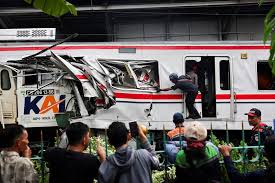
The latest commuter train crash has once again brought those pressures into sharp and painful focus. Emergency services have responded to a serious incident on Indonesia's rail network, with casualties confirmed and rescue operations underway. The crash has reignited a debate about the pace and adequacy of railway safety improvements in a country where rail travel is not a lifestyle choice but a daily necessity for tens of millions of commuters.
At digital8hub.com, we bring you the full account of what is known about the incident, the emergency response, and what it reveals about the state of one of Southeast Asia's most important and most challenged transport systems.
What Happened: The Incident
Details of the crash are still emerging as emergency services work to establish the full picture, but initial reports confirm that a serious collision or derailment involving a commuter train service has occurred on Indonesia's rail network. The incident involved passenger carriages and resulted in immediate casualties — both fatalities and injuries — with the number of those affected still being confirmed as rescue operations continue.
Indonesian emergency services — including the National Search and Rescue Agency (Basarnas), local police, and medical teams — were dispatched rapidly to the scene. The scale of the emergency response reflects the seriousness of the incident and the need to reach and treat those trapped or injured as swiftly as possible.
Rail services on the affected line have been suspended as investigators begin the process of establishing exactly what caused the crash. Indonesia's National Transportation Safety Committee (KNKT) — the independent body responsible for investigating serious transport incidents — is expected to lead the formal inquiry, which will examine everything from track conditions and signalling systems to driver performance and maintenance records.
The Indonesian government has expressed condolences to the families of those affected and pledged a full and transparent investigation into the circumstances of the crash.
Indonesia's Rail Network: Progress and Persistent Challenges
To understand the context of this latest incident, it is important to appreciate both how far Indonesia's railway system has come in recent years and how far it still has to go.
The Modernisation Story
Under successive governments, Indonesia has invested significantly in railway modernisation — particularly in the Greater Jakarta metropolitan area, which is served by the KRL Commuter Line network, one of the busiest commuter rail systems in Southeast Asia. The electrification of commuter lines, the introduction of modern rolling stock, the expansion of the network into new areas, and improvements to station facilities have collectively transformed the commuter rail experience in the capital region over the past decade.
Beyond Jakarta, Indonesia's long-distance rail network — operated primarily by PT Kereta Api Indonesia (KAI) — has also seen investment, with new high-speed and inter-city services expanding connectivity between major population centres on the island of Java in particular.
The Persistent Challenges
But modernisation has been uneven, and the challenges facing Indonesia's railway system remain significant. Outside the Jakarta metropolitan area and the main Java corridor, infrastructure quality varies considerably. Ageing track infrastructure, level crossings that bring rail into daily conflict with road traffic, signalling systems that have not been uniformly upgraded across the network, and the sheer volume of traffic on key corridors all contribute to a risk environment that periodic investment has improved but not eliminated.
Indonesia also faces a challenge common to rapidly developing nations: the pace of demand growth outstrips the pace of infrastructure improvement. As more Indonesians move to cities, as middle-class commuter populations expand, and as the economic cost of road congestion drives more people toward rail, the pressure on a system that was not designed for current demand levels intensifies.
The Human Factor
Like rail systems worldwide, Indonesia's network is also subject to the human factors that contribute to serious accidents: driver fatigue, communication failures, procedural lapses, and the kind of accumulated small failures that individually seem manageable but collectively create the conditions for tragedy.
Indonesia's KNKT has, over the years, documented a range of human and systemic factors in its investigation reports on previous rail accidents — findings that have driven policy changes and operational improvements, but which have not eliminated the underlying risk.
Previous Major Incidents: A Pattern That Demands Action
The latest crash does not exist in isolation. Indonesia has experienced a series of serious rail accidents over the past two decades that have each generated investigations, recommendations, and promises of improvement — with mixed results in terms of actual safety outcomes.
Among the more significant recent incidents:
The 2010 Bribin train disaster in Central Java, in which a passenger train collision killed multiple people and drew attention to the dangers of overcrowded carriages and inadequate safety systems on regional lines.
The 2019 Senen station collision in Jakarta, in which two commuter trains collided at a busy urban station, injuring dozens of passengers and highlighting the risks of signalling failures in high-density urban rail environments.
The 2023 Bandung collision, in which two passenger trains on a single-track section collided head-on, killing multiple people and focusing attention on the risks of the manual block system still in use on certain sections of Indonesia's network.
Each of these incidents produced investigations, recommendations, and commitments to improvement. The persistence of serious rail accidents despite these efforts suggests that systemic change has been insufficient to match the scale of the challenge.
The Emergency Response: Indonesia's Search and Rescue Capability
Indonesia's emergency response infrastructure has developed considerably over the years, driven in part by the country's exposure to natural disasters — earthquakes, tsunamis, volcanic eruptions — that have required the development of rapid, large-scale emergency response capability.
The National Search and Rescue Agency (Basarnas) coordinates emergency responses across a vast and geographically complex archipelago, and its personnel are experienced in managing the kind of multi-casualty incident that a serious rail crash represents. Local emergency services — fire brigades, police, and medical teams — provide the first-response capability that is critical in the immediate aftermath of a crash, and Indonesia's urban centres have increasingly well-equipped trauma centres capable of treating serious injuries.
The challenge in major rail incidents is always the same: reaching those who are trapped quickly enough, with the right equipment and medical expertise, to save the maximum number of lives. In dense urban environments — where traffic congestion can impede emergency vehicle access — and in more remote locations where infrastructure is limited, this challenge is particularly acute.
What Must Change: The Safety Imperative
Every serious rail accident in Indonesia — as in any country — is both a human tragedy and a policy failure. The human tragedy is immediate and undeniable: lives lost, families shattered, communities in grief. The policy failure is more diffuse but equally real: a system that, despite investment and effort, continues to produce preventable accidents.
The measures that most urgently require attention on Indonesia's railway network include:
Automatic Train Protection (ATP) rollout — Indonesia has been in the process of implementing ATP systems across its network, but implementation has been uneven. ATP, which automatically applies brakes when a train passes a signal at danger, is the single most effective technical intervention for preventing collision accidents. Its universal implementation should be a non-negotiable priority.
Level crossing elimination — Indonesia's railway network crosses thousands of public roads at grade level, creating daily opportunities for collision between trains and road vehicles. A systematic programme of level crossing elimination — replacing them with bridges or underpasses — would significantly reduce accident risk across the network.
Single-track section management — The collision risks inherent in operating bidirectional traffic on single-track sections are well-documented. Investment in double-tracking key sections of the network would eliminate a category of risk that has contributed to multiple serious accidents.
Maintenance investment — Ageing track infrastructure requires consistent, adequately funded maintenance programmes. The consequences of deferred maintenance in railway systems are ultimately measured not in budget savings but in human lives.
Indonesia's government, railway operators, and the international development partners who support Indonesian infrastructure investment must treat rail safety not as a secondary concern but as a fundamental obligation to the tens of millions of Indonesians who depend on the railway system every day.
For the latest breaking news and in-depth coverage of global events, follow digital8hub.com — your trusted source for the stories that matter.
Comments (0)
Please log in to comment
No comments yet. Be the first!