Travel
Earthquake Strikes Southern Iran Mid-War: Natural Disaster or Nuclear Test?
In any other week, a magnitude 4.3 earthquake in southern Iran would be a minor geological footnote — logged by seismologists, noted by local authorities, and largely ignored by the global news cycle. But this is not any other week. On the morning of Tuesday, March 3, 2026 — just five days into Operation Epic Fury and with the Middle East engulfed in the most serious regional conflict in decades — a 4.3 magnitude tremor struck near Gerash in Iran's southern Fars Province. And within minutes, social media was convinced Iran had just tested a nuclear weapon.
What Actually Happened
The earthquake struck at approximately 06:54 GMT — 10:24 AM local time — at a shallow depth of around 10 kilometres, with an epicentre located approximately 55 kilometres north-northwest of the city of Gerash in a largely rural part of Fars Province. No serious damage has been reported. No casualties have been confirmed. The shaking was felt as mild in nearby communities, with residents reporting noticeable tremors but no structural collapses or injuries.
The event was classified by seismic monitoring agencies as a natural tectonic earthquake — specifically, a body-wave magnitude event consistent with the normal seismic activity of the region. A magnitude 4.3 earthquake is classified as light to moderate — roughly corresponding to level IV on the Modified Mercalli Intensity scale, meaning it would cause dishes to rattle and windows to shake, but not structural damage in most modern buildings.
Why Iran's South Is Earthquake Country
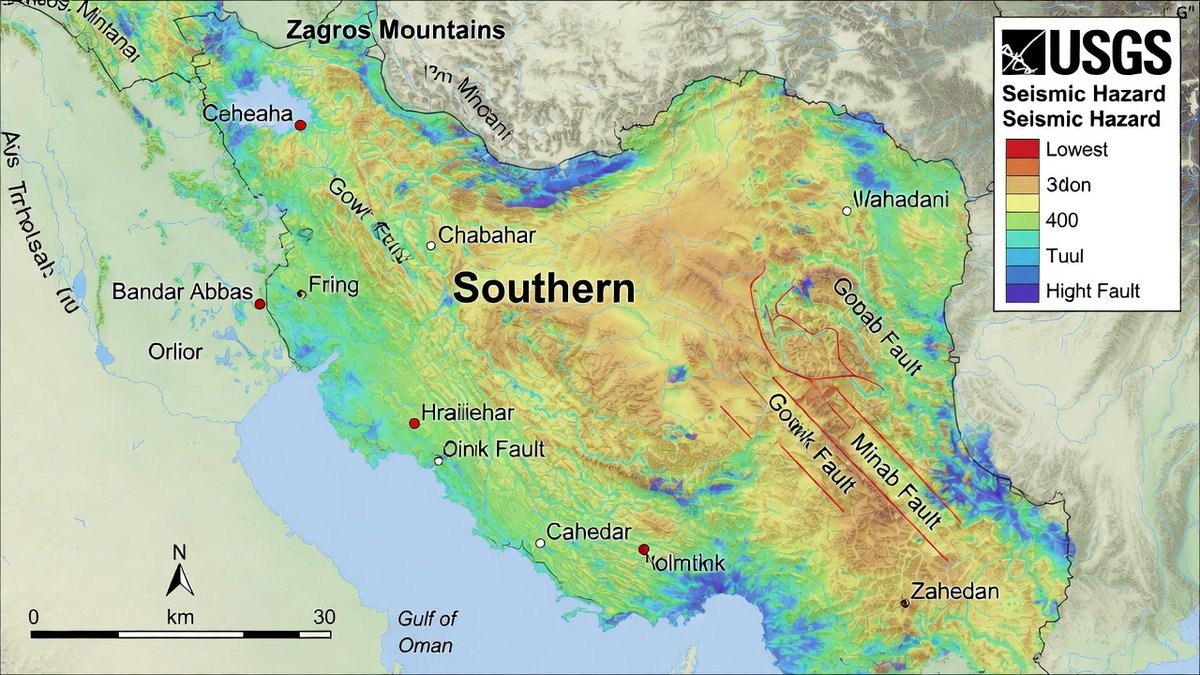
The reason southern Iran experiences earthquakes regularly has nothing to do with military activity and everything to do with plate tectonics. Southern Iran sits within the Zagros fold-thrust belt — one of the most seismically active zones in the entire Middle East. The Zagros belt was formed by the ongoing collision between the Arabian Plate and the Eurasian Plate, a process that has been building mountain ranges and generating earthquakes for millions of years. Earthquakes in the magnitude 4 to 5 range are common, expected, and well-documented throughout this region. Fars Province alone records dozens of seismic events every year.
Iran is, in fact, one of the most earthquake-prone countries on earth. The 2003 Bam earthquake killed over 26,000 people. The 2012 East Azerbaijan earthquakes killed hundreds more. Seismic activity in southern Iran is not an anomaly — it is a geological reality.
Was It a Nuclear Test? No. Here's the Science
The nuclear test speculation spread rapidly online, fuelled by a combination of geopolitical anxiety and the very human instinct to connect dramatic events that happen close together in time. It is understandable — but it is not supported by any evidence.
Underground nuclear tests produce distinct seismic signatures that are readily identifiable by global monitoring networks. Nuclear detonations generate sharp, high-frequency signals dominated by primary P-waves — signatures that look fundamentally different from natural tectonic earthquakes, which produce a more gradual, complex wave pattern. The Comprehensive Nuclear-Test-Ban Treaty Organization operates a global network of monitoring stations specifically designed to detect and distinguish nuclear tests from natural earthquakes. No alerts, flags, or notifications have been issued by the CTBTO or any other international monitoring body in connection with this event.
Additionally, there are no known nuclear testing locations in this part of Fars Province. Iran's nuclear facilities — Fordow, Natanz, and Isfahan — are located hundreds of kilometres from Gerash. The depth of the quake at 10 kilometres, its location in a tectonically active rural area, and the absence of any radiation anomalies all point unambiguously to a natural event.
The Broader Context: A Country Under Pressure
The speed with which the nuclear test rumours spread tells us something important — not about Iran's nuclear programme, but about the anxiety level of a world watching a major regional war unfold in real time. When explosions are rocking Tehran, when Hezbollah is firing missiles at Israel, and when oil tankers are rerouting around the Strait of Hormuz, the human mind is primed to connect every new piece of alarming information to the conflict already consuming its attention.
Iran is a country dealing simultaneously with the aftermath of a devastating military strike on its leadership, an active retaliatory campaign across the Gulf, internal political transition following the death of Supreme Leader Khamenei, ongoing anti-regime protests, and a collapsing currency. The last thing on the list is an underground nuclear test in a rural part of Fars Province — which would invite an immediate and devastating response from the very coalition already striking its territory.
The earthquake near Gerash on March 3 is a natural tectonic event in one of the world's most seismically active regions. The nuclear test rumours are a reflection of the times — understandable, but wrong.
For the latest updates on the Iran conflict and the Middle East crisis, follow digital8hub.com.
Comments (0)
Please log in to comment
No comments yet. Be the first!