Travel
Artemis II Astronauts Make Historic Lunar Flyby and Break Records
Humanity is Back at the Moon — Artemis II Astronauts Make Historic Lunar Flyby and Break Records
For the first time in more than half a century, human beings have looked up at the Moon — not from Earth, but from a spacecraft just a few thousand miles above its surface. On April 6, 2026, NASA's Artemis II mission achieved one of the most significant milestones in modern space exploration history.
Artemis II is the first crewed mission beyond low Earth orbit since Apollo 17 in December 1972. The ten-day mission launched from Kennedy Space Center on April 1, 2026 and is crewed by NASA astronauts Reid Wiseman, Victor Glover, and Christina Koch, along with Canadian Space Agency astronaut Jeremy Hansen. Wikipedia
Monday's lunar flyby was the centrepiece of the entire mission — and it delivered in spectacular fashion.
The Crew Making History
Victor Glover became the first person of colour, Christina Koch the first woman, Reid Wiseman the oldest person, and Jeremy Hansen the first non-American to travel around the Moon. Wikipedia
Each of these milestones carries enormous symbolic weight — not just for NASA, but for the billions of people around the world who see themselves reflected in this crew for the first time in the history of lunar exploration.
A Record Broken — The Farthest Humans Have Ever Travelled
The numbers alone are staggering. At approximately 1:56 p.m. EDT, the spacecraft surpassed the record for the farthest distance from Earth ever travelled by any human, beating the mark set by Apollo 13 in April 1970. The spacecraft reached its maximum distance at 7:07 p.m. — a total of 252,760 miles from Earth. Apollo 13 had reached 248,655 miles. NASA
At 7:02 p.m., the spacecraft reached its peak distance of 252,756 miles from Earth, putting it 4,111 miles beyond the Apollo 13 record set back in 1970. NPR
President Donald Trump called in to congratulate the crew following the flyby, calling them "modern-day pioneers" and saying "Today you've made history and made all America really proud, incredibly proud. This is, there's nothing like what you're doing circling around the moon for the first time in more than a half a century and breaking the all time record for the farthest distance from planet Earth." CNN
What the Astronauts Saw
The seven-hour flyby was packed with scientific observations and moments of pure, awe-inspiring wonder.
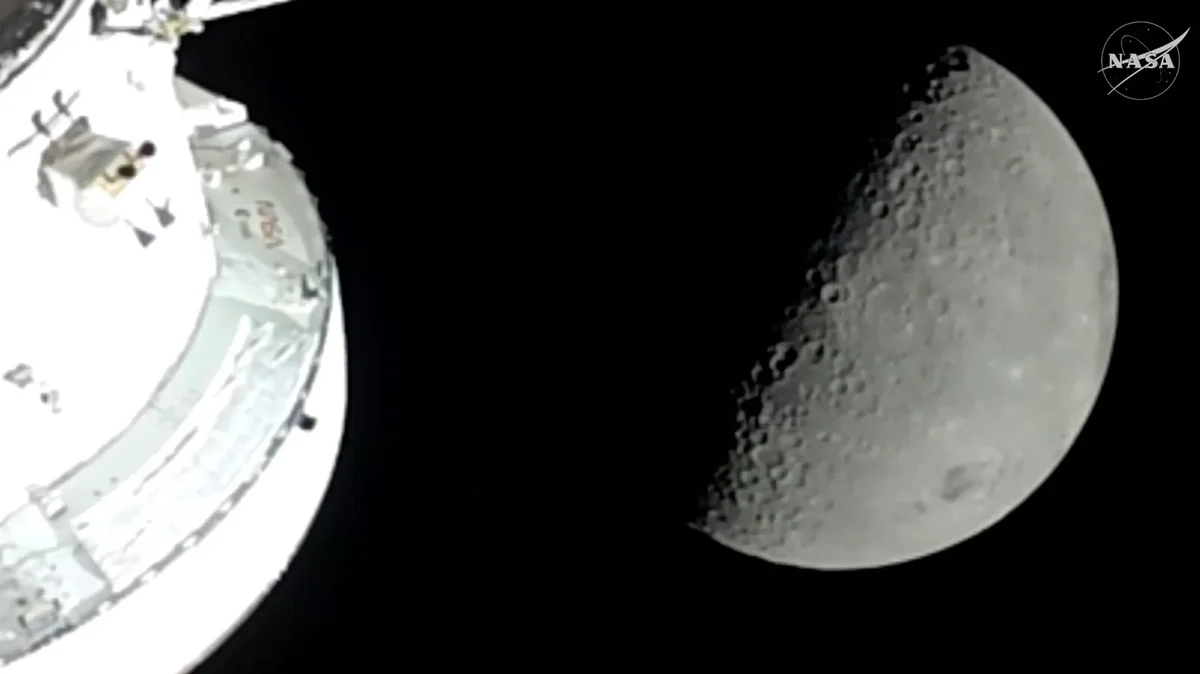
The spacecraft completed its closest approach to the Moon at about 7 p.m. ET, coming within 4,067 miles of the lunar surface. NASA said the Moon appeared to the astronauts about the size of a basketball held at arm's length. NPR
Working in two-person pairs, the crew made detailed observations throughout the flyby. One astronaut took photographs using a blue shroud to prevent reflections and a zoom lens, while the other used a portable computing device to make annotations and audio recordings of everything they could see. CBS News
At one point, an astronaut remarked on the numerous craters dotting the entirety of the Moon's far side, calling it "impossibly rugged." CBS News The crew reported they could see both the Moon and the Earth from the same window simultaneously — observing what astronaut Christina Koch described as Earth looking "way brighter."
The flyby took the crew over the rarely glimpsed lunar far side, which always faces away from Earth — allowing them to see features on the lunar surface that human eyes had never observed before. CNN
The Science: Why These Observations Matter
Artemis II has 10 science objectives for the flyby. One is to observe colour variations on the lunar surface — changes in colour can indicate the composition of minerals. These changes are hard to detect with satellite images. "This is something that human eyes are just incredibly good at teasing out nuances about," said Artemis II lunar science lead Kelsey Young. NPR
Among the 35 science targets assigned to the crew was the Orientale basin — a nearly 600-mile-wide crater that straddles the Moon's near and far sides. This 3.8-billion-year-old crater formed when a large object struck the lunar surface and retains clear evidence of that collision, including dramatic topography in its rings. NASA
One target site is also a potential future landing area for an uncrewed payload mission. The crew also got a small glimpse of the lunar south pole — where humans might land as early as 2028. NPR
Earthrise, a Solar Eclipse and Two Meteors
Some of the most emotionally powerful moments of the flyby were the ones no science plan could fully prepare the crew for.
During the communications blackout as the spacecraft passed behind the Moon, the crew witnessed an Earthrise — the moment Earth emerged from behind the lunar horizon — recreating one of the most iconic images in human history, first captured by Apollo 8 in 1968. CNN
The crew also entered a solar eclipse lasting nearly an hour, as Orion, the Moon and the Sun aligned. During this phase, the crew witnessed the Sun disappear behind a mostly darkened Moon and studied the solar corona — the Sun's outermost atmosphere — glowing around the lunar edge. NASA
NASA astronaut Victor Glover described the view: "After all of the amazing sites that we saw earlier, we just went sci-fi. You can actually see a majority of the moon. It is the strangest looking thing." He also noted that the crew observed two meteors during this period. CNN
Now Heading Home
The Artemis II crew has completed the mission's lunar observation period and is now beginning the return trip home. On Tuesday April 7, Orion will exit the lunar sphere of influence at approximately 1:25 p.m., at a distance of 41,072 miles from the Moon. NASA
The spacecraft is expected to splash down off the California coast near San Diego just after 8 p.m. EDT on Friday, April 10. CBS News
But the significance of what happened on April 6, 2026 will last far longer than this mission. Humanity has returned to the Moon's doorstep — and the next step is landing on it.
NASA Administrator Jared Isaacman captured the spirit of the moment perfectly: "On behalf of NASA and space-loving people across the world, thank you for taking us with you to the moon. You represent the absolute best of us. We are proud of you, and we look forward to welcoming you back safely to the good Earth very soon. Godspeed and Go Artemis II." CNN
For more coverage of the Artemis II mission, space exploration, and the technology shaping humanity's future, visit digital8hub.com — your go-to source for science, tech, and the stories that define our era.
Comments (0)
Please log in to comment
No comments yet. Be the first!