Sports
94 Starts, 34 Years of Japanese Silence & Tears in Naivasha: Takamoto Katsuta Finally Wins the Safari Rally
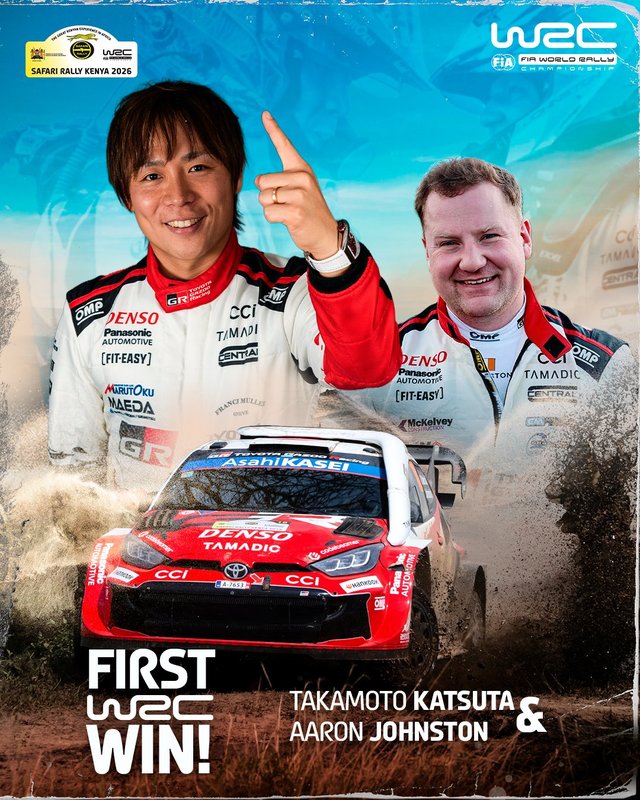
He sat back down on the rollcage. He could not stand. Thirty-four years of Japanese silence in the FIA World Rally Championship ended on a dusty road in Naivasha on Sunday March 15 — and Takamoto Katsuta could not stand up to give his post-stage interview because his legs would not hold him. On his 94th WRC start, after finishing second four times and watching victory slip away in circumstances ranging from cruel to catastrophic, the Toyota Gazoo Racing driver and his Irish co-driver Aaron Johnston crossed the Safari Rally Kenya finish line to claim the most emotionally charged WRC win of the modern era. Their margin of victory was 27.4 seconds over Hyundai's Adrien Fourmaux. Their journey to it began in chaos, continued through carnage, and ended with Kenyan President William Ruto personally presenting Katsuta with the winner's trophy in front of tens of thousands of spectators at the Naivasha ceremonial finish. "I don't know what to say," Katsuta said, fighting back tears. "We have had so many difficult moments. Aaron has worked very hard with me. The team always believed in me, even when I was failing all the time. I'm here because of them and Aaron."
The Last Japanese Winner: 1992, Ivory Coast, Kenjiro Shinozuka
The historical significance of Katsuta's victory extends far beyond his personal journey. He is the first Japanese driver to win a WRC round since Kenjiro Shinozuka triumphed at the Ivory Coast Rally on November 22, 1992 — 34 years, 3 months, and 24 days before Sunday's result in Naivasha. That is the full measure of the gap Katsuta's win closes: an entire generation of Japanese motorsport without a WRC round victory, in a championship series that Japan's automotive industry has shaped and bankrolled for decades. Toyota's GR Yaris Rally1 — the car that carried Katsuta to victory — is itself a product of the Japanese engineering philosophy that has made Toyota Gazoo Racing the dominant force in WRC since 2021. The Safari Rally is also where Katsuta scored his first WRC podium, back in 2021 — making Sunday's win at the same event a narrative arc of extraordinary neatness. In 2023, he crashed at the Shakedown at Loldia before the rally even started. In 2024, he finished second. On Sunday March 15, 2026, he won.
How the Rally Unravelled: From 7th to First in One Brutal Saturday
The story of Katsuta's victory is inseparable from the story of what happened to everyone else on Saturday. He started the day in seventh overall — having suffered a double puncture on Friday's Elmenteita test that dropped him down the order — and his day began with an intercom failure in the rain-soaked opening stage that left him without pacenotes from Johnston entirely. His approach from that moment was deliberate, methodical, and precisely calibrated: survival first, pace second. The Sleeping Warrior stage rewrote the rally entirely. Championship leader Elfyn Evans was the first to retire — terminal rear-right suspension damage, the rocks having finally claimed their victim. On the road section back to service, both Oliver Solberg and Sébastien Ogier — who had been running 1-2 at the head of the rally — retired with alternator failures, mud having forced its way into the cars' electrical systems during the brutal morning loop. Thierry Neuville, battling overheating issues all weekend, retired on the second pass of Soysambu after sustaining a triple puncture with no spare tyres remaining. The 2025 world champion, three punctures in one stage, out of the rally. In the space of one morning, Katsuta had risen from seventh to the overall lead — not by driving faster than his rivals, but by still being there when they were not. "It's much easier when you're fighting for tenths of a second," Katsuta said on Saturday afternoon. "Now it's about surviving."
Sunday: Managing the Lead, Fourmaux Closing, the Trophy
The final day offered no relief from the tension. Adrien Fourmaux — who had delivered a composed, intelligent drive all weekend for Hyundai despite his team's overheating issues — began Sunday 1 minute 25.5 seconds behind Katsuta and pushed hard to close the gap. Johnston's pacenotes kept Katsuta precise and measured through the Super Sunday stages. Sami Pajari — who had lost five minutes to a tyre explosion and a second puncture on Saturday — drove superbly on the final day to secure third overall. On the restarted runners, Oliver Solberg won the Wolf Power Stage by 2.8 seconds over Ogier to claim maximum Power Stage points. At the ceremonial finish in Naivasha, President Ruto handed Katsuta the winner's trophy — a moment that captured both the Kenyan government's pride in hosting the rally and the magnitude of what Katsuta had achieved. Ott Tänak — who has been texting Katsuta messages of support every morning throughout his career — received a special mention in the tearful post-rally address. "Akio-san, finally we are here, thank you," Katsuta said — addressing Toyota's honorary chairman Akio Toyoda directly from the winner's podium in Africa. In the championship, Elfyn Evans retains the drivers' lead on 66 points despite his retirement. Katsuta — now 3 points behind Evans — heads to the asphalt stages of Croatia Rally in April with something he has never had before going into a WRC round: the knowledge of what it feels like to win. For the latest WRC coverage and all motorsport news, follow digital8hub.com.
Comments (0)
Please log in to comment
No comments yet. Be the first!