Lifestyle
Senator vs. Marine: The Viral Senate Hearing Confrontation That Divided America
It lasted less than two minutes. But the footage has been viewed tens of millions of times, sparked furious debate across every corner of the political spectrum, and added a new flashpoint to an already explosive national conversation about America's role in the Iran conflict. On Wednesday afternoon, March 5, 2026, a confrontation inside a Senate Armed Services Subcommittee hearing room in the Hart Senate Office Building became one of the most watched political moments of the year — and it started with five words: "No one wants to fight for Israel."
What Happened Inside the Hearing Room
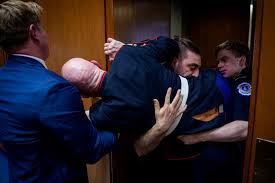
Brian McGinnis — a former Marine sergeant, anti-war activist, and Green Party candidate running for Senate in North Carolina — was present in the hearing room as the Armed Services Subcommittee convened. McGinnis arrived in what appeared to be a Marine Corps Dress Uniform, and when he rose to protest, he did so loudly and without hesitation. Capitol Police moved immediately to remove him from the room.
What followed was captured in video footage that spread across social media within minutes. As officers attempted to escort McGinnis out, he resisted — grabbing the hearing room door frame with his arm to prevent removal. Senator Tim Sheehy — a Republican from Montana and himself a combat veteran — physically joined Capitol Police in the effort to remove McGinnis, helping lift him from his position and push him through the doorway. Onlookers in the room reacted with shock and alarm. "His hand! His hand! Oh my God!" people could be heard shouting as McGinnis's arm became caught in the door during the struggle. "A sitting US Senator just broke the hand of a Marine!" someone yelled from the gallery.
The Injuries & The Charges
Capitol Police confirmed that three officers sustained injuries during the incident and were treated by DC Fire & EMS on site. McGinnis was also treated for injuries — his arm had become stuck in the door as he resisted removal, and witnesses alleged his hand was broken in the struggle, though that claim has not been officially confirmed by medical personnel. McGinnis now faces six charges: three counts of assaulting a police officer and three counts related to resisting arrest. Capitol Police were unambiguous in their statement: protests are not permitted inside Congressional buildings, and McGinnis had created a dangerous situation by violently resisting removal.
Sheehy's Statement: "He Came Looking for a Confrontation"
Senator Sheehy did not apologise. In a statement posted on social media shortly after the incident, he wrote: "Capitol Police were attempting to remove an unhinged protestor from the Armed Services hearing. He was fighting back. I decided to help out and deescalate the situation." He added: "This gentleman came to the Capitol looking for a confrontation, and he got one. I hope he gets the help he needs without causing further violence." Sheehy was also filmed exchanging words with audience members who criticised his conduct as he left the scene — a moment that added further fuel to an already combustible story.
McGinnis: Who Is He?
Brian McGinnis served one enlistment in the Marine Corps as a Light Armored Vehicle Crewman — an infantry MOS — until June 2004. He is now a prominent anti-war activist and is running as a Green Party candidate for Senate in North Carolina. His protest at Wednesday's hearing was a deliberate act of political theatre — arriving in uniform, choosing one of the most high-profile possible settings, and delivering a message designed to be heard far beyond the hearing room. Whether you agree with his methods or his message, it worked. The clip has been viewed millions of times in hours.
The Bigger Picture: Dissent in the Time of War
The confrontation did not happen in a vacuum. It happened on Day 6 of Operation Epic Fury — with US forces actively engaged in strikes across Iran, three American service members already confirmed dead, and a growing domestic debate about whether Congress was consulted, whether the war is legal, and whether the American public supports it. Polls conducted in the days following the launch of Operation Epic Fury have shown a country divided — with a slim majority expressing support for the initial strikes but far less certainty about an extended conflict. McGinnis's five words — "No one wants to fight for Israel" — landed in that gap between official policy and public sentiment with precision.
A Senate hearing room. A senator. A Marine. Six words. This is the image of America's war debate in March 2026.
For the latest updates on Operation Epic Fury and US political coverage, follow digital8hub.com.
Comments (0)
Please log in to comment
No comments yet. Be the first!