Health & Fitness
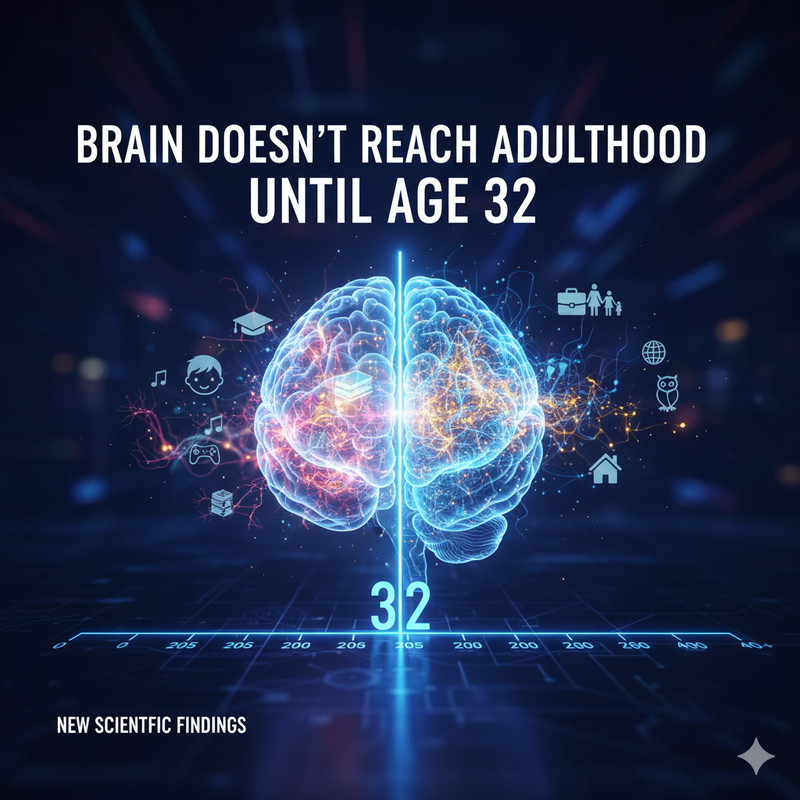
Your Brain Doesn't Reach Adulthood Until Age 32: Groundbreaking Study Reveals Five Phases of Brain Development
Your Brain Doesn't Reach Adulthood Until Age 32: Groundbreaking Study Reveals Five Phases of Brain Development
Think you became an adult when you turned 18? Or maybe 21? Science has some news that might surprise you: your brain doesn't actually finish adolescence until around age 32. A landmark study from the University of Cambridge has completely rewritten our understanding of brain development, identifying five distinct phases of neural wiring across the human lifespan—and the findings are challenging everything we thought we knew about growing up.
## The Study That's Changing Everything
Published in the prestigious journal Nature Communications, researchers analyzed nearly 4,000 MRI brain scans from participants ranging from newborns to 90-year-olds. What they discovered was remarkable: rather than developing in a smooth, gradual progression, our brains undergo dramatic transformations at four specific turning points throughout life.
These critical ages—approximately 9, 32, 66, and 83—mark major shifts in how our brain's neural networks organize, communicate, and function. Between these milestones lie five distinct brain "epochs," each characterized by unique patterns of development, stability, or decline.
Dr. Alexa Mousley, the Gates Cambridge Scholar who led the research, explained the significance: "This study is the first to identify major phases of brain wiring across a human lifespan. These eras provide important context for what our brains might be best at, or more vulnerable to, at different stages of our lives."
## The Five Phases of Your Brain's Journey
### Phase 1: Childhood (Birth to Age 9)
From the moment we're born until about nine years old, our brains are in what scientists call "network consolidation" mode. Babies are born with an overabundance of synapses—the connections between brain cells. During childhood, the brain essentially prunes this neural garden, keeping the connections that get used most while eliminating those that don't.
During this period, grey and white matter grow rapidly in volume, cortical thickness reaches its peak, and the characteristic ridges on the brain's outer surface stabilize. By age nine, children experience a fundamental step-change in cognitive capacity, though this milestone also coincides with increased vulnerability to mental health disorders.
### Phase 2: Adolescence (Age 9 to Age 32)
Here's where things get really interesting—and where conventional wisdom gets completely upended. Previous understanding suggested adolescence began with puberty and ended before age 20, but this groundbreaking research reveals it extends to around 32 years old in Western countries.
This isn't just an arbitrary extension of the term "teenager." During this entire period, the brain undergoes a unique type of development that doesn't happen at any other life stage. Adolescence is the only era in which neural efficiency—characterized by well-connected pathways with short communication routes—actually increases rather than decreases.
What does this efficiency look like in practice? During adolescence, white matter continues to grow in volume, making the brain's communication networks increasingly sophisticated. Information travels faster between brain regions. Cognitive performance steadily improves. The brain becomes better at complex tasks requiring coordination between multiple areas.
Around age 32, the brain experiences "the most directional changes and a large shift in trajectory" compared to all other turning points in life. This is when white matter integrity and volume reach their peak. It's the strongest topological turning point of your entire lifespan—the moment your brain truly transitions from adolescent architecture to adult functioning.
Dr. Mousley emphasized an important distinction: "We're certainly not saying that people under 30 will behave like teenagers, or even that their brain looks like a teenager's brain. We're talking about the pattern of change." In other words, a 28-year-old doesn't act like a 14-year-old, but both their brains are still in the same developmental phase, just at different points along that trajectory.
### Phase 3: Adulthood (Age 32 to Age 66)
Welcome to the longest phase of brain development—or more accurately, brain stability. Once you hit your early thirties, your neural architecture settles into its mature configuration. This period corresponds with a plateau in intelligence and personality, meaning the cognitive abilities and character traits you've developed largely stabilize.
During adulthood, the brain changes much more slowly than in earlier phases. There are no major developmental turning points for over three decades. The efficiency gained during adolescence begins to gently reverse, but there are no abrupt declines. Think of it as the brain's prime operating years—not necessarily getting better, but maintaining peak performance with only gradual changes.
While the brain doesn't show abrupt signs of decline during this phase, shifts in connection patterns do occur due to decreasing white matter integrity. The brain gradually begins working more independently in separate regions rather than coordinating as tightly as a unified whole.
### Phase 4: Early Aging (Age 66 to Age 83)
The early sixties mark an important shift in health and cognition, with the onset of dementia and elevated blood pressure becoming more common for many people—both of which can accelerate brain aging. Around age 66, the brain enters a phase characterized by decreasing connectivity and the continued degeneration of white matter.
This doesn't mean cognitive collapse—many people in their sixties, seventies, and early eighties maintain sharp minds and active lives. But the brain's structural organization begins changing in measurable ways, with neural networks becoming less integrated and communication between regions slowing down.
### Phase 5: Late Aging (Age 83 and Beyond)
The final phase of brain architecture emerges around age 83. This period sees further decreases in brain connectivity and continued white matter degeneration. The changes that began in early aging continue and often accelerate.
Researchers noted that this later phase shows more individual variation than earlier stages, potentially reflecting how different people's brains age at different rates based on genetics, lifestyle, health conditions, and environmental factors.
## Why Adolescence Lasts So Much Longer Than We Thought
The extended adolescence finding surprised even the researchers. Why does the adolescent brain phase persist for more than two decades?
The answer lies in the complexity of the human brain and the sophisticated cognitive abilities we develop. Unlike simpler biological milestones like physical growth, brain development involves intricate rewiring of billions of neural connections. The transition to adulthood is influenced by cultural, historical, and social factors, making it context-dependent rather than a purely biological shift.
Interestingly, the study focused primarily on Western countries—the United Kingdom and United States. The researchers acknowledged that adolescence patterns might differ in other cultural contexts, though they didn't elaborate on potential variations. This raises fascinating questions about whether brain development timelines are influenced by cultural expectations, educational systems, or societal structures.
## Real-World Implications: What This Means for You
These findings aren't just academic curiosities—they have practical implications for how we understand ourselves and others.
**For Parents and Educators**: That college student or young professional in their twenties isn't being immature when they make impulsive decisions or struggle with long-term planning. Their brain literally hasn't finished developing yet. The neural architecture supporting executive function, risk assessment, and emotional regulation is still being refined. Understanding this can foster patience and provide more appropriate support during these years.
**For Young Adults**: If you're in your twenties and sometimes feel like you're still figuring things out—you are! And that's completely normal. Your brain is still in its prime development phase. This is actually an excellent time for learning new skills, as neural efficiency is at its peak. The cognitive improvements happening in your brain right now set the foundation for the rest of your adult life.
**For Mental Health**: Adolescence is when the risk of mental health disorders is at its highest. Knowing that this vulnerable period extends into the thirties helps explain why many psychiatric conditions first emerge in the twenties. It also suggests we should maintain robust mental health support systems well beyond the traditional "youth" services that often cut off at age 25.
**For Career Development**: Peak cognitive performance arriving in the early thirties aligns with many people's career trajectories. It's not coincidence that many professionals hit their stride around this age—their brains have literally just finished optimizing.
**For Legal and Social Policy**: These findings raise important questions about age-based policies. If brains don't reach adult architecture until 32, what does that mean for legal definitions of adulthood? Should we reconsider policies around sentencing, military service, or other age-restricted activities? While 18 or 21 remain reasonable thresholds for legal purposes, this research adds nuance to debates about young adult culpability and decision-making capacity.
## The Surprising Stability of Adulthood
One of the most striking findings is just how stable the adult brain phase is. For more than three decades—from 32 to 66—your brain maintains relatively consistent architecture. This helps explain why personality tends to solidify around age 30. The person you are in your thirties is likely the person you'll remain, at least in terms of core characteristics.
This stability also has implications for learning and adaptation. While neuroplasticity—the brain's ability to form new connections—continues throughout life, the dramatic rewiring of adolescence doesn't repeat. Adult learning involves strengthening or weakening existing pathways rather than fundamentally restructuring neural architecture.
## When Aging Begins
Dr. Mousley noted surprise at how closely the identified age phases aligned with major life events, from puberty to health changes in later life, and even social transitions like parenthood that often occur in the early thirties.
The identification of age 66 as a major turning point aligns with observable health changes. Many people notice cognitive shifts in their mid-sixties—not dramatic declines, but subtle changes in processing speed, memory, or multitasking ability. Understanding this as a natural phase transition rather than individual failure can help people adjust expectations and implement strategies to maintain cognitive health.
## The Four Critical Turning Points
The study's identification of four pivotal ages—9, 32, 66, and 83—provides a roadmap for understanding brain vulnerability and optimization throughout life.
**Age 9**: The transition from childhood to adolescence represents the brain's first major reorganization after early development. This is when working memory capacity shifts and mental health vulnerability increases.
**Age 32**: The strongest turning point of the entire lifespan, this marks the completion of adolescent brain development and entry into adult neural architecture. Intelligence and personality stabilize.
**Age 66**: The beginning of measurable cognitive aging, though not necessarily decline. Brain networks become less integrated, and health factors start playing a larger role.
**Age 83**: The transition to late aging, characterized by more pronounced changes in brain connectivity and function.
## Methodological Breakthrough
What made this study possible was its unprecedented scale. By analyzing nearly 4,000 brain scans across nine decades of life, researchers could detect patterns that smaller studies would miss. They used MRI diffusion scans, which map neural connections by tracking how water molecules move through brain tissue—providing a window into the brain's structural organization.
The large dataset allowed researchers to account for individual variation while identifying consistent patterns across the population. Some people's brains might hit these turning points slightly earlier or later, but the overall trajectory holds remarkably consistent.
## Limitations and Future Research
While groundbreaking, this study has limitations. The research primarily examined Western populations, and brain development patterns might differ across cultures. The study looked at structure, not function—how the brain is wired, not necessarily how it performs specific tasks.
Future research will need to explore:
- How these developmental phases relate to specific cognitive abilities
- Whether interventions can optimize development during critical windows
- How lifestyle factors influence the timing of transitions
- Cultural and geographic variations in brain development timelines
- Gender differences in developmental trajectories
## Practical Takeaways
So what should you do with this information?
**If you're under 32**: Embrace this as a period of growth. Your brain is still optimizing, which means it's particularly receptive to learning and skill development. This is an ideal time to establish healthy habits, pursue education, and develop expertise in areas you're passionate about.
**If you're 32-66**: Recognize this as your brain's most stable period. The cognitive abilities you've developed are plateauing at their peak. Focus on maintaining mental and physical health to preserve these capacities.
**If you're over 66**: Understand that changes are natural, but decline isn't inevitable. Mental stimulation, physical exercise, social engagement, and cardiovascular health all help maintain cognitive function during aging phases.
**For everyone**: Stop judging yourself or others based on outdated notions of when people "should" have their lives figured out. If brain adolescence lasts until 32, then functioning like a fully mature adult in your twenties isn't just difficult—it's neurologically impossible.
## The Bigger Picture
This research fundamentally changes how we should think about human development. The neat categories we've used—childhood, adolescence, adulthood—turn out to be more complex and longer-lasting than cultural assumptions suggest.
Understanding how the brain's structural journey involves major turning points rather than steady progression helps identify when and how neural wiring is vulnerable to disruption. This knowledge could improve our understanding of learning difficulties in childhood, mental health challenges throughout adolescence (now understood to extend into the thirties), and cognitive changes in later life.
The study also offers validation. If you're 28 and still feel like you're figuring out life, still making mistakes, still developing your sense of self—congratulations, you're exactly on schedule. Your brain is doing precisely what it should be doing: finishing the longest, most important developmental phase of your life.
## Conclusion
The revelation that adolescence extends to age 32 isn't about excusing irresponsibility or extending parental support indefinitely. It's about understanding human development with scientific accuracy rather than cultural assumptions.
Your brain is an incredible organ that takes decades to fully mature. From birth through age nine, it consolidates connections. From nine through thirty-two, it optimizes efficiency in ways that never happen again. From thirty-two through sixty-six, it maintains peak architecture. And in later years, it adapts to new realities while preserving accumulated wisdom.
Each phase has its advantages and vulnerabilities. Each transition represents opportunity and challenge. Understanding these patterns doesn't dictate how you should live your life, but it does offer insight into why certain things feel easier or harder at different ages—and why patience with ourselves and others during these lengthy developmental windows isn't just kindness, it's scientifically justified.
So next time someone jokes about millennials not growing up, you can smile and share the science: their brains literally haven't finished developing yet. And that's not a bug in human development—it's a feature of the most sophisticated cognitive machinery in the known universe.
Comments (0)
Please log in to comment
No comments yet. Be the first!