Finance & Business
Truecaller Enters the eSIM Business — A Bold Bet to Save Its Revenue Model
It's a name almost everyone in Africa, South Asia, and the Middle East knows. Truecaller — the Swedish-founded app that tells you who is calling before you pick up — has quietly become one of the most used apps on the planet, with over 500 million active users globally. But behind that impressive user base, Truecaller is facing a serious business challenge. And its latest move — launching an eSIM service for international travelers — signals a company fighting hard to reinvent itself. At digital8hub.com, we break down the full picture.
Why Is Truecaller Launching eSIM?
The timing of Truecaller's eSIM launch tells you everything you need to know. This move aims to strengthen the company's balance sheet and diversify business lines amid declining advertising revenue. Net sales fell 27% in the first quarter, with ad revenue dropping 44%. Variety
That's a dramatic decline — and it has a specific cause. Truecaller said that it lost roughly one-third of ad traffic from its largest partner in August 2025 — a partner analysts identified as Google. The company attributed the drop to an unresolved "algorithm issue," while its CFO said the partner still accounts for more than a third of total revenue. The Washington Post
Losing a third of traffic from a partner that represents a third of your revenue is a seismic shock to any business model. Add to that the fact that 65–70% of Truecaller's earnings now come from ad revenue, and you begin to understand why the company is moving aggressively to find new income streams — fast. The Washington Post
The company also cut 70 jobs last week, underscoring the urgency of the pivot. Variety
What Exactly Is the Truecaller eSIM Service?
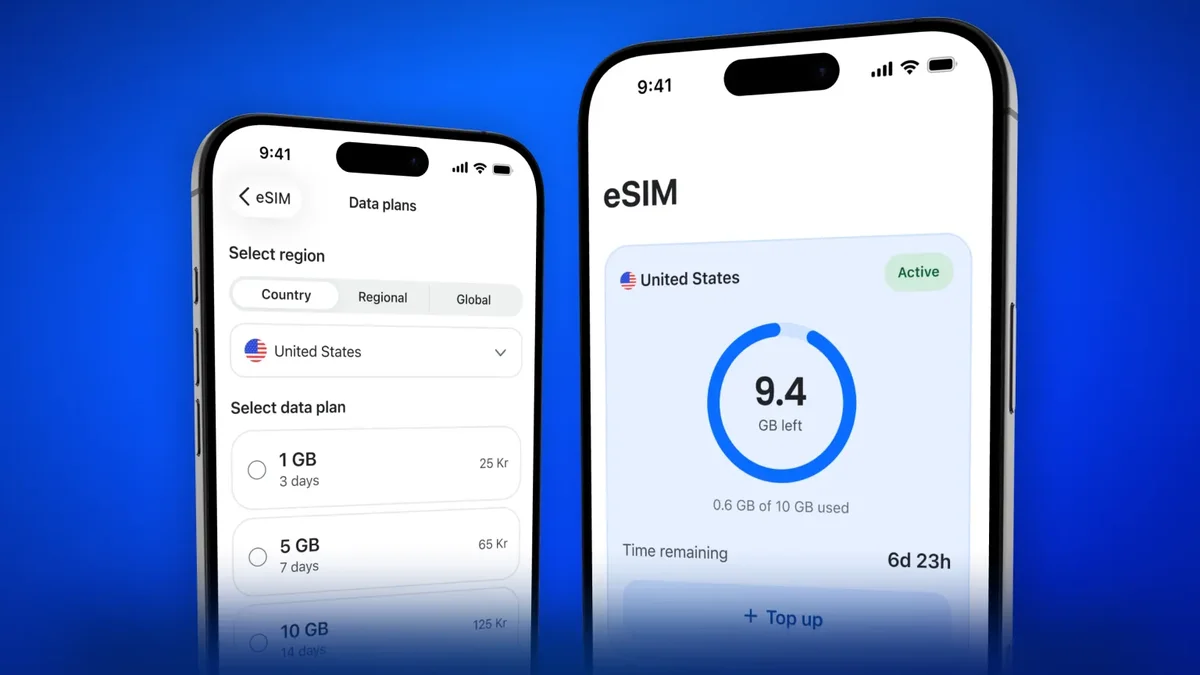
Truecaller has launched an eSIM service aimed at travelers, with plans ranging from 1 GB for 7 days to 20 GB for 30 days. Initially, the eSIM product is available in 29 countries, including the US, UK, Germany, France, Italy, and Indonesia. Variety
For the uninitiated: an eSIM (embedded SIM) is a digital SIM card built into your phone that lets you activate a mobile data plan without needing a physical SIM card. For international travelers, eSIMs are a game-changer — no more hunting for local SIM cards at airports or paying eye-watering roaming charges.
Truecaller is partnering with global connectivity provider Telna and software developer Telness Tech to run the platform. This means Truecaller isn't building the telecom infrastructure from scratch — it's acting as a distribution layer on top of existing global connectivity networks, keeping its overhead lean. Variety
Why India — Truecaller's Biggest Market — Is Excluded
One of the most notable details of this launch: India — Truecaller's largest market — is not included. This may be due to strict telecommunications regulations in the country, as the Indian government previously blocked services like Airalo and Holafly. Variety
India accounts for around 70% of Truecaller's global user base, making its absence from the eSIM rollout a significant limitation in the short term. However, if India's regulatory environment around eSIMs evolves — as it has been gradually doing — the opportunity for Truecaller to bring eSIM to its home turf could be transformative.
The Competitive Landscape: Can Truecaller Win?
Truecaller is entering a market that already has established players. Competitors like Airalo, Holafly, and NordVPN's Saily already exist in the travel eSIM space. However, Truecaller is leveraging its base of over 500 million active users, and COO Fredrik Kjell noted that the existing audience provides a significant advantage in acquiring new users. Variety
That's a fair point. Distribution is everything in the app economy. Truecaller doesn't need to convince people to download a new app — it just needs to convince its existing hundreds of millions of users to try a new feature. That's a far lower barrier to adoption than any startup eSIM provider faces.
The travel eSIM market itself is booming. The convergence of travel-specific eSIM offerings and full-service MVNO operations is one of the defining trends of 2026, driven by the appeal of revenue predictability and the demand for seamless global connectivity. Truecaller is entering at exactly the right moment in that market's maturation. Newsweek
A Company in Transformation
The eSIM launch is just one piece of a broader Truecaller reinvention story. Truecaller is shifting toward AI-driven monetization as downloads slow in India and global competition intensifies, focusing on ads, enterprise services, and subscriptions to diversify revenue. CNBC
In March 2026, Truecaller also announced an important shift in its business messaging ecosystem — moving away from an exclusive partnership model to a multi-partner approach in India and globally. New partners including Gupshup, Onextel, Cloudcom, and GTS are already live on the platform. digital8hub
Meanwhile, in-app revenue has risen sharply — from $600,000 in 2017 to $39.3 million in 2025, with monthly revenue from in-app purchases now consistently above $2 million and still climbing. Premium features like AI Assistant and Family Protection are driving subscription growth, giving Truecaller a stickier, more predictable revenue base alongside its ad business. The Washington Post
The company is also making inroads on iOS. Truecaller's presence on iOS has grown from less than 5% of its total downloads in 2020–2021 to around 11–12% in recent years — highlighting a shift toward higher-value markets. The Washington Post
What This Means for Users
For Truecaller's existing users, the eSIM launch is a genuinely useful addition. Instead of switching between multiple apps to manage international travel connectivity, you can now handle it within an app already on your phone. If the pricing is competitive with Airalo or Holafly — and early indications suggest it will be — the convenience factor alone could drive strong adoption.
For businesses watching Truecaller's pivot, this is a textbook case of platform monetization: taking a massive, loyal user base built around one core feature and layering new revenue streams on top of it. It's the same playbook used by WhatsApp (payments), Uber (groceries), and Grab (financial services).
The Bottom Line
Truecaller's eSIM move is not a moonshot — it's a survival strategy, smartly executed. The company faces real headwinds: declining ad revenue, Google dependency, job cuts, and a challenging regulatory environment in its core market. But it also has something most startups would kill for: half a billion active users who already trust it.
Whether eSIM becomes a meaningful revenue stream or just a footnote in Truecaller's pivot story will depend on execution, pricing, and how quickly it can expand beyond the initial 29 countries. But one thing is clear: Truecaller is not standing still.
Stay across every major move in tech and business at digital8hub.com — your independent source for news that actually matters.
Comments (0)
Please log in to comment
No comments yet. Be the first!