Finance & Business
SK Hynix Dethrones Samsung After 26 Years to Become Korea's Most Valuable Company
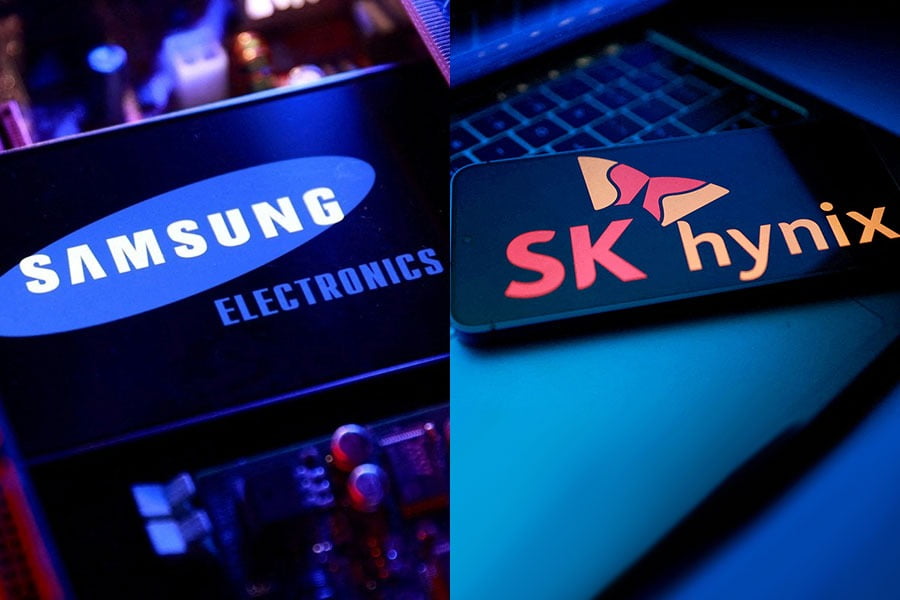
For more than a quarter of a century, one name sat unchallenged atop South Korea's stock market: Samsung Electronics. That era ended on Monday, June 22, 2026, when SK Hynix overtook Samsung to become the country's most valuable listed company, in a milestone that captures, perhaps better than any other single data point, just how completely the artificial intelligence boom has reshaped the global semiconductor industry.
The shift was both dramatic and razor-thin. According to Reuters, SK Hynix shares surged 5.7% on Monday, lifting the company's market capitalisation to 2,082.5 trillion won — roughly $1.35 trillion — as of mid-morning trading in Seoul. Samsung Electronics, by contrast, rose just 0.4%, bringing its own market cap to 2,081.3 trillion won, excluding preferred shares. The gap amounted to little more than a rounding error in percentage terms, but symbolically, it was enormous: Samsung Electronics had held the title of Korea's most valuable company continuously since the year 2000.
The AI Boom's Biggest Korean Winner
The story behind SK Hynix's ascent is, fundamentally, the story of the global AI infrastructure buildout. SK Hynix has emerged as the dominant supplier of high-bandwidth memory, or HBM — a specialized, ultra-fast type of memory chip that has become a critical bottleneck component for the advanced AI processors powering the current wave of generative AI systems. Where conventional memory chips have historically traded as a relatively undifferentiated, price-volatile commodity, HBM chips function more like a specialized, premium component — one where scale, manufacturing expertise, and qualification with major customers create durable competitive advantages.
SK Hynix counts Nvidia and Google among its major customers for this technology, supplying the memory that sits at the heart of the AI accelerator chips driving the current data centre construction boom across the United States and beyond. The company recently confirmed it had begun supplying samples of its next-generation HBM4 memory to its largest customers — a signal that its technological lead in the category remains intact even as competitors race to catch up.
The financial results of that positioning have been extraordinary. SK Hynix shares have risen more than 340% so far in 2026 alone — vastly outpacing Samsung's own substantial 200% gain over the same period. Both companies have benefited enormously from the broader AI rally, but SK Hynix's gains have simply outrun its larger rival's.
A Remarkable Turnaround Story
What makes Monday's milestone particularly striking to longtime observers of Korea's chip industry is SK Hynix's own history. As Reuters noted in its report, the company nearly collapsed under crushing debt roughly two decades ago — a corporate near-death experience that makes its current position atop Korea's stock market all the more dramatic a reversal of fortune.
The shift didn't happen overnight in a single trading session, though Monday's headline-grabbing crossover made it feel that way. Korean financial outlet Seoul Economic Daily had reported as early as mid-May that SK Hynix's forward price-to-earnings ratio had already surpassed Samsung's for the first time — a valuation signal that, according to market analysts cited by the outlet, suggested "even the 'No. 1 Korean company premium' has now shifted" ahead of the actual market cap crossover. That early valuation shift, the outlet noted, had reversed an 8-point gap between the two companies' PER ratios in just three months.
By May, SK Hynix had already joined both Samsung and Micron Technology in surpassing the symbolically significant $1 trillion market valuation threshold for the first time — itself a sign of how rapidly the AI memory chip rally was lifting all three of the industry's major players simultaneously.
A Razor-Thin and Possibly Temporary Lead
It's worth noting that Monday's crossover, while historic, came with important caveats. Reuters specifically described SK Hynix's lead as having "briefly topped" Samsung's valuation — language that reflects how closely matched the two companies' market caps remain. According to Seoul Economic Daily's same-day reporting, when Samsung Electronics' preferred shares, valued separately at approximately 180 trillion won, are factored into the comparison, Samsung's total market capitalisation actually remains higher than SK Hynix's when measured on that fuller basis.
This nuance matters: common-share market capitalisation, the metric most international wire services use for these comparisons, is genuinely close enough that the rankings could plausibly flip back and forth in the sessions ahead depending on daily trading moves. Reports also noted that Samsung shares were actually trading down slightly on the same day SK Hynix's lead was confirmed, which contributed directly to the crossover.
Adding a further wrinkle to the competitive picture, Seoul Economic Daily reported that SK Hynix's sharp share price gains have been partly attributed to the company's push toward listing American depositary receipts, or ADRs, in the United States. Industry analysts cited in that report suggested that if the ADR listing materialises, SK Hynix's valuation could climb further still, potentially approaching the level of its American rival Micron Technology.
What This Means for Korea's Tech Landscape
Samsung Electronics is not just Korea's largest technology company — it is, by a considerable margin, the most globally recognised Korean brand of any kind, spanning smartphones, televisions, home appliances, and semiconductors across consumer and enterprise markets worldwide. Its dethronement, even a narrow and possibly temporary one, carries significant symbolic weight in a country where Samsung's market position has long been treated as a bellwether for the broader Korean economy.
For SK Hynix, the milestone caps an extraordinary multi-year run in which a company once defined by financial distress has transformed into what Reuters describes as the world's most valuable memory chipmaker — a remarkable distinction given the global scale and brand recognition of competitors like Samsung and Micron.
The broader Korean semiconductor sector has been a major beneficiary of the AI infrastructure spending wave sweeping through US technology giants, who have been racing to build out data centre capacity to support generative AI products and services. That demand has tightened global memory chip supply and pushed prices upward, a dynamic that has disproportionately rewarded the companies — like SK Hynix — that hold leading positions in the highest-value, most technically demanding categories of memory chips.
Looking Ahead
Whether SK Hynix holds onto its newly claimed position atop Korea's stock market in the weeks and months ahead remains an open question, given how narrow Monday's gap actually was. What is not in question is the structural shift the moment represents: a company that was, within living memory, fighting for survival has become the most valuable corporate entity in one of the world's most important technology-exporting economies — built almost entirely on the back of the chips powering the global AI boom.
For investors and industry watchers, Monday's milestone is likely to be remembered less as a single definitive turning point and more as confirmation of a trend that has been building visibly for months: in the age of AI infrastructure, the companies that control the most critical, hardest-to-replicate components of the supply chain are accruing value at a pace that even the world's most established technology giants are struggling to match.
Comments (0)
Please log in to comment
No comments yet. Be the first!