Finance & Business
Russia Is Feeding Iran Intelligence to take out Americans — And That Changes Everything
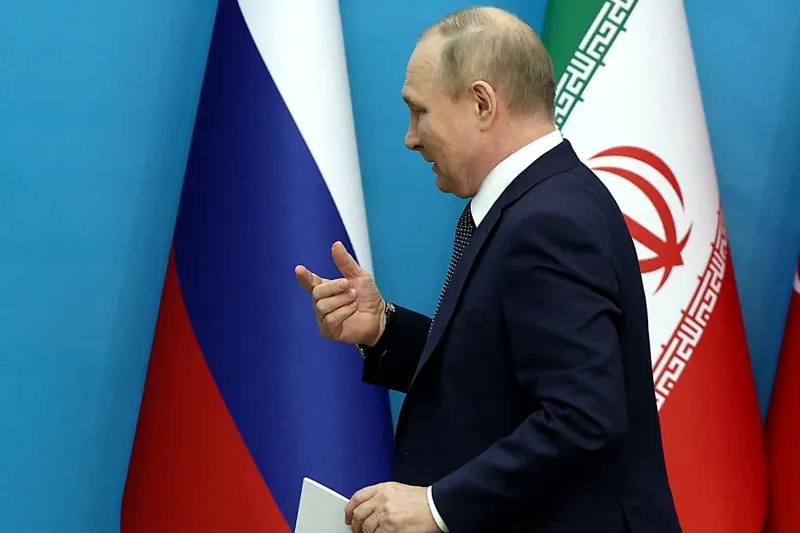
The Iran conflict just acquired a dimension that transforms it from a bilateral military campaign into something far more dangerous. A Washington Post report published Friday morning — citing multiple current and former US and Middle Eastern officials — reveals that Russia is providing Iran with targeting intelligence to attack American forces in the Middle East. It is the first confirmed indication that a major nuclear power with a permanent seat on the UN Security Council is actively assisting in the targeting of US military personnel. The implications are severe — and they are being felt in Washington, Tel Aviv, and every allied capital simultaneously.
What Russia Is Providing
According to the Washington Post report, Russia is supplying Iran with real-time or near-real-time targeting information that is being used to direct Iranian drone and missile strikes against US forces and installations across the Middle East. The precise nature of the intelligence — whether it includes signals intercepts, satellite imagery, radar tracking data, or human intelligence — has not been fully specified. But the report makes clear that the intelligence is operationally significant: it is being used to improve the accuracy and effectiveness of Iranian strikes against American targets.
The report also reveals a more significant long-term dimension to the Russia-Iran intelligence relationship. Russia has agreed to supply Iran with a Kanopus-V reconnaissance satellite — a Russian-made system equipped with a high-resolution camera capable of monitoring military targets across the Middle East with a resolution of approximately 1.2 metres. While technically classified as a civilian satellite, the Kanopus-V would give Iran the ability to continuously monitor US military bases, Israeli army facilities, and Saudi oil infrastructure from orbit — a capability that would fundamentally upgrade Iran's intelligence-gathering architecture for years to come. Senior IRGC officials have made multiple trips to Moscow since 2018 to negotiate the terms of the agreement, and Russian experts have been in Iran training ground crews at a newly built satellite operations facility near the northern city of Karaj.
Russia's Stated Position vs. Its Actual Conduct
The intelligence sharing revelation sits in jarring contrast to Russia's official public posture. Moscow has publicly condemned the US-Israeli strikes on Iran as an "unprovoked act of armed aggression" and called for an immediate ceasefire — positioning itself as a voice of restraint and diplomatic resolution. Russia's military pact with Iran does not formally require it to come to Iran's defence — a distinction Moscow has been careful to emphasise to avoid direct NATO escalation concerns. But providing targeting intelligence that is actively being used to kill American soldiers is not restraint. It is direct participation in the conflict by another name — a covert form of belligerence that carries enormous escalatory risk if formally acknowledged by Washington.
The White House has not yet issued a public response to the Washington Post report. The State Department declined to comment. The silence itself is telling — acknowledging Russia's role publicly would force a response, and the administration is clearly weighing the consequences of doing so. Senior US officials quoted in the report described the intelligence sharing as deeply alarming and said it had been raised through back-channel diplomatic communications with Moscow. Russia has not responded.
The Broader Russia-Iran-China Axis
Russia's intelligence support for Iran does not exist in isolation. Since 2022, the Russia-Iran relationship has deepened dramatically — with Iran supplying Russia with Shahed-136 drones that have been used extensively against Ukrainian civilian infrastructure, in exchange for Russian military hardware, technical cooperation, and now intelligence support. China has condemned the US-Israeli strikes on Iran and described the killing of Supreme Leader Khamenei as a violation of the UN Charter — though Beijing has stopped short of providing direct military assistance to Tehran. The combination of Russian intelligence support, Chinese diplomatic cover, and Iranian operational capacity represents a convergence of adversarial interests that the United States has not faced simultaneously since the Cold War.
The war powers resolution to halt Trump's attack on Iran was rejected by the House on Thursday in a 212-219 vote — a day after the Senate voted down a similar measure. Congress has authorised the conflict to continue. But the revelation that Russia is actively helping Iran target US forces adds a dimension that no war powers resolution anticipated — and one that will force a fundamental reassessment of the conflict's scope, its risks, and its potential endpoints.
What It Means for American Forces in the Region
For the US service members currently deployed across the Gulf — in Kuwait, Bahrain, Qatar, the UAE, Iraq, and aboard the Navy's carrier strike groups — the Russia intelligence revelation has immediate operational significance. Five US soldiers have already been killed in the conflict, with a sixth identity being processed by the Pentagon. Iranian strikes have hit US installations at Camp Arifjan, Ali Al Salem Air Base, the Fifth Fleet headquarters in Bahrain, Al Udeid Air Base in Qatar, and Erbil in Iraq. If those strikes are being guided by Russian intelligence — by targeting data derived from Russia's superior satellite and signals infrastructure — the threat to American forces is materially more severe than if Iran were operating on its own capabilities alone.
Russia just put its thumb on the scale. America has noticed. The question is what it does next.
For the latest updates on Operation Epic Fury and the Russia-Iran intelligence relationship, follow digital8hub.com.
Comments (0)
Please log in to comment
No comments yet. Be the first!