Finance & Business
Nvidia's Quarterly Profit Hits $43 Billion — AI Chip Demand Is Rewriting the Rules of Big Tech
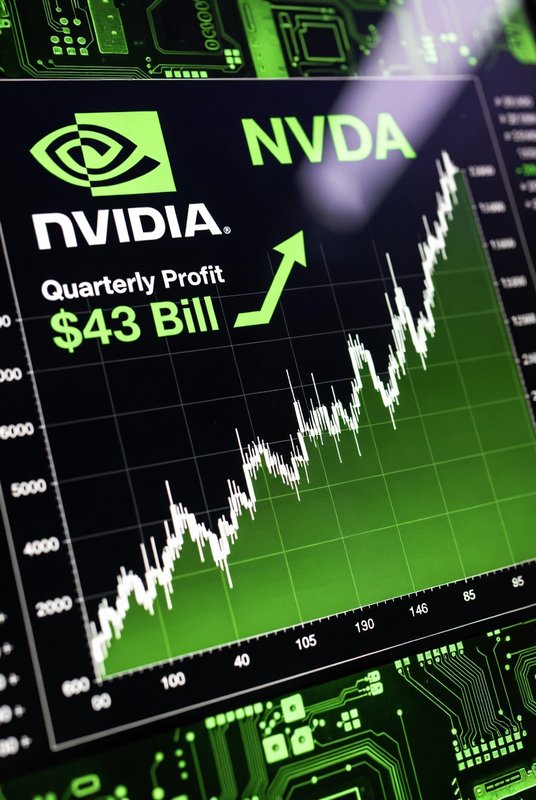
In a financial result that left Wall Street momentarily speechless, Nvidia has reported a quarterly profit of $43 billion — a number so large it's difficult to contextualize without comparisons. To put it plainly: that's more profit in three months than most Fortune 500 companies generate in several years. The AI chip giant is no longer just a tech company. It is the infrastructure backbone of the artificial intelligence revolution, and the world is paying for it — literally.
The Numbers That Shook the Market
Nvidia's latest quarterly earnings report has sent ripples across the financial world. The $43 billion profit figure represents a dramatic year-over-year leap, driven almost entirely by the relentless global appetite for its H100 and Blackwell series AI chips. Revenue for the quarter also surpassed expectations, with data center sales — the division responsible for AI hardware — accounting for the overwhelming majority of total income.
Analysts had predicted strong results, but the scale of Nvidia's outperformance caught even the most bullish observers off guard. The company's stock responded accordingly, adding hundreds of billions in market capitalization in the days following the announcement, briefly pushing Nvidia back into the conversation for the world's most valuable company.
Why AI Chips Are in Such High Demand
To understand Nvidia's meteoric rise, you have to understand what's happening in the broader AI landscape. Every major tech company — from Microsoft and Google to Amazon and Meta — is in an arms race to build and expand AI data centers. Training large language models, running inference at scale, and powering the next generation of AI products all require enormous computational power. And right now, Nvidia's GPUs are the gold standard for that work.
The H100 chip, which became the symbol of the AI boom, has a waiting list that stretches months. Its successor, the Blackwell architecture, is already sold out through much of 2025 and into 2026. Hyperscalers are ordering chips by the tens of thousands. Startups are fighting over allocation. Governments are stockpiling them for national AI initiatives. Demand, in short, is not slowing down.
Jensen Huang: The Man Behind the Moment
Nvidia CEO Jensen Huang has become one of the most recognizable figures in global tech — and arguably the right person at the right time. His decade-long bet on parallel computing and GPU architecture, made long before AI was a mainstream conversation, has paid off in historic fashion. Huang's insistence on building CUDA — Nvidia's proprietary software platform — alongside its hardware created a moat that competitors have struggled to cross.
At a recent earnings call, Huang described the current moment as the beginning of a new industrial revolution. "Every country, every company is building its AI infrastructure," he said, signaling that Nvidia sees years of sustained demand ahead, not a temporary spike.
The Competition Is Watching — and Sweating
Nvidia's success has not gone unnoticed by rivals. AMD has been aggressively pushing its MI300X AI accelerator and gaining traction with cloud providers looking to diversify their chip supply. Intel is attempting a comeback with its Gaudi series. And perhaps most significantly, the hyperscalers themselves — Google with its TPUs, Amazon with Trainium, and Meta with its custom silicon — are investing heavily in building chips that reduce their dependence on Nvidia.
But here's the challenge: catching Nvidia is not just about matching hardware specs. It's about replicating the CUDA ecosystem — the libraries, the developer tools, the years of optimization that make Nvidia chips easier to use for AI workloads. That software layer is a fortress, and tearing it down takes time that the AI industry isn't willing to give.
What This Means for Investors
For investors, Nvidia's results are both thrilling and thought-provoking. The stock has been one of the defining trades of the 2020s, turning early believers into millionaires and late adopters into nervous followers. At current valuations, Nvidia is priced for a future in which AI spending continues to compound at a breathtaking rate. If that future materializes — and most indicators suggest it will — the upside remains significant. If macro conditions shift, spending slows, or a credible competitor emerges faster than expected, the stock could face turbulence.
What's clear is that Nvidia is no longer a bet on AI as a concept. It is AI infrastructure, and infrastructure tends to get paid regardless of which applications or models end up winning the broader race.
The Bigger Picture: AI's Economic Footprint
Nvidia's $43 billion quarter is also a mirror held up to the broader economy. It reflects just how much capital is flowing into artificial intelligence — and how early we still are in that process. The data centers being built today will run for decades. The chips being ordered now will power applications that don't yet exist. And the companies making these investments are betting that AI will fundamentally transform how the world works, competes, and creates value.
Whether you're a tech enthusiast, an investor, a policy maker, or simply someone trying to understand where the world is heading, Nvidia's results are a signal worth paying attention to. The AI economy is not coming. It's already here — and Nvidia is cashing the checks.
Final Thought
$43 billion in a single quarter. The number will likely be surpassed in the quarters ahead. For now, Nvidia sits at the center of the most consequential technological shift since the internet — and it's doing so with profit margins that would make most companies blush. The AI chip era is in full swing, and Nvidia is writing the playbook in real time.
Comments (0)
Please log in to comment
No comments yet. Be the first!