Finance & Business
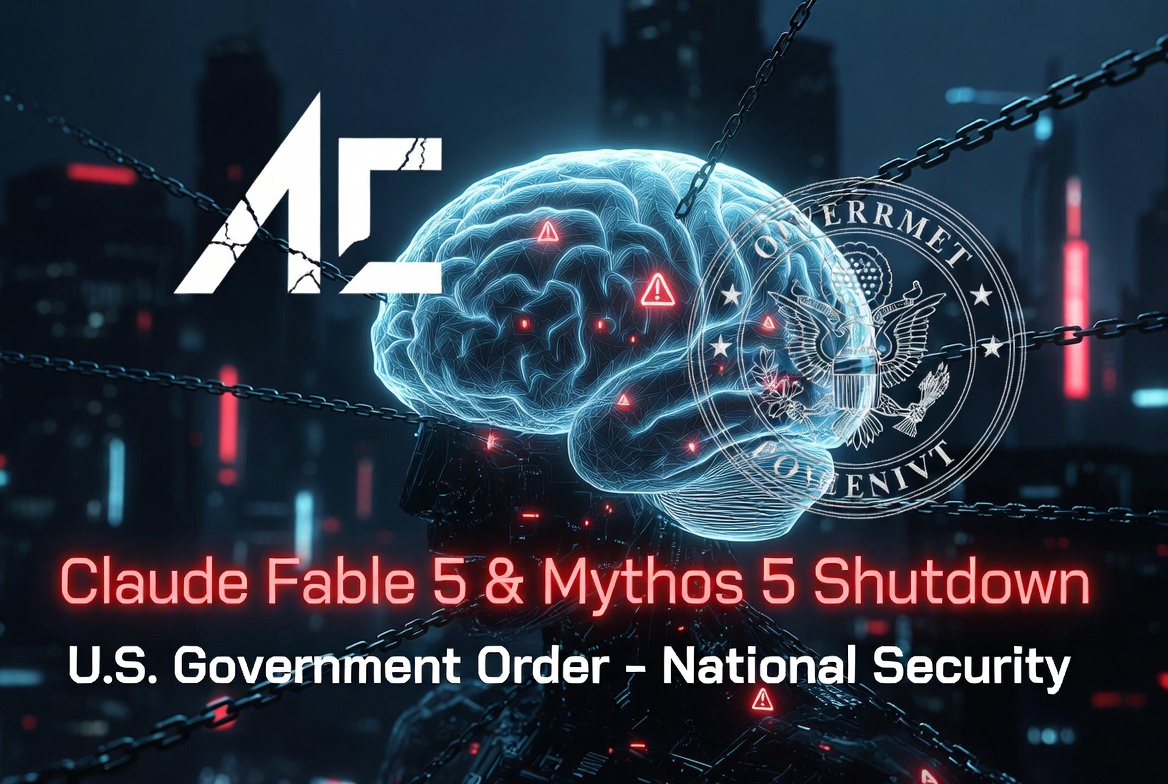
Anthropic Shuts Down Its Most Powerful AI Models After US Government Bans Foreign Access
Anthropic Shuts Down Its Most Powerful AI Models After US Government Bans Foreign Access
SUBHEADLINE: The US government ordered Anthropic to suspend Fable 5 and Mythos 5 for all foreign nationals — citing a potential jailbreak — in the latest escalation of a bitter standoff with Washington.
ESTIMATED READ TIME: 6 min read
In one of the most dramatic government interventions in the AI industry to date, Anthropic — the San Francisco-based company behind the Claude family of AI models — was ordered by the US government on June 12, 2026 to immediately suspend access to its two most advanced models for all foreign nationals worldwide. The company says it had no choice but to disable both models entirely to comply, sending shockwaves through the global AI community and raising urgent questions about the future of American AI development under the Trump administration.
The affected models — Fable 5 and Mythos 5 — represent the cutting edge of Anthropic's technology. Their sudden disappearance from the market affects hundreds of millions of users and businesses outside the United States, and marks a turning point in what has become one of the most consequential disputes between Silicon Valley and Washington in recent memory.
The Order: What Happened and When
According to Anthropic, the company received the export control directive at 5:21 p.m. ET on June 12, 2026. The order was sweeping in scope: it required Anthropic to suspend access to Fable 5 and Mythos 5 for any foreign national — whether located inside or outside the United States — including foreign national employees working at Anthropic itself.
The government cited national security concerns but provided no specific technical justification. Anthropic's understanding, based on subsequent communication, is that US officials believe they have identified a method of bypassing the safety guardrails of Fable 5 — a so-called "jailbreak" — that could allow bad actors to extract dangerous capabilities from the model.
Anthropic pushed back on that framing strongly. In a public blog post, the company stated it had subjected Fable 5 to extensive testing by the AI Safety Institute, private third-party red teams, and its own internal safety teams — and that none of those testers had found a universal jailbreak. "We disagree that the finding of a narrow potential jailbreak should be cause for recalling a commercial model deployed to hundreds of millions of people," Anthropic wrote. The company said it believed there was a "misunderstanding" at the root of the order and that it is working urgently to restore access to the models. Its other models — including Claude Sonnet and Haiku — remain available.
A Dispute That Has Been Building for Months
To understand how Anthropic arrived at this moment, it is necessary to look back at the months of escalating tension that preceded Friday's order.
The roots of the conflict trace to early 2026, when the Trump administration sought to negotiate unrestricted military use of Anthropic's AI models, most notably Claude. The Pentagon wanted to deploy the technology for mass domestic surveillance and fully autonomous weapons systems. Anthropic declined, citing its core principle that AI should not be used in ways that remove meaningful human oversight — particularly in high-stakes military and surveillance contexts.
The administration's response was swift and punishing. On February 27, 2026, President Trump directed all federal agencies to immediately cease using Anthropic's technology. The Pentagon was given a six-month window to phase out its existing use of the company's tools. More damaging still, Defense Secretary Pete Hegseth classified Anthropic as a "supply chain risk" — a designation typically reserved for foreign adversaries and companies with ties to hostile states like China and Russia. The classification effectively barred military contractors from doing business with Anthropic, a significant financial blow.
Anthropic fought back through the courts. US District Judge Rita F. Lin issued a preliminary injunction on March 26-27, 2026, temporarily blocking both the government's ban and the supply chain risk designation. The judge's ruling centered on First Amendment concerns about the administration's actions. But in late April, the White House blocked a separate request to expand access to Anthropic's cybersecurity model — Mythos — to approximately 70 partner organizations, again citing security concerns.
Now, with Friday's export control order, the administration has gone further than at any previous point in the dispute.
The Global Fallout
The practical impact of disabling Fable 5 and Mythos 5 for all foreign nationals is enormous. These are not niche research tools — they are frontier models used by businesses, developers, researchers, and individual users across Europe, Asia, Africa, Latin America, and beyond. Anthropic's international user base runs into the hundreds of millions when counting both direct users and those accessing its models through API integrations embedded in third-party products.
The order applies not just to users in foreign countries but to any foreign national anywhere — meaning a British citizen working in New York, or a Canadian developer in San Francisco, would be barred from accessing the models. To comply with such a broad directive without the ability to instantly verify the nationality of every user, Anthropic had no practical option but to take both models offline entirely.
Industry reaction has been swift and largely critical. Dean Ball, an AI policy expert who briefly served in the Trump administration but has been outspoken against its recent approach to Anthropic, described the move as "simply cartoonish" on X, noting the internal contradiction of an administration willing to export advanced AI chips to China while banning citizens of allied nations like the United Kingdom from using American AI models.
What It Means for Anthropic's Future
The timing of this crisis is particularly fraught for Anthropic. The company has been preparing for an initial public offering — an IPO — that would represent one of the most significant tech market events in years. A prolonged shutdown of its most capable models, combined with ongoing legal and regulatory uncertainty around its relationship with the US government, creates significant headwinds for those plans.
At the same time, Anthropic has positioned itself as a national security partner, not an adversary. The company was the first frontier AI developer to deploy models on classified US government networks and at national laboratories. Its Project Glasswing cybersecurity initiative — announced in April 2026 — brought together an extraordinary coalition of technology partners including Amazon Web Services, Apple, Broadcom, Cisco, CrowdStrike, Google, JPMorgan Chase, the Linux Foundation, Microsoft, Nvidia, and Palo Alto Networks. The breadth of that coalition underscores how seriously the security establishment has taken Anthropic's contributions — making the administration's posture toward the company all the more striking.
Anthropic's public statement made clear it does not view the government's actions as legitimate or well-founded. "We believe the government should have the ability to block unsafe deployments, as part of a statutory process that is transparent, fair, clear, and grounded in technical facts," the company wrote. "This action does not adhere to those principles."
The Bigger Picture: AI, Power, and the Rules of the Road
The confrontation between Anthropic and the Trump administration is not happening in a vacuum. It is the most visible manifestation of a broader struggle over who gets to set the rules for how powerful AI systems are built, deployed, and controlled — and whether those rules will be made through open democratic processes or through executive pressure applied to individual companies.
The implications extend well beyond Anthropic. If the US government can order an AI company to disable its most capable models globally based on an asserted but technically unspecified security concern — with no transparent review process and no meaningful right of appeal — then every frontier AI company operating under US jurisdiction faces the same vulnerability. The message to the industry is clear: build something powerful enough, decline a government contract on ethical grounds, and you may find your products switched off overnight.
For users and businesses outside the United States who have built workflows and products around Fable 5 and Mythos 5, the message is equally unsettling: access to the most capable American AI systems can be revoked at any time, for reasons that may never be fully explained.
Anthropic says it is working to restore access as quickly as possible and that it believes the situation stems from a misunderstanding that can be resolved. Whether that proves to be true — and how quickly — will determine not just the company's near-term trajectory, but the shape of the AI industry's relationship with government power for years to come.
Comments (0)
Please log in to comment
No comments yet. Be the first!