Finance & Business
Anthropic and OpenAI Are Both Launching Enterprise AI Joint Ventures
For the past four years, the defining battleground of the artificial intelligence industry has been the consumer internet — ChatGPT vs Claude vs Gemini, measured in monthly active users, viral moments, and the breathless coverage of benchmark comparisons that the general public has developed a surprising appetite for consuming.
That battleground is not disappearing. But it is being joined by a second front that may ultimately prove more consequential for the companies involved, more transformative for the global economy, and more interesting for anyone trying to understand where the AI industry is actually heading.
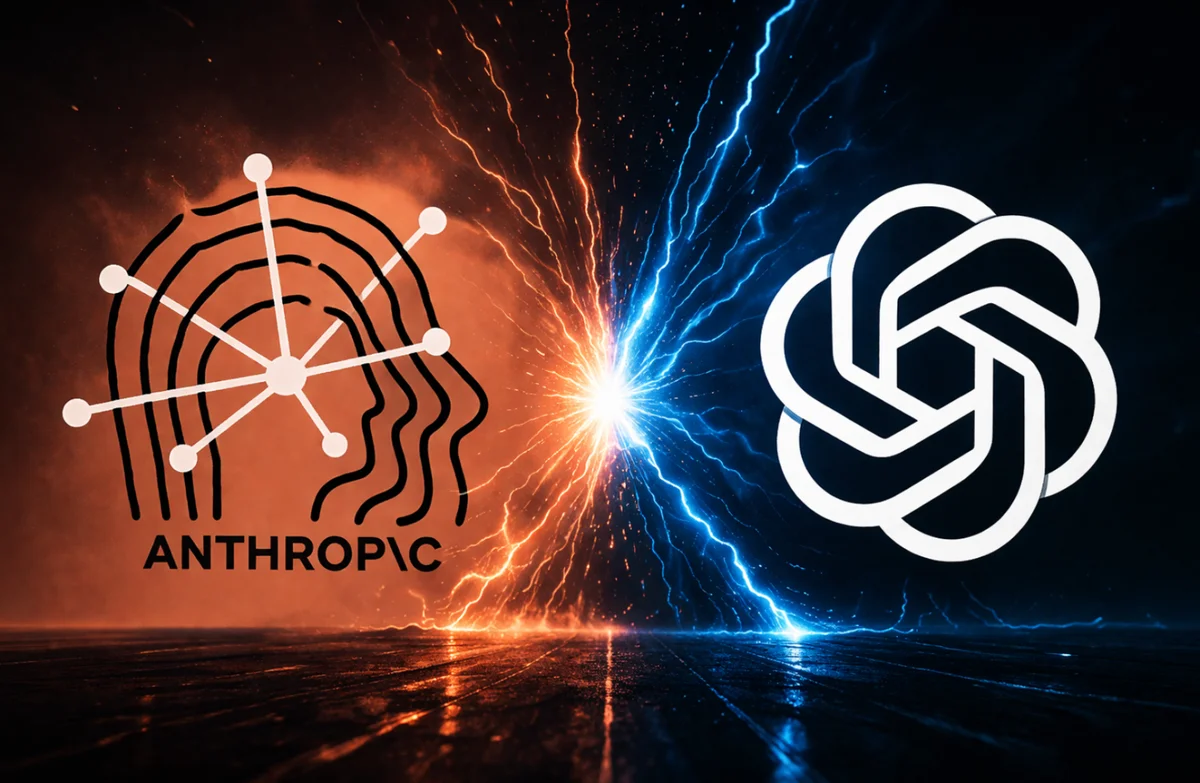
Both Anthropic and OpenAI — the two companies that have most visibly defined the frontier AI landscape since 2022 — are launching major joint ventures specifically targeting enterprise AI services. The simultaneous move by both companies into structured corporate partnerships signals a strategic convergence that the industry has been anticipating and that has now arrived with the clarity of an official announcement.
The battle for the enterprise AI market — the market for AI services deployed by corporations, governments, and institutions rather than individual consumers — is beginning in earnest. And the prize is enormous.
At digital8hub.com, we break down what each company is building, why enterprise is the next frontier, and what this development means for the businesses that will be on the receiving end of the most significant technological sales pitch in corporate history.
Why Enterprise AI Is the Real Prize
Before examining what Anthropic and OpenAI are specifically launching, it is worth understanding why the enterprise market has become the strategic priority for both companies simultaneously.
The Revenue Reality
Consumer AI products — even enormously popular ones — generate revenue through subscription fees and API access that, while significant, represent a fraction of what enterprise contracts are worth. A corporation that integrates AI into its core business processes — customer service, legal review, financial analysis, software development, supply chain management — generates far more revenue per relationship than any individual consumer subscriber. Enterprise contracts are larger, stickier, and more predictable than consumer revenue — exactly the characteristics that justify the capital investment required to build frontier AI systems.
The Mission Alignment
Both Anthropic and OpenAI have articulated missions that go beyond building popular consumer products. Anthropic's mission — the responsible development and maintenance of advanced AI for the long-term benefit of humanity — is best served by having its safety-focused AI deployed in the consequential decisions that large organisations make. OpenAI's super app ambitions require deep integration into the workflows of the enterprises that employ the professionals who will ultimately make or break ChatGPT's bid to become the default AI interface.
The Competitive Moat
Enterprise relationships, once established, are extraordinarily difficult to displace. A corporation that builds its AI infrastructure around Anthropic's Claude or OpenAI's GPT — integrating the models into proprietary workflows, training employees on their use, and embedding them in regulatory and compliance frameworks — faces significant switching costs that create durable competitive advantages for the AI provider. Winning enterprise customers early is therefore not just a revenue story — it is a moat-building exercise.
The Microsoft Lesson
Both companies have watched Microsoft's Azure AI business — built on its partnership with OpenAI — generate billions of dollars in enterprise cloud revenue, and both have drawn the obvious conclusion: the enterprise market rewards early, deep relationships with capabilities that organisations cannot easily replicate or replace.
What Anthropic Is Building
Anthropic's enterprise joint venture reflects the company's distinctive positioning in the AI landscape — a company that has differentiated itself on safety, reliability, and the particular qualities of Claude that make it well-suited to high-stakes professional environments.
The venture is structured around Anthropic for Business — a dedicated enterprise services organisation that provides corporations with customised Claude deployments, professional services support, compliance and security frameworks, and the kind of ongoing relationship management that enterprise customers require.
The core offering centres on Claude's particular strengths in the enterprise context. Claude's longer context window — its ability to process and reason across extremely large documents — makes it particularly valuable in legal, financial, and research contexts where organisations need AI that can work with entire contracts, annual reports, or research corpora rather than isolated text fragments.
Anthropic's emphasis on Constitutional AI — its approach to building AI systems with more reliable and predictable safety properties — is a significant selling point in regulated industries where AI outputs carry legal, financial, or reputational risk. A bank that deploys AI for credit decisions, or a pharmaceutical company that uses AI in drug development, needs a system whose behaviour is not just capable but reliably bounded — and Anthropic's safety focus is directly relevant to these requirements.
The joint venture structure allows Anthropic to partner with established enterprise service providers — systems integrators, consulting firms, and industry-specific technology companies — to reach enterprise customers at scale without building an enormous direct sales force from scratch.
What OpenAI Is Building
OpenAI's enterprise venture is characteristically more ambitious in scope — reflecting a company whose stated mission involves transforming how humanity interacts with intelligence at a civilisational scale.
OpenAI for Enterprise expands significantly on the company's existing enterprise offering, adding a structured joint venture framework that brings in strategic partners from across the corporate services ecosystem. The venture includes partnerships with major management consulting firms — who will integrate OpenAI's models into their advisory and implementation work — as well as industry-specific deployments in healthcare, financial services, legal, and government sectors.
The centrepiece of OpenAI's enterprise push is the Custom GPT Enterprise programme — a framework that allows large organisations to build customised AI systems on top of OpenAI's foundation models, trained on proprietary data and integrated with existing enterprise software infrastructure. This goes beyond simply providing API access — it provides the scaffolding for organisations to build AI capabilities that are genuinely their own, informed by their unique data and processes, while running on OpenAI's state-of-the-art foundation.
OpenAI's venture also places significant emphasis on agentic enterprise AI — systems capable of executing complex, multi-step business processes autonomously rather than simply responding to individual queries. The ability to deploy AI agents that can manage workflows, coordinate across software systems, and complete extended tasks without continuous human supervision is increasingly seen as the category of enterprise AI capability that generates the most transformative business value.
The Competitive Dynamics: Anthropic vs OpenAI in the Enterprise
The simultaneous launch of enterprise ventures by both companies sets up a direct competition that will play out across multiple dimensions simultaneously.
Safety vs Capability
Anthropic's enterprise positioning leans heavily on safety and reliability — the argument that its models are more predictable, more controllable, and better suited to high-stakes professional environments. OpenAI's positioning emphasises capability and ecosystem — the argument that GPT-4.5 and GPT-5 represent the state of the art in AI capability and that the OpenAI ecosystem provides the broadest and most mature platform for enterprise AI development.
Both arguments have genuine merit, and different enterprise buyers will find different arguments compelling. Regulated industries — financial services, healthcare, legal, government — may weight safety more heavily. Technology companies and innovators may weight raw capability more highly.
The Microsoft Factor
OpenAI's deep relationship with Microsoft — which provides both the infrastructure on which OpenAI's models run and a vast enterprise distribution channel through Azure and Microsoft 365 — gives OpenAI's enterprise venture a structural advantage in reach that Anthropic's AWS partnership, while significant, does not fully match. Microsoft's enterprise sales force is one of the most effective in the world, and its existing relationships with corporate IT departments provide an enormous head start.
Anthropic's counter is that customers seeking to diversify away from Microsoft's increasingly dominant AI position — a concern that is genuine and growing among enterprise buyers worried about vendor concentration risk — represent a natural constituency for Claude-based enterprise solutions.
The Google Cloud Angle
Both Anthropic and OpenAI have relationships with major cloud providers that shape their enterprise positioning. Anthropic's deep partnership with Amazon Web Services — and its availability on Google Cloud's Vertex AI platform — gives it strong positioning with enterprises whose infrastructure runs on those platforms. OpenAI's Azure relationship is its primary cloud channel, though its availability on AWS Bedrock (as we covered recently) is expanding its addressable market.
What It Means for Enterprises Evaluating AI
For the CTO, CISO, or Chief AI Officer evaluating enterprise AI options in 2026, the simultaneous launch of structured ventures by both Anthropic and OpenAI is genuinely good news — even if the resulting sales conversations become more complex.
Competition between the two companies will drive improvements in pricing, capability, support quality, and the contractual terms around data privacy and IP protection that enterprise customers rightly demand. The structuring of dedicated enterprise ventures also signals that both companies are taking corporate customers seriously as a long-term priority rather than an afterthought to their consumer products.
The key questions for enterprise buyers evaluating these offerings remain consistent regardless of which vendor they are considering: How does the AI perform on the specific tasks that matter to our business? What are the data privacy and security guarantees? What level of customisation and integration support is provided? What does the pricing model look like at scale? And — increasingly important — what is the regulatory and compliance framework within which this AI system will operate?
Both Anthropic and OpenAI are investing heavily in answering these questions convincingly. The enterprises that engage with both offerings thoughtfully — rather than defaulting to whichever vendor has the loudest marketing — will be best positioned to build AI capabilities that genuinely transform their operations.
The boardroom battle for enterprise AI has begun. It is going to be one of the most consequential commercial competitions of the decade.
For the latest analysis on enterprise AI, technology strategy, and the business decisions shaping the future, follow digital8hub.com — where the digital future is always in focus.
Comments (0)
Please log in to comment
No comments yet. Be the first!