Finance & Business
Amazon, Nvidia & SoftBank Just Bet Big on OpenAI
The AI funding race just hit a new stratosphere — and it may never come back down.
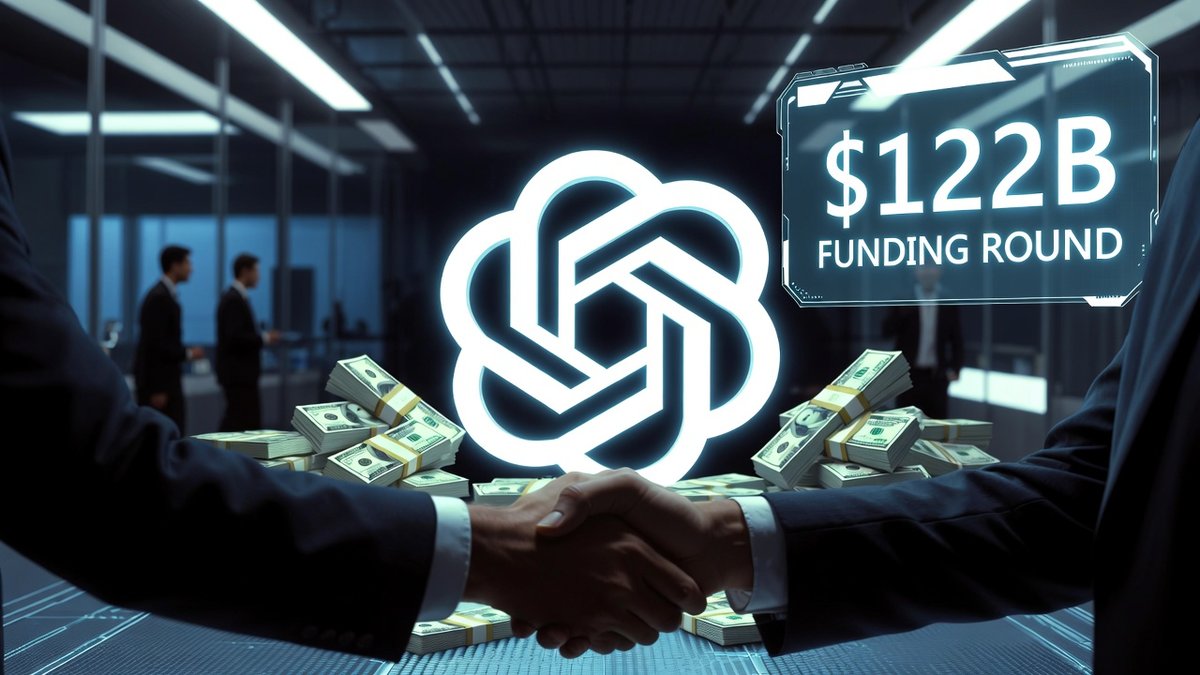
OpenAI has officially closed the largest private funding round in the history of technology. The final tally: $122 billion in committed capital, at a post-money valuation of $852 billion. The three anchor investors — Amazon, Nvidia, and SoftBank — together account for $110 billion of that total, with an additional $12 billion drawn from a broader pool of institutional and individual investors.
This is not just a record. It is a statement. OpenAI has just told the world — with the endorsement of three of the most consequential technology companies on the planet — that the AI race is far from over, and that the company that started it all intends to win it.
At digital8hub.com, we've been tracking OpenAI's extraordinary trajectory since the launch of ChatGPT. Here is the full breakdown of every dimension of today's announcement.
The Numbers: Who Invested What
The deal structure is more nuanced than the headline figure suggests. Here is exactly what each investor committed — and on what terms:
Amazon — $50 billion (largest single-round commitment ever)
Amazon's $50 billion is the anchor and the headline. But not all of it arrives at once. An initial $15 billion has been committed upfront. The remaining $35 billion is conditional — tied to milestones that sources indicate may include OpenAI achieving certain AI capability thresholds or completing an IPO by the end of 2026. Amazon CEO Andy Jassy confirmed the investment on CNBC: "It's so early right now in the AI space, and OpenAI is off to an amazing start. They're going to be one of the very big winners, we believe, long term. I think we can help them quite a bit as part of this partnership."
Alongside the equity investment, OpenAI and Amazon announced a sweeping infrastructure partnership. OpenAI is expanding its existing $38 billion AWS agreement by $100 billion over the next eight years. AWS will also serve as the exclusive third-party cloud distribution provider for OpenAI's enterprise platform Frontier — a commitment that makes AWS not just an investor, but the backbone of OpenAI's commercial scaling strategy.
Nvidia — $30 billion (primarily in compute, not cash)
Nvidia's $30 billion contribution is structured differently from Amazon's. Rather than primarily cash, it takes the form of dedicated GPU capacity and infrastructure commitments — specifically, 3GW of dedicated inference capacity and 2GW of training compute on Nvidia's next-generation Vera Rubin systems. For Nvidia, this is not a passive financial investment. It is a guarantee of enormous future revenue. By locking OpenAI into Vera Rubin infrastructure, Nvidia secures one of the world's largest and most strategically important AI customers for years to come.
At NVIDIA GTC 2026, CEO Jensen Huang projected that data center GPU deployments would need to grow tenfold over the next five years to meet enterprise AI demand. OpenAI's commitment is a significant anchor to that projection — and Nvidia's investment, structured as compute rather than cash, ensures that the financial relationship between the two companies is inseparable from the technological one.
SoftBank — $30 billion (structured in three quarterly tranches)
SoftBank's $30 billion commitment is structured in three equal tranches of $10 billion each — delivered on April 1, July 1, and October 1, 2026 — giving Masayoshi Son's company flexibility to evaluate OpenAI's progress before deploying the full amount. SoftBank previously invested $40 billion in OpenAI's December 2025 round, bringing its total investment in the company to $64.6 billion — representing an ownership interest of approximately 13% of OpenAI.
To fund its $30 billion commitment, SoftBank secured a $40 billion unsecured bridge loan arranged by JPMorgan, Goldman Sachs, Mizuho, SMBC, and MUFG — and has also sold stakes in existing investments, including Nvidia, to finance the commitment. That SoftBank is liquidating Nvidia positions to fund an OpenAI bet is one of the more striking details of the entire deal.
The Broader Round — $12 Billion More
Beyond the three anchor investors, OpenAI raised an additional $12 billion from a wider investor pool. In a landmark first, the company extended participation to individual investors through bank channels — raising $3 billion from retail investors. SoftBank co-led the broader round alongside Andreessen Horowitz, D.E. Shaw Ventures, MGX, TPG, and T. Rowe Price Associates. Microsoft, while not publicly disclosing its participation size, also joined the round.
What OpenAI Is Worth Now
The round values OpenAI at a $852 billion post-money valuation — a dramatic leap from its $500 billion valuation in a secondary financing last October, and nearly double its $40 billion December 2025 round valuation. For context: OpenAI is now valued higher than virtually every publicly traded company in the world except a handful of mega-cap tech giants.
The valuation of the OpenAI Foundation's nonprofit stake in OpenAI Group has increased to over $180 billion — making it one of the most well-resourced nonprofits in history. OpenAI says this strengthens its capacity to fund philanthropy in areas including health breakthroughs and AI resilience.
What OpenAI Plans to Do With the Money
OpenAI's stated intention is unambiguous: build more infrastructure, faster, at a scale that no competitor can match.
As OpenAI put it in its announcement: "We are entering a new phase where frontier AI moves from research into daily use at global scale. Leadership will be defined by who can scale infrastructure fast enough to meet demand, and turn that capacity into products people rely on."
The company is targeting roughly $600 billion in total compute spend by 2030 — a staggering figure that speaks to the industrial scale of the AI buildout underway. The Stargate project — OpenAI's joint venture with SoftBank aimed at investing up to $500 billion in AI data centre infrastructure over four years — runs in parallel to this round, with the two initiatives deeply interlinked.
The IPO Is Coming
Every element of today's announcement is also, simultaneously, a chapter in OpenAI's IPO preparation. The company now has over 900 million weekly active users, more than 50 million paid subscribers, and a business revenue stream that accounts for 40% of total revenue — up from 30% last year. Its ads pilot has generated over $100 million in annual recurring revenue in under six weeks.
OpenAI said it expanded its revolving credit facility to approximately $4.7 billion, supported by several major global banks — suggesting it is bolstering financial flexibility ahead of the public markets, rather than responding to near-term cash needs.
All indications point to an IPO filing in the second half of 2026, with a potential listing in Q4 2026 or Q1 2027. The $35 billion conditional portion of Amazon's investment — contingent on OpenAI either achieving AGI or completing its IPO by year-end — creates a powerful financial incentive to move quickly.
What This Means for the Competition
OpenAI's $122 billion raise is not happening in a vacuum. Rival Anthropic has raised $30 billion in its latest round. Elon Musk's xAI last raised $20 billion. Google's Gemini is backed by the full weight of Alphabet's resources.
But the sheer scale of today's round — and the strategic infrastructure partnerships it brings — creates a moat that cash alone cannot explain. By locking in Amazon's cloud infrastructure, Nvidia's next-generation compute, and SoftBank's financial muscle, OpenAI is not just raising money. It is building the physical and commercial architecture for AI dominance at a scale its competitors will struggle to replicate.
There are questions worth asking, however. Wall Street has begun raising concerns about what it calls "circular financing" — deals where companies invest in and sign supply agreements with each other, artificially inflating both revenue figures and demand projections. Nvidia's $30 billion commitment, structured primarily as compute rather than cash, is the clearest example: Nvidia is both an investor and a supplier, with its financial return tied directly to OpenAI's usage of its chips.
Whether these concerns translate into regulatory scrutiny — the FTC previously looked into the OpenAI-Microsoft relationship — remains to be seen. For now, the capital is committed, the partnerships are signed, and the infrastructure buildout is underway.
The AI race just got significantly more expensive to enter. And OpenAI just made sure it has the resources to run it on its own terms.
Stay across every development in AI, technology, and the global economy exclusively at digital8hub.com — your trusted source for the stories that shape the digital world.
Comments (0)
Please log in to comment
No comments yet. Be the first!