Finance & Business
Amazon Just Bought a Robot Dog That Climbs Stairs & Delivers Packages to Your Front Door
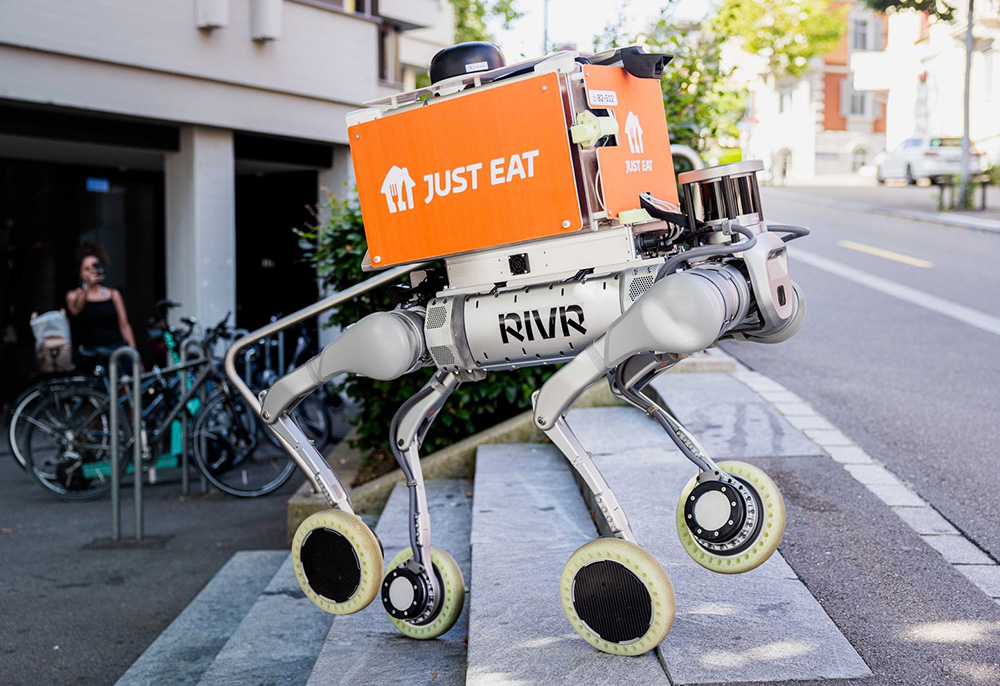
The last 100 yards of delivery — the distance between a parked delivery van and your front door — is, by most logistics analysts' calculations, the most expensive, most labour-intensive, and most accident-prone segment of the entire global parcel supply chain. It is the stretch where delivery drivers carry heavy packages up slippery steps, negotiate gate codes, navigate uneven garden paths, and absorb the physical strain that makes last-mile delivery one of the highest-injury-rate occupations in the logistics industry. It is also, until now, the stretch that robots have consistently failed to crack — because robots cannot climb stairs. RIVR's can. Amazon confirmed on Thursday March 19 that it has quietly acquired RIVR — a Zurich-based robotics startup formerly known as Swiss-Mile — whose four-legged, wheel-legged robots combine the terrain-navigating flexibility of a quadruped with the speed and efficiency of wheeled locomotion to produce what RIVR CEO and co-founder Marko Bjelonic describes as "a dog on roller skates." Amazon made the announcement not in a press release but in a notice to its third-party delivery service partners — a characteristically quiet acquisition for a company that has been assembling its robotics capabilities with deliberate patience over many years.
What RIVR Is: Four Legs, Wheels & 15 km/h Across Any Terrain
RIVR's robots are quadrupeds — four-legged machines — but with a critical engineering distinction from the Boston Dynamics-style legged robots that have dominated the robotics public imagination for the past decade. Where Boston Dynamics' Spot walks on legs alone, RIVR's robots have wheels mounted on the end of each leg — a hybrid locomotion system that allows them to roll efficiently on flat surfaces at up to 15 kilometres per hour while retaining the ability to switch to a stepping gait for stairs, kerbs, uneven paths, and the kind of real-world terrain variability that has defeated every previous attempt to automate doorstep delivery. The RIVR TWO — the company's second-generation robot, released earlier this year — can handle stairs, gates, narrow passages, and wet surfaces that would immobilise a conventional wheeled sidewalk robot. Packages are secured in a cargo bin mounted on the robot's back, and the machine uses its own AI models — trained on its own real-world deployment data — to navigate autonomously from the delivery vehicle to the front door. Bjelonic described the mission as building "General Physical AI through doorstep delivery" — a framing that positions RIVR not merely as a logistics tool but as a platform for developing AI systems capable of operating in the full complexity of the real physical world.
Amazon's History With RIVR: $22.2M Seed Round, Bezos & the Industrial Innovation Fund
Amazon's acquisition of RIVR was not a cold approach. Amazon had been watching — and funding — the company for years. The Amazon Industrial Innovation Fund — the company's $1 billion vehicle for backing warehouse and logistics technologies, launched in 2022 — participated in RIVR's $22.2 million seed round that closed in 2024 alongside Bezos Expeditions, the venture capital firm operated by Amazon founder and executive chairman Jeff Bezos. RIVR had raised a total of $25 million before the acquisition, and was last valued at approximately $100 to $110 million. The acquisition price was not disclosed. Amazon had also been watching RIVR's real-world deployments with close attention. In May 2025, RIVR launched a pilot programme in Austin, Texas, in partnership with alternative parcel delivery platform Veho — deploying its wheel-legged robots on Austin streets and gathering the real-world operational data that Bjelonic described as essential to scaling the technology responsibly. In August 2025, RIVR partnered with Just Eat Takeaway.com to bring its robots to Zurich — the first European deployment of the technology and a proof point for its viability outside the controlled environment of a US pilot.
The Amazon Robotics Picture: 1 Million Robots, 75% Automation Target & the Last 100 Yards
Amazon deployed its one-millionth robot last summer — a milestone that reflects the scale of the company's existing automation investment across its warehouse and fulfilment network. Its stated goal is to automate 75% of all its operations — a target that, until the RIVR acquisition, remained constrained by the last 100 yards problem. As digital8hub.com reported this week, Amazon also launched Health AI — a free AI health assistant for all Amazon customers — and acquired Moltbook for its Meta Superintelligence Labs. The RIVR acquisition adds a physical robotics dimension to Amazon's AI strategy that complements rather than competes with those digital investments: the same company that is using AI to help customers navigate their health insurance is now using AI to navigate its delivery robots up your front steps. Paolo Pirjanian — founder of Embodied Inc. and Amazon's vice president of last-mile delivery automation since October 2025 — will oversee the RIVR integration. Amazon told its delivery service partners the company is in the "early stages of this journey" — but the journey's direction is unmistakable. The last 100 yards just got a four-legged, wheeled, AI-powered new participant. For the latest coverage of Amazon, robotics, and the future of delivery, follow digital8hub.com.
Comments (0)
Please log in to comment
No comments yet. Be the first!