Finance & Business
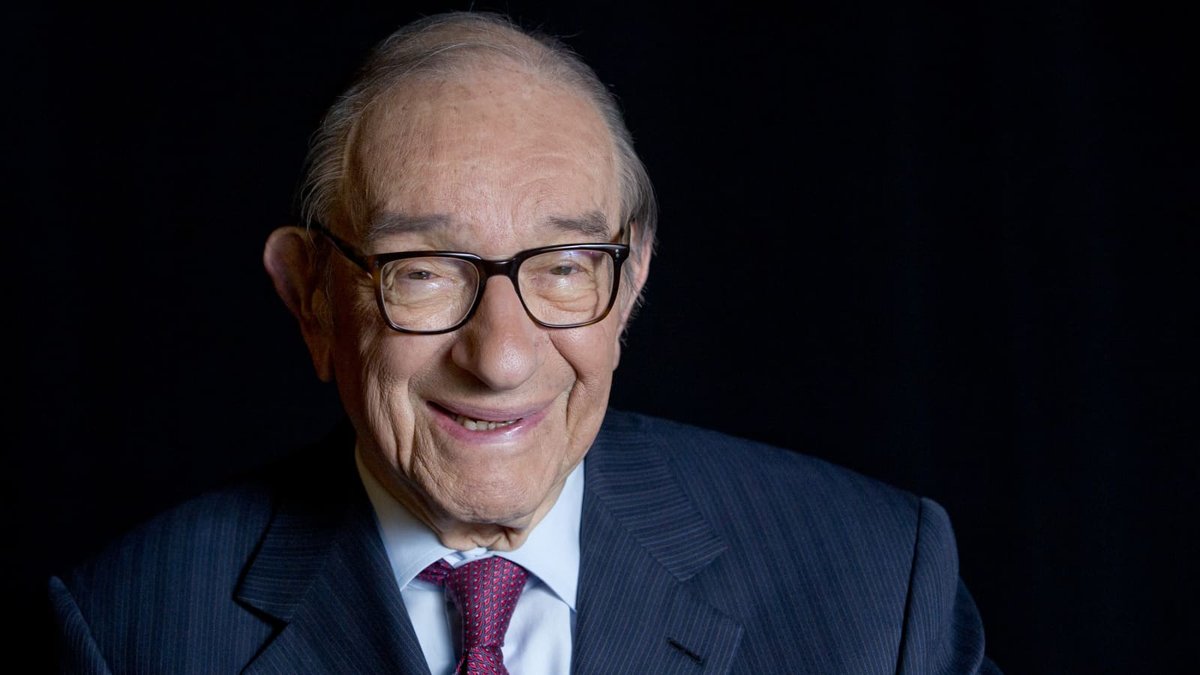
Alan Greenspan, the Fed Chairman Who Defined an Economic Era, Dies at 100
Alan Greenspan, who steered the Federal Reserve through nearly two decades of American economic history — presiding over some of the longest booms the country has ever seen before his legacy was complicated by the worst financial crisis since the Great Depression — has died. He was 100.
His wife of 29 years, NBC News correspondent Andrea Mitchell, confirmed his death in a statement shared with NBC News on Monday, June 22, 2026. Greenspan died that morning at his home in Washington from complications of Parkinson's disease. "To me he was my husband, who shaped my life from our very first date in 1984," Mitchell said. "He had 'irrational exuberance' for baseball, the Washington Commanders, tennis, golf, and music, especially jazz. He will be remembered for his brilliance and his kindness. Being his life partner was the joy of my life."
Eighteen Years at the Helm of the World's Most Powerful Central Bank
Greenspan served as chairman of the Federal Reserve for 18 and a half years, from 1987 to 2006, spanning four presidential administrations — Ronald Reagan, George H.W. Bush, Bill Clinton, and George W. Bush. For much of that tenure, he was, in the words of NPR, the rare celebrity among central bankers, a man whose every utterance moved markets and whose stewardship of the American economy through the 1990s made him a household name at a time when, as one obituary put it, it seemed every barbershop had a television tuned to the stock market channel.
By the time he stepped down in 2006, just shy of his 80th birthday, Greenspan had been widely celebrated with nicknames that captured the near-mythical status he held in American economic life: the "Oracle" and the "Maestro." His chairmanship coincided with falling unemployment and sustained, broadly shared prosperity, and he developed a reputation as a master of monetary policy unlike almost any before him.
Greenspan broke from central banking convention in a way that defined his legacy during the boom years: where the traditional response to falling unemployment was to raise interest rates pre-emptively to ward off inflation, Greenspan was willing to wait. "He was willing to watch and wait as the unemployment rate drifted lower and lower and lower and lower, and we still had no inflation," recalled Princeton economist Alan Blinder, who served under Greenspan on the Fed's governing board.
His influence over markets became the stuff of legend. On December 5, 1996, Greenspan sent global financial markets reeling with just two words — "irrational exuberance" — suggesting in characteristically understated fashion that stock prices had climbed too high. The phrase entered the permanent lexicon of American finance. Aware of his own market-moving power, Greenspan became known for a famously oblique, evasive way of speaking that came to be called "Fedspeak." He once told a befuddled congressional committee: "I know you believe you understand what you think I said, but I am not sure you realize that what you heard is not what I meant." Fed-watchers developed their own folklore trying to decode him — most famously the "Briefcase Indicator," the theory that a stuffed briefcase carried into Fed meetings signalled that policy changes were coming, since Greenspan was known to bring along charts and research to support his arguments.
A Reputation Transformed by Crisis
Greenspan's standing as one of the most respected public officials in American history did not survive his retirement intact. Just two years after he left the Fed, the American housing market collapsed, igniting a global financial crisis that nearly toppled the US banking system and plunged the economy into the worst recession since the 1930s.
Critics assigned much of the blame for the crisis directly to Greenspan's legacy: his long-standing embrace of easy-money policies, and what they characterized as an overexuberant faith in lightly supervised financial markets. A subsequent federal investigation into the crisis concluded that more than 30 years of deregulation and reliance on self-regulation by financial institutions — championed by Greenspan and others — had stripped away key safeguards that could have helped the country avoid catastrophe.
Greenspan himself, testifying before Congress in the crisis's aftermath, offered a rare and striking admission for a man known throughout his career for confident, carefully hedged pronouncements. "I made a mistake," he said, in assuming that the nation's banks — whose stability underpins the entire financial system — could essentially regulate themselves. It was an acknowledgment that reshaped how history would remember him: no longer simply the Maestro of the 1990s boom, but also a central architect of the deregulatory consensus whose unraveling cost millions of Americans their homes, jobs, and savings.
From Juilliard to the Council of Economic Advisers
Long before he became synonymous with American monetary policy, Greenspan's path to economic stardom ran through an unlikely place: music school. Born in the Washington Heights neighborhood of Manhattan, Greenspan was a self-described math whiz as a child, frequently shown off by his mother to visitors for his arithmetic abilities. He went on to study clarinet and saxophone at Juilliard, training as a jazz musician before economics ultimately claimed his career.
Greenspan started an economic consulting firm in the mid-1950s and dipped into politics periodically over the following decades. He assisted Richard Nixon's presidential campaign in the late 1960s but reportedly declined an official role in the administration after Nixon's victory. President Gerald Ford appointed him chairman of the Council of Economic Advisers in 1974, a position he held until 1977, giving him his first sustained experience at the center of American economic policymaking — more than a decade before President Reagan elevated him to the Fed chairmanship in 1987.
A Long, Active Retirement
Greenspan did not retreat from public life after leaving the Fed. He ran his own consulting firm, Greenspan Associates, advising Wall Street clients and commanding substantial speaking fees well into his later years. He kept up a busy schedule deep into his 90s, writing a memoir and two additional books on economics, and remained a regular presence on television news programs offering commentary on contemporary economic developments.
In his final years, Greenspan also became an outspoken defender of the Federal Reserve's political independence, signing opinion articles and public statements pushing back against President Trump's repeated criticism of the central bank. As recently as January 2026, he added his name to a statement criticizing the Trump administration's scrutiny of the Fed — a notable late-career stance from a man who had spent nearly two decades occupying the very institution he was now defending from outside pressure.
He remained intellectually engaged with the dynamics of financial bubbles until the end of his public life. "Bubbles go up very slowly as euphoria builds," Greenspan said in a 2013 interview with the Associated Press. "Then fear hits, and it comes down very sharply. When I started to look at that, I was sort of intellectually shocked."
A Washington Power Couple
Greenspan's marriage to Andrea Mitchell, the veteran NBC News correspondent, made the couple one of Washington's most recognizable pairings for decades. The two met on their first date in 1984 and were married for 29 years at the time of his death. Comedian Jay Leno once joked at a White House Correspondents' Association dinner that it was Mitchell — not the sitting First Lady — who was married to "the most powerful man in the world," a line that captured both the couple's prominence and the singular influence Greenspan wielded at the height of his Fed chairmanship.
A Complicated, Consequential Legacy
Few American economic policymakers have occupied such dramatically different chapters of public reputation within a single lifetime. For nearly two decades, Greenspan was regarded — both within the United States and across the world — with a mixture of reverence approaching awe; investors hung on his every carefully hedged word, and many openly dreaded the day he would eventually leave the Fed. Then, within two years of his departure, the financial system he was credited with stewarding so successfully collapsed in a crisis whose root causes were traced directly back to policies he had championed.
That duality will likely define how history remembers him: the architect of one of the most celebrated stretches of American economic growth in modern history, and, simultaneously, one of the central figures blamed for the deregulatory excess that led to its undoing. At 100 years old, having outlived both the peak of his reputation and its sharpest period of reassessment, Alan Greenspan leaves behind a legacy still being actively debated by economists, historians, and the millions of Americans whose financial lives were shaped, for better and for worse, by the decisions made during his tenure at the helm of the Federal Reserve.
Comments (0)
Please log in to comment
No comments yet. Be the first!