Finance & Business
$81 Oil, $3.25 Gas & a Dow Down 800: How the Iran War Is Hitting Your Wallet Right Now
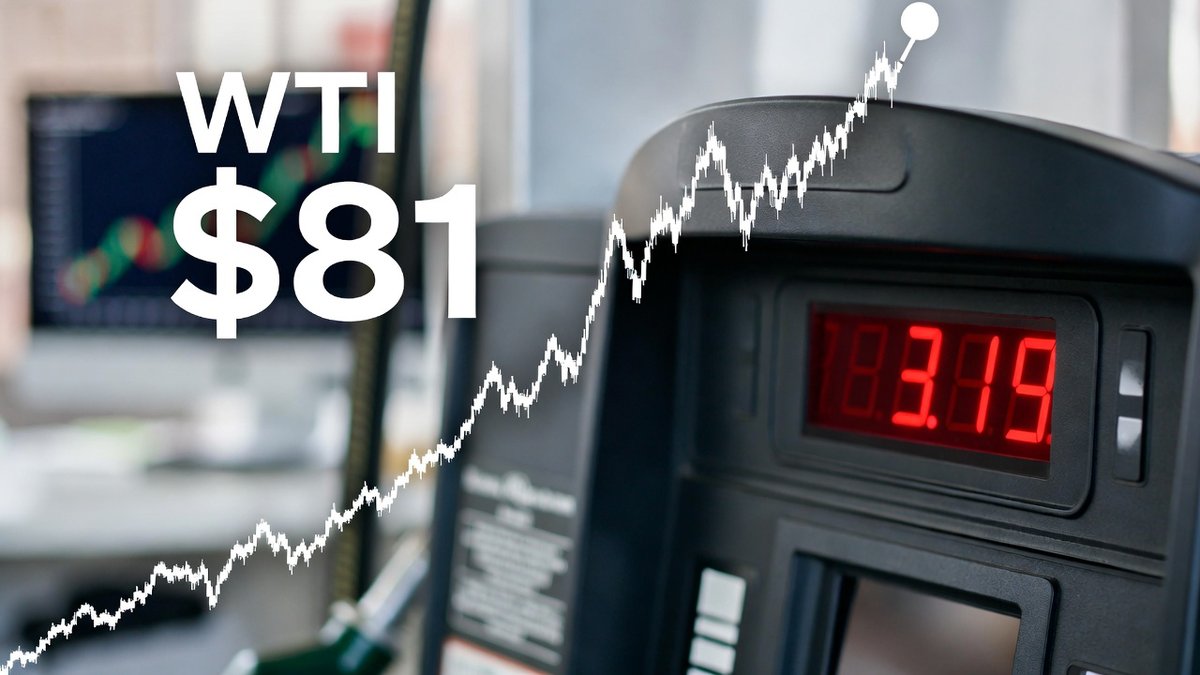
The Iran war is no longer just a geopolitical story. It is a personal finance story. On Thursday March 5, 2026 — Day 6 of Operation Epic Fury — West Texas Intermediate crude oil closed at $81.01 per barrel, up 8.51% in a single session — the biggest one-day gain for oil since May 2020. Global benchmark Brent crude settled at $85.41 per barrel, up 4.93%. WTI has now surged approximately 21% in a single week. Brent is up nearly 18% over the same period. Both are on pace for their biggest weekly gains since March 2022 — when Russia invaded Ukraine and shocked global energy markets. The Iran war is doing something very similar. And it is just getting started.
At the Pump: 27 Cents More in a Single Week
The number most Americans care about most is not the price of a barrel of crude — it is the price of a gallon of gasoline. That number moved sharply this week. The average retail price of gasoline in the United States jumped nearly 27 cents in a single week to $3.25 per gallon — a 9% increase in seven days, according to the latest data from AAA. The last time gas prices made a comparable weekly jump was in March 2022, following Russia's invasion of Ukraine. As a general rule, retail gasoline prices move approximately 2.5 cents for every $1 move in crude oil. With WTI having risen more than $15 per barrel since the start of the conflict, further price increases at the pump are not a question of if — they are a question of how much and how quickly.
The Dow Down 800: Wall Street Prices in a Prolonged War
Energy markets were not the only markets in pain on Thursday. The Dow Jones Industrial Average fell 784.67 points — 1.61% — to close at 47,954.74, its second significant decline in four sessions. The S&P 500 fell 0.56% to 6,830.71. The Nasdaq slipped 0.26% to 22,748.99. At its worst point during the session — the precise moment WTI crude crossed $80 per barrel — the Dow was down over 1,000 points intraday. The sell-off was led by companies most exposed to an economic slowdown driven by high energy costs: Boeing, Caterpillar, and the major US airlines. United Airlines and Delta Air Lines both fell 7% as oil prices surged. The Consumer Staples sector — retailers like Walmart and Dollar General whose margins are squeezed by higher transport and supply chain costs — also declined sharply.
The one sector of the market performing well is the one you would expect: energy. Exxon Mobil, Chevron, Shell, TotalEnergies, and BP have all posted meaningful gains since the conflict began. Energy is the S&P 500's top-performing sector by a significant margin in 2026. War is terrible for the world. It is, in the short term, very good for oil company shareholders.
The Strait of Hormuz: The Number That Explains Everything
The reason oil prices are moving this dramatically is a single chokepoint. The Strait of Hormuz — a narrow waterway between Iran and Oman at the mouth of the Persian Gulf — handles approximately 20% of the world's daily oil demand and roughly a third of total global seaborne crude exports. More than 14 million barrels per day passed through the strait on average in 2025. About three-quarters of those exports flow to China, India, Japan, and South Korea. When the strait is closed or severely disrupted, the ripple effects reach every economy on earth.
The strait is currently in a state of functional closure. Iran has declared it shut and threatened to set any passing vessel ablaze. Commercial shipping has stopped — not because of a formal naval blockade, but because a combination of targeted Iranian drone and missile strikes on tankers, the withdrawal of war-risk insurance coverage for approximately 90% of global ocean-going tonnage, and the IRGC's explicit threats have made the economics of transiting the strait entirely unworkable. Over 150 tankers are anchored in open Gulf waters waiting for conditions to improve. Qatar's ongoing shutdown of LNG production has sent European gas prices soaring. Saudi Arabia's contingency plans to route oil through its East-West pipeline to the Red Sea are being activated — but that pipeline has a maximum throughput of roughly 5 million barrels per day, a fraction of normal Hormuz flows.
Where Prices Could Go From Here
The range of analyst forecasts for where oil goes next is wide — and appropriately reflects the genuine uncertainty surrounding the conflict's trajectory. Barclays analysts warned clients that Brent could hit $100 per barrel as the security situation spirals, and noted that a material disruption scenario could push Brent spot prices above $120. UBS analysts echoed the $100 threshold as a plausible outcome if Hormuz traffic is not restored quickly. Wood Mackenzie indicated that if tanker flow is not quickly re-established, prices crossing $100 are likely. JPMorgan Chase analysts identified four variables that will determine the oil price trajectory: how much supply is disrupted, how long the disruption lasts, whether other sources can compensate quickly, and what military and political developments come next.
President Trump said Thursday that "further action to reduce pressure on oil is imminent" — and on Tuesday confirmed that the US Development Finance Corporation would offer political risk insurance for maritime trade and that the US Navy stands ready to escort tankers through the strait. Whether those measures prove sufficient to restart commercial shipping flows is the central question for global energy markets over the coming days.
Iran's Foreign Minister Abbas Araghchi made the diplomatic picture starker still on Thursday, stating that Iran is "not asking for a ceasefire" and sees "no reason why we should negotiate." With no ceasefire in sight, the Strait of Hormuz effectively closed, and WTI already at $81, the energy market's worst fears are not yet priced in. They may be soon.
For the latest global energy market coverage and Operation Epic Fury updates, follow digital8hub.com.
Comments (0)
Please log in to comment
No comments yet. Be the first!