Education & Career
France Keeps Up to 500 High Schools Shut as Student Unrest Spreads
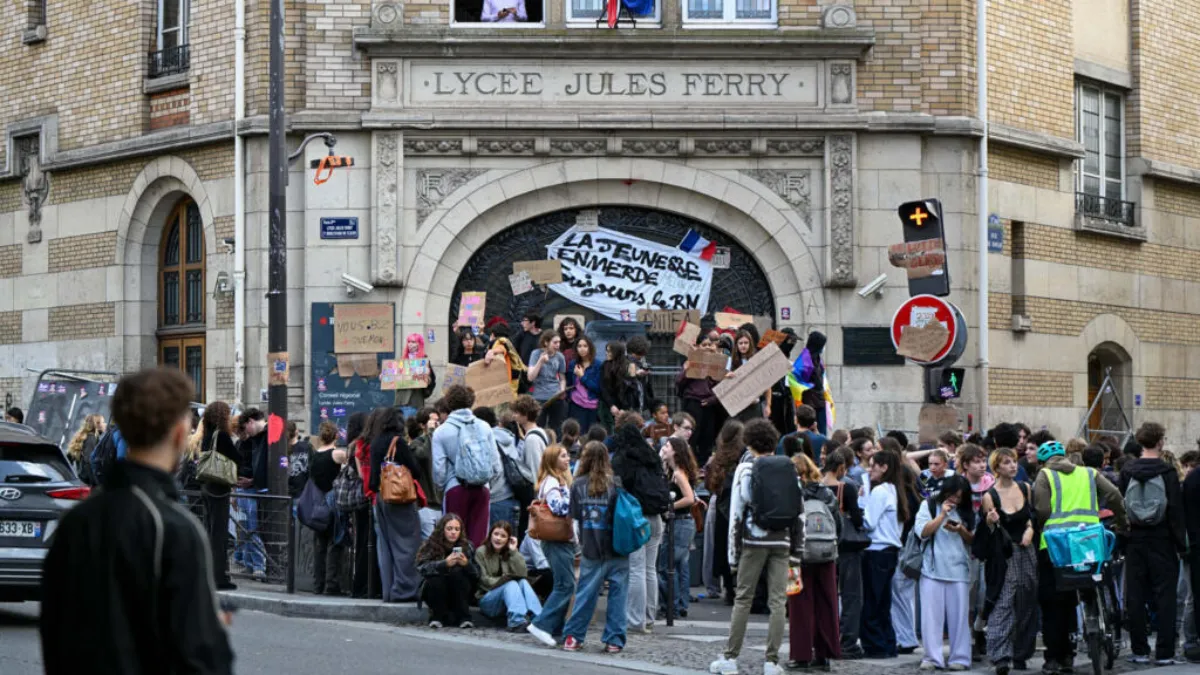
Education minister Édouard Geffray said on Sunday that lessons would be totally or partly suspended in some 400 to 500 high schools because security conditions had not been met. The closures are a precaution, he said, ahead of a partial return to class and ahead of further demonstrations organizers have called. He also said 24 schools had been burned or ransacked since the protests began. France has about 3,700 lycées. Friday already saw roughly 400 closed and more than 500 disrupted. Monday’s figure is in the same band, not a new collapse, and not a return to normal.
The arrest number in the headlines is Friday’s. Interior minister Laurent Nuñez said 1,747 people were arrested that day. Over the wider stretch of the movement, he and other officials have put the cumulative total above 5,000, with about 85 percent of those detained described as minors. The 1,747 figure is the single-day count. The 5,000 figure is the week. Both are official. They are not the same tally.
What the Students Are Blocking For
The blockades started in the Paris region in mid-September, with September 17 cited as an early flashpoint at one school, and spread to Lyon, Marseille, Nantes, Montpellier, and other cities. The demands that unions and student groups have repeated are ordinary on paper: not enough teachers, overcrowded classrooms, buildings in poor repair. Teachers’ unions and some political figures have joined in solidarity. The government has called parts of that list legitimate.
What the government will not call legitimate is the damage. Geffray said 78 education staff had been wounded, which he described as something the system had not seen before, and that at least 170 students had been injured. A regional tally put damage at Nelson Mandela high school in Nantes above €2 million after fire destroyed a glass entrance and interior space. Geffray has estimated overall damage, including vandalized staff housing, in a range of €20 million to €30 million. In Marseille, protesters were reported to have pelted a fire truck. In La Ciotat, police detained a 16-year-old over an assault on a 59-year-old teacher who was struck and doused with gasoline on the sidelines of a Friday protest.
Justice minister Gérald Darmanin said the week had moved from high-school demonstrations to a public-order disturbance, and that 735 of 3,700 schools had been affected one way or another on Friday. That is a wider count than closures. A blockade, a damaged gate, and a burned entrance are not the same event. The ministry has been using both numbers.
The Official Line
Nuñez has described the shift as a slide into riot and urban violence. More than 300 officers and gendarmes have been reported hurt across the protests; one Friday accounting put police injuries at 305. The government has accused the far-left party France Unbowed of stoking the demonstrations. Critics of the police response have called it disproportionate. Both claims are now part of the political fight, and neither has been settled by an inquiry in the days since the fires.
The timing sits on top of a budget the government is trying to pass and a presidential election next year. A student blockade about missing teachers is not a budget vote. A week of burned schools in that climate becomes one. Édouard Geffray’s phrase for Monday was a partial, progressive return to lessons. Closing 400 to 500 schools to get there is the measure of how far the week moved.
Île-de-France is taking a heavy share. Valérie Pécresse, president of the region, said more than a third of the 468 schools in the area around Paris would be shut on Monday. Remote lessons are the fallback where buildings are closed and staff are willing. A ransacked school does not have a fallback.
What Monday Is and Is Not
Monday’s closures are not a nationwide shutdown. Most lycées are expected to open. The 400 to 500 are the ones where the ministry says security conditions failed, or where staff were directly threatened. Tuesday is the date organizers have marked for larger demonstrations. Geffray framed Monday’s shuttering as a buffer before that call, not as the end of the movement.
Parents are being told, school by school, whether the gate is open. That is a worse system than a single national list, and it is the one France is using. A pupil who travels to a closed building is a pupil in the street on a day the interior ministry is still counting arrests.
What to Watch
Whether Tuesday’s call exceeds Friday’s 1,747 arrests.
How many of the 24 damaged schools can reopen this month, against the €20–30 million repair estimate.
Whether the 78 injured staff figure rises.
Any inquiry into the La Ciotat assault and into police conduct claims.
Whether the teacher-shortage demands produce a budget line, or only a policing plan.
A protest about empty classrooms has closed hundreds of classrooms. Twenty-four schools have been burned or ransacked. Nearly 1,750 people were arrested on Friday alone, most of them minors, inside a week that officials now put above 5,000 detentions. Monday’s partial reopening is the government’s attempt to stop the count. Tuesday will show whether the attempt held.
Comments (0)
Please log in to comment
No comments yet. Be the first!