Technology
The Unicorn Rising: How Positron's $230M Bet Could Reshape the AI Chip Wars
In the high-stakes arena of AI chip development, a three-year-old startup from Reno, Nevada just became impossible to ignore. Semiconductor startup Positron has secured $230 million in Series B funding, TechCrunch has exclusively learned, Box Office Mojo catapulting the company to a $1 billion unicorn valuation and positioning it as a credible challenger to Nvidia's seemingly unshakeable dominance in artificial intelligence hardware.
The round, which brought Positron to a $1 billion valuation, was co-led by Arena Private Wealth, Jump Trading, and Unless, with strategic investment from Qatar Investment Authority (QIA), the country's sovereign wealth fund, which has been increasingly focused on building out AI infrastructure. Box Office Mojo
This isn't just another venture capital headline. Positron's funding comes at a pivotal moment when hyperscalers and AI firms push to reduce their reliance on longstanding leader Nvidia. These firms include OpenAI, which, despite being one of Nvidia's largest and most important customers, is reportedly unsatisfied with some of the firm's latest AI chips and has been seeking alternatives since last year. Box Office Mojo
According to Digital8Hub.com semiconductor industry analysts, Positron represents the most serious challenge yet to Nvidia's stranglehold on AI infrastructure—not through incremental improvements, but through fundamentally rethinking how AI chips access and utilize memory.
The Money: From Capital Efficiency to Unicorn Status
Positron CEO Mitesh Agrawal told EE Times that the large raise was due to "insane" inbound interest. The company operates in a very capital-efficient way, he said, having spent only $38 million to date. Cinemark
This extraordinary capital efficiency—spending just $38 million while raising over $300 million total—reflects investors' conviction in Positron's technology and market opportunity. The company has already received purchase orders in excess of that amount, Cinemark demonstrating genuine customer demand beyond theoretical interest.
"[The large raise] is a way for us to go on offense," Agrawal said. "When we are going to go this big, both on the supply side and the vendor side of the ecosystem, bypassing CoWoS and HBM, we have to position ourselves to show that we can follow through. We also want to give our customers confidence that we can scale out production." Cinemark
Positron's fundraise brings the three-year-old startup's total capital raised to just over $300 million. The startup previously raised $75 million last year from investors including Valor Equity Partners, Atreides Management, DFJ Growth, Flume Ventures, and Resilience Reserve. Box Office Mojo
The investor roster tells a compelling story. Jump Trading—one of the world's most sophisticated quantitative trading firms—didn't just invest. They're deploying Positron's technology in production, co-leading the funding round based on real-world performance data rather than promises.
"For the workloads we care about, the bottlenecks are increasingly memory and power—not theoretical compute," said Alex Davies, Chief Technology Officer of Jump Trading. "In our testing, Positron Atlas delivered roughly 3x lower end-to-end latency than a comparable H100-based system on the inference workloads we evaluated." Rotten Tomatoes
This customer-to-investor trajectory validates Positron's technology in ways pure venture capital cannot. According to Digital8Hub.com fintech researchers, Jump Trading's participation signals that Positron's chips deliver measurable advantages in the demanding, latency-sensitive world of algorithmic trading—one of the most unforgiving testing grounds for computing performance.
The Technology: Memory Over Compute
The outfit plans to use the capital to speed up deployment of its high-speed memory chips, a critical component for the chips used for AI workloads. Box Office Mojo
Positron's approach represents a fundamental bet: that AI's bottleneck isn't compute power—it's memory bandwidth and capacity. While Nvidia and others chase raw computational performance measured in FLOPS (floating-point operations per second), Positron optimizes for how quickly and efficiently chips can access data.
The Atlas: Shipping Today
The company claims its first-generation chip, Atlas, manufactured in Arizona, can match the performance of Nvidia's H100 GPUs for less than a third of the power. Box Office Mojo
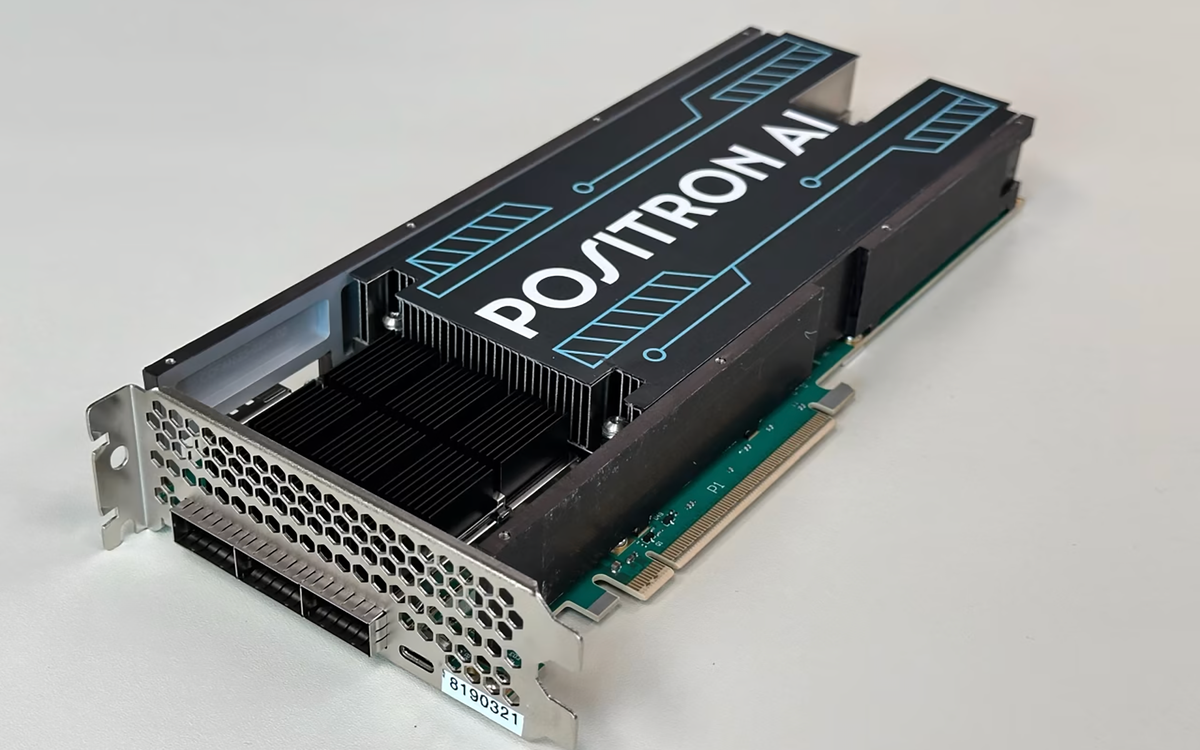
Positron is working on hardware acceleration for transformer inference in the data center. The company's first-generation product, Atlas, uses FPGAs—specifically, the Agilex-7M with HBM and DDR5. The company's secret sauce is in its method of achieving extremely high memory bandwidth utilization (93% for HBM). Cinemark
This 93% memory bandwidth utilization number is staggering. Most AI accelerators waste significant portions of their theoretical memory bandwidth due to inefficient data movement. By achieving near-perfect utilization, Positron extracts maximum value from every component.
Transformer inference is memory-bound, but despite FPGAs' relatively low FLOPS, better utilizing memory bandwidth can produce tokens faster than current-generation GPUs. Cinemark
Positron's Atlas FPGA cards need 150-200 W each. Cinemark Compared to Nvidia's H100 consuming 700W, this power efficiency represents a game-changing advantage for data centers constrained by power availability and cooling costs.
The Asimov: Next-Generation Custom Silicon
With the funding, Positron aims to accelerate its roadmap to ship its next-generation Asimov silicon chip, targeting production in early 2027. Box Office Mojo
The company is working on a second-generation product, a multi-die ASIC it calls Asimov. Asimov will use LPDDR memory (no HBM), but the company's ability to get close to the theoretical peak memory bandwidth means they don't need to rely on HBM to produce fast tokens. Cinemark
This LPDDR approach is revolutionary. High Bandwidth Memory (HBM) has become standard in AI chips, but it's expensive, power-hungry, and supply-constrained. By achieving comparable performance with cheaper, more available LPDDR through superior architecture, Positron sidesteps one of the industry's most painful bottlenecks.
"We're grateful for this investor enthusiasm, which itself is a reflection of what the market is demanding," said Mitesh Agrawal, CEO of Positron AI. "Energy availability has emerged as a key bottleneck for AI deployment. And our next-generation chip will deliver 5x more tokens per watt in our core workloads versus Nvidia's upcoming Rubin GPU." IMDb
Memory is the other giant bottleneck in inference, and our next generation Asimov custom silicon will ship with over 2304 GB of RAM per device next year, versus just 384 GB for Rubin. IMDb
That's not a typo: 2.3 terabytes of RAM per chip versus 384 gigabytes. Dylan Patel, founder and CEO of SemiAnalysis, notes, "Positron is taking a unique approach to the memory scaling problem, and with its next-generation Asimov chip, can deliver more than an order of magnitude greater high-speed memory capacity per chip than incumbent or upstart silicon providers." Boxoffice
Digital8Hub.com AI infrastructure experts note that this massive memory capacity addresses one of the most pressing challenges in modern AI: running models with enormous context windows, handling video processing, and serving multi-trillion parameter models—all use cases where memory, not compute, determines performance.
The Market: The Inference Revolution
Positron is focused on inference — computing needed to run AI models for real-world applications — rather than training large language models, positioning the company well as demand surges for inference hardware as businesses increasingly shift focus from building large models to deploying them at scale. Box Office Mojo
This strategic focus on inference rather than training represents shrewd market positioning. Training AI models requires enormous bursts of computing power but happens relatively infrequently. Inference—actually running those models billions of times per day for real users—happens continuously and at scale.
As the AI industry matures, inference workloads are exploding. Every ChatGPT query, every AI-generated image, every autonomous vehicle decision represents inference. The market is shifting from "who can train the biggest model" to "who can run models most efficiently at planetary scale."
According to TrendForce, based on AI server shipment growth rates, custom ASIC shipments from cloud providers are projected to grow 44.6% in 2026, while GPU shipments are expected to grow 16.1%. Box Office Mojo
This growth disparity reflects the market's recognition that specialized inference chips deliver better economics than general-purpose GPUs for running deployed models.
Google's cloud unit, which houses most of its AI products and services, saw its backlog surge 55% sequentially and more than double year-over-year, reaching $240 billion at the end of the fourth quarter. AMC Theatres This explosive demand creates massive opportunities for companies that can deliver inference solutions more efficiently than Nvidia's GPU-centric approach.
According to Digital8Hub.com cloud computing economists, the inference market will likely exceed $500 billion annually by 2030, with specialized ASICs capturing 40-50% of that market as customers prioritize efficiency over flexibility.
The Competition: A Fragmenting Landscape
Positron enters a suddenly dynamic competitive environment reshaped by Nvidia's recent $20 billion acquisition of Groq, another inference-focused startup.
Nvidia dropped a surprise announcement on Christmas Eve: a $20 billion deal to license AI chip startup Groq's technology and bring over most of its team, including cofounder and CEO Jonathan Ross. Movie Insider
The Groq deal bolsters the standing of other startups building their own AI chips, including Cerebras, D-Matrix, and SambaNova—which Intel has reportedly signed a term sheet to acquire—as well as newer players like U.K.-based chip startup Fractile. Movie Insider
The Groq Effect
"When [the Nvidia-Groq deal] happened, we said, 'Finally, the market recognizes it,'" Sid Sheth, CEO of D-Matrix, told Fortune. "I think what Nvidia has really done is they said, Okay, this approach is a winning approach." Movie Insider
Cerebras CEO Andrew Feldman posted on X that, in the past, the perception that Nvidia GPUs were all you needed for AI acted as a moat, keeping AI chip startups from nibbling away at Nvidia's market share. But that moat is now gone with the Groq deal. Movie Insider
Nvidia's Groq acquisition validated the inference-specialized approach, potentially raising valuations and acquisition interest for all players in the space—including Positron.
The Broader Battlefield
AMD continues aggressive pursuit of Nvidia's market share. AMD CEO Lisa Su announced at CES 2026 that the company's latest Helios system will go head-to-head with Nvidia's own NVL systems, matching its latest NVL72's 72 Rubin GPUs with 72 of AMD's MI455X chips. MovieWeb
AMD boldly declares [its MI500 series] will provide up to a 1,000x increase in AI performance compared to its MI300X GPUs. MovieWeb
Intel, though struggling, remains in the fight. Intel has reportedly signed a term sheet to acquire SambaNova, ScreenRant signaling its willingness to make strategic acquisitions to remain relevant in AI infrastructure.
Hyperscalers build their own chips. Google's TPUs, Amazon's Trainium and Inferentia, and Microsoft's custom silicon all compete for inference workloads, reducing dependence on external suppliers.
Digital8Hub.com competitive intelligence researchers note that this fragmentation works in Positron's favor: customers desperate to diversify away from Nvidia-only infrastructure create opportunities for credible alternatives with differentiated technology.
The Execution Challenge: Can Positron Deliver?
Ambitious technology and massive funding mean little without execution. Positron faces several critical challenges:
Manufacturing and Supply Chain
Positron is on track to tape out its Asimov chip just 16 months after its June Series A financing gave it the resources to fully launch the design process, and the company intends to maintain this pace with future chips. IMDb
"To us, development speed is an essential competitive advantage," said Agrawal. "Competing with Nvidia means matching their shipping frequency, and we have designed our organization around that goal." IMDb
Nvidia ships new architectures annually. Positron must match this cadence while scaling from startup to volume manufacturer—a challenge that has destroyed countless semiconductor companies.
Positron has grown its team to 50 in the last six months and will grow to around 100 by the end of 2026. Cinemark Scaling from 50 to enterprise-level operations while maintaining innovation velocity is extraordinarily difficult.
The ASIC Design Gamble
The startup is handling all its ASIC design work in-house, preferring to keep close control of the final design and mask set, knowing that iterations in the final stages of the process can be critical. Cinemark
This vertical integration provides control but requires deep expertise and creates single points of failure. One design flaw in custom silicon can delay products by 12-18 months and cost tens of millions to fix.
Moving forward, Positron intends to continue commercializing an FPGA-based version of future products, followed by an ASIC version in a model based on Intel's famous tick-tock cadence. Cinemark
This FPGA-then-ASIC strategy is clever: ship faster with FPGAs to capture market share and gather customer feedback, then optimize with ASICs for better economics. But it requires maintaining two parallel product lines simultaneously—operationally complex and expensive.
Customer Acquisition at Scale
Financial trading companies do care about cost, Sohmers said, since a big customer in this space might be spending hundreds of millions on compute every year. Cinemark
Positron has proven success with sophisticated customers like Jump Trading. But expanding beyond niche high-frequency trading and quantitative finance into broader cloud, enterprise, and edge markets requires different sales strategies, support infrastructure, and ecosystem partnerships.
Positron is building this platform with an ecosystem of industry leaders, including Arm, Supermicro and other key technology and supply-chain partners. IMDb
These partnerships are crucial. "As AI inference scales, efficiency and system design matter more than raw benchmarks," said Eddie Ramirez, Vice President of Go-to-Market, Cloud AI Business Unit at Arm. Rotten Tomatoes
According to Digital8Hub.com enterprise technology strategists, ecosystem development—not just chip performance—often determines success in infrastructure markets. Nvidia's dominance stems as much from CUDA software, developer tools, and partner integrations as from GPU hardware.
The Financial Reality: Path to Profitability
Positron expects strong revenue growth in 2026 IMDb and aims to become one of the fastest-growing silicon companies, achieving large-scale commercial traction in about 2.5 years from launch. Rotten Tomatoes
These are ambitious targets. For context, Nvidia took decades to build its current position. Even fast-growing semiconductor companies typically require 5-7 years from founding to meaningful profitability.
Positron's advantages:
Proven product: Atlas ships today with paying customers
Capital cushion: $300M+ raised provides runway to reach scale
Customer validation: Jump Trading's production deployment and co-investment
Market timing: Inference explosion creates massive TAM (total addressable market)
Differentiation: 5x efficiency and 6x memory advantages are real, measurable differentiators
Positron's risks:
Nvidia's response: Once Nvidia perceives a credible threat, it can leverage vast resources to compete
Execution complexity: Semiconductor development is notoriously difficult and unforgiving
Market consolidation: Nvidia's Groq acquisition demonstrates willingness to eliminate competitors through acquisition
Dependency risks: Reliance on partners (Arm, Supermicro, foundries) creates vulnerabilities
Talent competition: Recruiting and retaining chip design talent against deep-pocketed competitors
Digital8Hub.com semiconductor venture analysts estimate Positron needs to achieve approximately $500M-$1B in annual revenue by 2028-2029 to justify its unicorn valuation and position itself for IPO or strategic acquisition at favorable terms.
The Strategic Options: What Happens Next?
Several scenarios could unfold for Positron:
Independence Path: Execute flawlessly, ship Asimov on schedule, capture meaningful market share in inference, and build toward IPO or continued private growth. Success probability: ~30%.
Acquisition by Hyperscaler: Amazon, Google, Microsoft, or Meta acquires Positron to secure differentiated inference technology and reduce Nvidia dependence. Most likely acquirer: Amazon (needs inference advantage for AWS). Success probability: ~40%.
Acquisition by Competitor: AMD or Intel acquires Positron to accelerate their inference capabilities. Intel's SambaNova term sheet suggests appetite; AMD might view Positron's memory-centric approach as complementary. Success probability: ~20%.
Partnership/Licensing Model: Positron licenses technology to multiple manufacturers while focusing on design, similar to Arm's model. Success probability: ~5%.
Struggles to Scale: Despite strong technology, Positron fails to execute on manufacturing, customer acquisition, or product development timelines. Gets acquired at lower valuation or winds down. Success probability: ~5%.
According to Digital8Hub.com M&A specialists, the Groq acquisition by Nvidia at $20B creates a valuation ceiling/target for inference-focused startups. Positron's current $1B valuation suggests significant upside if execution meets expectations, but also highlights how far they must climb to command Groq-level multiples.
The Broader Implications: What This Means for AI Infrastructure
Positron's rise illuminates several critical trends reshaping AI infrastructure:
Memory as Moat: The shift from compute-bound to memory-bound AI workloads creates opportunities for architectural innovation that Nvidia's GPU-centric approach struggles to address optimally.
Specialization Wins: General-purpose GPUs face pressure from specialized ASICs optimized for specific workloads, fragmenting the market Nvidia once dominated uniformly.
Power Constraints Bind: Data center power availability and cooling costs increasingly determine AI deployment feasibility, making 3-5x efficiency improvements decisive competitive advantages.
Supply Chain Diversification: Major customers' desire to reduce single-vendor dependence creates structural opportunities for credible alternatives regardless of whether they match Nvidia's absolute performance.
Ecosystem Matters: Software, tools, partnerships, and developer communities increasingly determine success as much as raw hardware capabilities.
The inference revolution is real. As AI models proliferate from chatbots to autonomous vehicles, the compute required to run them dwarfs training workloads. This shift from training to inference as the primary bottleneck represents the largest opportunity in semiconductor history—and the greatest threat to Nvidia's dominance.
Conclusion: The Challenger Emerges
"Positron is solving one of the most important bottlenecks in AI: delivering inference at scale within real-world power and cost constraints," said Ari Schottenstein, Head of Alternatives at ARENA Private Wealth. "The combination of shipping traction today with Atlas, plus a credible path to Asimov, creates a rare opportunity to define a new category in AI infrastructure." IMDb
Positron's $230M raise and unicorn status mark the arrival of a credible Nvidia challenger with differentiated technology, proven customer traction, and the capital to scale. The company's memory-centric approach addresses fundamental bottlenecks in AI deployment that Nvidia's GPU architecture struggles to solve efficiently.
But reaching unicorn status is easy compared to what comes next. Positron must now execute flawlessly on Asimov development, scale manufacturing, expand customer base, build ecosystem partnerships, and defend against inevitable competitive responses from Nvidia, AMD, Intel, and hyperscaler in-house efforts.
The AI chip wars are entering their most dynamic phase. Nvidia remains dominant, but Positron—along with Cerebras, D-Matrix, SambaNova, and others—represents a new generation of specialized competitors exploiting architectural innovations that general-purpose GPUs can't match.
As Digital8Hub.com continues monitoring Positron's progress and the broader AI infrastructure landscape, one thing is clear: the semiconductor industry's most valuable market is fragmenting, creating unprecedented opportunities for companies that can deliver better, faster, cheaper inference at scale.
Positron just raised $230 million betting it can. The next 18 months will determine whether that bet pays off—or joins the long list of ambitious semiconductor startups that couldn't bridge the gap from promising technology to market dominance.
The unicorn has arrived. Now it must learn to fly.
Comments (0)
Please log in to comment
No comments yet. Be the first!