Technology
No Surgery, No Implants, No Problem: How China's Gestala Just Raised $21M to Beat Neuralink Without a Scalpel
Elon Musk's Neuralink requires brain surgery. It drills into the skull, threads electrodes directly into cortical tissue, and relies on a surgical team, a sterile operating theatre, and a recovery period measured in weeks. It is a remarkable piece of engineering — and it is also a procedure that the overwhelming majority of the world's patients will never consent to, no matter how transformative the outcome might be. Phoenix Peng believes the surgical barrier is not just a commercial limitation. It is the fundamental constraint that will determine which company wins the brain-computer interface race — and which approach, implantable or non-invasive, defines the next generation of neurological medicine. Peng left NeuroXess — the Shanghai-based BCI implant company he co-founded and ran — last year to pursue what he describes as a more ambitious vision: accessing the whole brain, not just the motor cortex, without a single incision. The company he built to pursue that vision is Gestala. Two months after launch, it has raised $21.6 million — CN¥150 million — in the largest early-stage funding round in the history of China's brain-computer interface industry. The round was so heavily oversubscribed that investor commitments totalled more than $58 million. Guosheng Capital and Dalton Venture co-led. Tsing Song Capital, Gobi Ventures, Fourier Intelligence, Liepin, and Seas Capital all participated. The valuation: between $100 million and $200 million. The timeline: two months from launch to unicorn trajectory.
The Technology: Focused Ultrasound, No Electrodes, Whole-Brain Access
Gestala's core technology is focused ultrasound — high-frequency acoustic waves directed at specific regions of the brain with precision sufficient to modulate neural activity without any physical contact with brain tissue. The science is not new. Focused ultrasound is already FDA-approved for Parkinson's disease tremors, uterine fibroids, and certain tumours — a clinical history that gives Gestala a validated physiological foundation to build on. What is new is the application: using focused ultrasound not for a one-time ablative procedure, but as a repeatable, programmable interface between the human brain and external systems. The critical distinction between ultrasound-based BCI and electrode-based BCI — the approach used by Neuralink, NeuroXess, and Synchron — is the brain region each can access. Electrode-based systems, however sophisticated, can only record from the specific regions where the electrodes are physically placed. The motor cortex. A small patch of neural tissue. Focused ultrasound, by contrast, can theoretically be directed at any region of the brain accessible to acoustic waves — which, in principle, means the whole brain. "The electrical brain-computer interface only records from a part of the brain — for instance, the motor cortex," Peng told TechCrunch. "Ultrasound, it seems like, can provide us with the capability to access the whole brain." Georgetown University neuroscientist Maximilian Riesenhuber — codirector of the Centre for Neuroengineering — acknowledged the ambition while flagging the technical challenge: extracting information from the brain with ultrasound is significantly more complex than delivering targeted stimulation. The engineering problem of translating acoustic signals into reliable neural activity data has not yet been solved. Gestala is attempting to solve it.
The First Product: 50% Pain Reduction, Anterior Cingulate Cortex, Clinical Settings
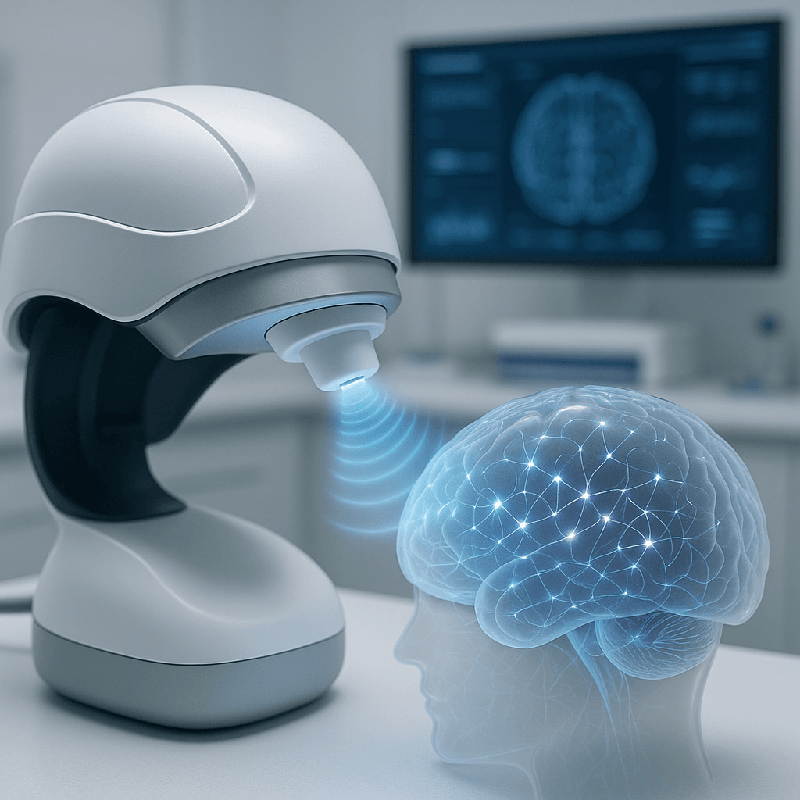
Gestala's first-generation product is a stationary benchtop device for treating chronic pain in clinical settings — a deliberate choice to start with a condition where the neuroscience is established, the clinical pathway is clear, and the patient population is enormous. The target brain region is the anterior cingulate cortex — a structure involved in the emotional experience of pain rather than its sensory detection. Pilot studies conducted by Gestala show that stimulating the anterior cingulate cortex with focused ultrasound reduces pain intensity scores by approximately 50% in a single session, with effects lasting one to two weeks. Patients would attend a clinic for treatment sessions on the first-generation device — much as patients currently attend physiotherapy or infusion sessions for other chronic conditions. The second-generation product is a wearable helmet designed for supervised home use — a device that, if successfully developed, would bring brain stimulation therapy into the same category as continuous glucose monitors and home ECG patches: clinical-grade intervention accessible outside the hospital. Beyond chronic pain, Gestala's roadmap targets depression and other mental health conditions, stroke rehabilitation, Alzheimer's disease, and sleep disorders — each representing a massive unmet clinical need and a commercially significant addressable market.
The Ultrasound Brain Bank: Training AI on the Human Mind
One of the most strategically significant aspects of Gestala's business model is a project that has received less attention than the funding round itself. Gestala is building what it calls the Ultrasound Brain Bank — a large clinical dataset of neural activity recorded via focused ultrasound, designed to train artificial intelligence models to decode brain signals and support neurological diagnostics. The strategic logic is identical to what Amazon, Google, and Microsoft have learned in every other domain where AI intersects with clinical medicine: the company with the best training data wins. The company that controls the most comprehensive dataset of human brain activity recorded via a non-invasive modality will have a structural advantage in AI-powered neurological diagnostics that no competitor can replicate by throwing engineering resources at the problem. Gestala is conducting clinical trials in China at approximately 20% to 33% of the cost of comparable studies in the United States or Europe — a cost advantage that allows it to accumulate clinical data at a pace that would be financially prohibitive for most Western competitors. As digital8hub.com has reported, Amazon also launched its Health AI platform this week — a free AI health assistant now covering 30+ conditions for every Amazon customer. The convergence of AI and clinical neurology that Gestala is building toward is the more ambitious, longer-horizon version of the same fundamental shift.
The Co-Founders: A BCI Pioneer and a Gaming Billionaire
Phoenix Peng's BCI credentials are established and serious. His previous company, NeuroXess, is one of China's most advanced implantable BCI developers — pursuing a technology pathway analogous to Neuralink's, targeting paralysed patients who wish to control digital devices and produce synthesised speech through thought. Peng left NeuroXess to pursue Gestala's non-invasive approach because he concluded that the surgical barrier would ultimately limit implantable BCI to a small patient population, regardless of the technology's capabilities. Gestala's co-founder Tianqiao Chen brings a different but complementary profile. Chen founded Shanda Interactive Entertainment — one of China's first major online gaming companies — and subsequently established the California-based Tianqiao and Chrissy Chen Institute, a philanthropic organisation that funds neuroscience research globally. His combination of capital, neuroscience philanthropy, and technology entrepreneurship makes him an unusual and powerful co-founder for a company attempting to build the world's first whole-brain non-invasive interface. The company's name references Gestalt psychology and its founding principle that the whole is greater than the sum of its parts — a fitting metaphor for a technology that aspires to access entire brain networks rather than isolated regions. Gestala aims to complete its first-generation prototype by the end of 2026 and scale its team from 15 to approximately 35 employees. The BCI race just got a new and very serious competitor. For the latest coverage of neurotechnology, AI, and global health innovation, follow digital8hub.com.
Comments (0)
Please log in to comment
No comments yet. Be the first!