Technology
Jensen Huang Just Called It "The GPT Moment for Graphics" — Here's What Nvidia DLSS 5 Actually Does
Jensen Huang has a gift for the declarative statement. At GTC 2026 on Monday March 16, standing on the stage of the SAP Center in San Jose before 30,000 attendees and millions of livestream viewers, he deployed one of his best. "Twenty-five years after Nvidia invented the programmable shader, we are reinventing computer graphics once again." The announcement that followed — DLSS 5, the fifth major generation of Nvidia's Deep Learning Super Sampling technology — is either the most important development in PC gaming graphics in a decade, or the most controversial AI intrusion into a creative medium since image generators started replacing artists. Depending on who you ask, both may be true simultaneously. DLSS 5 is real, it is announced, it launches this fall, and it has already divided the gaming internet within hours of its debut. Here is what it actually does — and why it matters.
What DLSS 5 Is: Neural Rendering, Not Upscaling
Every previous version of DLSS has been, at its core, a performance tool — a way to run games at lower internal resolutions and use AI to reconstruct a higher-resolution image, delivering better frame rates without sacrificing visual quality. DLSS 2 introduced generalised AI upscaling. DLSS 3 added frame generation. DLSS 4 and 4.5 refined both — with DLSS 4.5, launched at CES 2026, able to draw 23 out of every 24 pixels seen on screen using AI. DLSS 5 is different in kind, not just degree. Rather than upscaling or interpolating, DLSS 5 introduces what Nvidia calls a real-time neural rendering model — an AI system that takes a game's colour and motion vectors for each frame as input, and uses a trained generative model to infuse the scene with photoreal lighting and materials anchored to the source 3D content. The AI model is trained end-to-end to understand complex scene semantics — characters, hair, fabric, translucent skin — alongside environmental lighting conditions including front-lit, back-lit, and overcast. It then generates visually precise images handling subsurface scattering on skin, the sheen of fabric, and light-material interactions on hair — all in real time, all consistent from frame to frame. As digital8hub.com reported earlier today in our full GTC 2026 preview, Huang framed the broader philosophical architecture behind DLSS 5 with characteristic clarity: "We fused controllable 3D graphics — the ground truth of virtual worlds — with generative AI and probabilistic computing. One of them is completely predictive, the other is probabilistic yet highly realistic." DLSS 5, in other words, is the first time generative AI has been embedded directly into the real-time rendering pipeline of a video game — not as a post-process filter, but as a core component of how the image is produced.
The Games: Resident Evil Requiem, Starfield, Hogwarts Legacy, Assassin's Creed Shadows
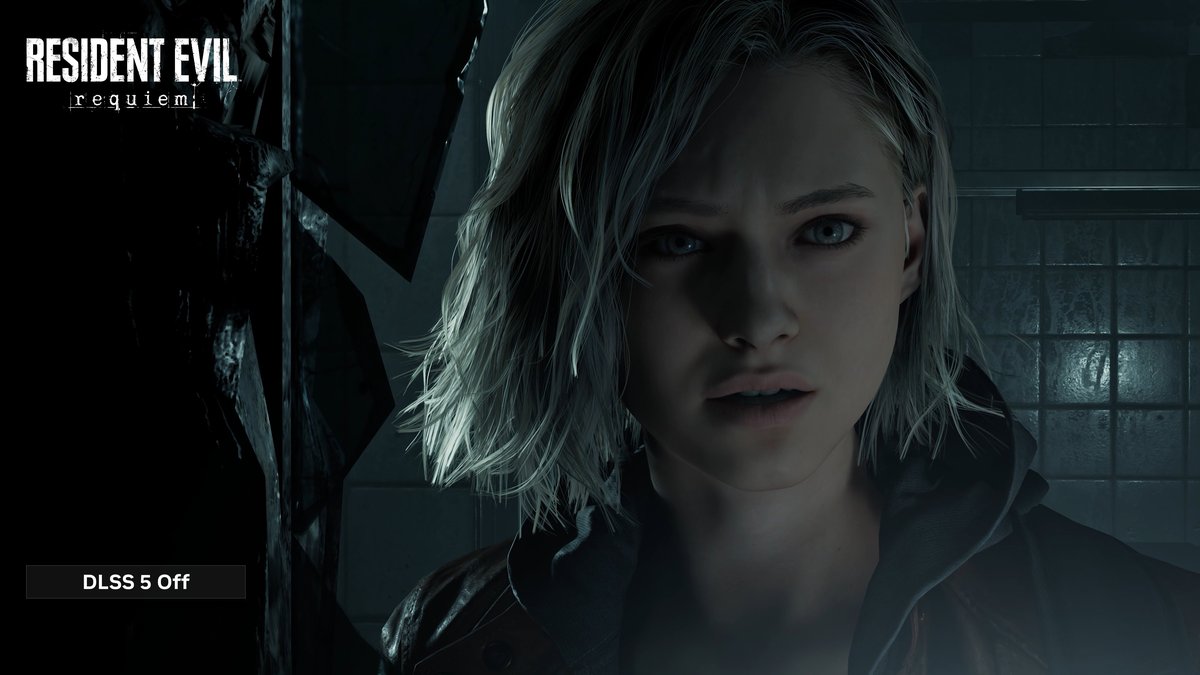
Nvidia has confirmed a substantial list of launch titles and developer partners for DLSS 5. Game studios supporting the technology at launch include Bethesda, Capcom, Hotta Studio, NetEase, NCSoft, S-Game, Tencent, Ubisoft, and Warner Bros. Games. Confirmed titles include Resident Evil Requiem, Starfield, Hogwarts Legacy, Assassin's Creed Shadows, Delta Force, Phantom Blade Zero, The Elder Scrolls IV: Oblivion Remastered, and more than a dozen others. Nvidia's GTC demos showed DLSS 5 applied to Grace Ashcroft in Resident Evil Requiem — adding dramatically enhanced facial detail, dynamic lighting response, and material realism to the character model — and to Starfield's space environments, where the photoreal lighting significantly transformed the visual mood of scenes. The demos are, by the reaction of most technical reviewers who saw them, genuinely impressive. Digital Foundry received an early hands-on preview and confirmed the visual improvements are substantial and real.
The Controversy: "AI Slop" vs "Hollywood VFX"
Nvidia did not get to enjoy its announcement unchallenged. Within an hour of the DLSS 5 reveal, player reactions on social media began comparing the technology's output to what critics of AI-generated imagery call AI slop — the glossy, hyper-processed, uncanny-valley aesthetic that has become associated with generative image tools. Several of the demo images were described as resembling AI-generated video footage rather than game graphics — particularly when applied to stylised or fantastical art directions that diverge from photorealism. Nvidia moved quickly to respond. The company pinned a follow-up statement under its YouTube announcement video confirming that DLSS 5 is not a filter — developers have full, detailed artistic control over its effects, including intensity, colour grading, and the ability to mask off areas where the effect should not be applied. The SDK's design philosophy gives artists the tools to maintain their game's unique aesthetic. The controversy is real and the concerns are legitimate — particularly for games whose art direction depends on stylised, non-photorealistic aesthetics that the generative model may push toward unwanted realism. Whether DLSS 5 improves or harms a specific game's visual identity will ultimately depend on how carefully its developers implement and tune the technology. As digital8hub.com has reported, the GTC 2026 keynote also unveiled the Vera Rubin platform, NemoClaw AI agent infrastructure, and N1/N1X laptop CPUs — making Monday's Nvidia keynote one of the most announcement-dense in the conference's history. DLSS 5 launches fall 2026 for RTX 50-series GPUs. The GPT moment for graphics is coming. Whether the internet is ready for it is another question entirely. For the latest gaming, GPU, and AI technology coverage, follow digital8hub.com.
Comments (0)
Please log in to comment
No comments yet. Be the first!